In 2016, a partner at OpenView named Blake Bartlett noticed something. The best software companies were not growing through sales calls or marketing campaigns. They were growing through the product itself.
People tried it, the product proved its value, and the rep showed up later to close what the product had already started. He gave it a name: product-led growth.
Naming it was the move. Bartlett had written a post in 2014 called "Product-Market Fit Is Not Enough," about using your product as your primary marketing asset. By 2016 he was saying "product-led growth" into every microphone he could find, from a community webinar to the SaaStr podcast, and OpenView set an explicit goal to put PLG on the map. Within a few years it went from one investor's observation to the default operating model for B2B SaaS.
The reason it stuck is simple. PLG did not invent a new behavior. It named a shift in how buyers already behaved. That same thing is happening again right now, and almost nobody has named it yet.
What PLG actually changed.
Before PLG, the buyer met your company through a person or an ad. After PLG, the buyer met your company through the product. Free tier, instant value, try before you buy.
| Company | What product-led growth produced |
|---|---|
| Slack | 0 to 8 million daily active users in four years. At IPO, 575 customers paying over $100K a year were 40% of revenue. |
| Dropbox | 3,900% growth in 15 months on a referral loop. 500 million registered users. |
| Calendly | Every scheduling link became a live demo. The product was the marketing. A $3B valuation. |
The pattern underneath all of it: put the thing buyers actually want at the front of the journey, and growth compounds, because each user pulls in the next one. That front door just moved again.
The buyer moved. again.
Here is what your buyer does now, before they ever land on your site. They open ChatGPT or Perplexity and describe their problem. The AI hands back a shortlist of three to five tools, with reasons. They ask follow-ups. They compare options. They draft the business case. Then, and only then, do they visit a couple of websites or take a sales call, to confirm what the AI already told them.
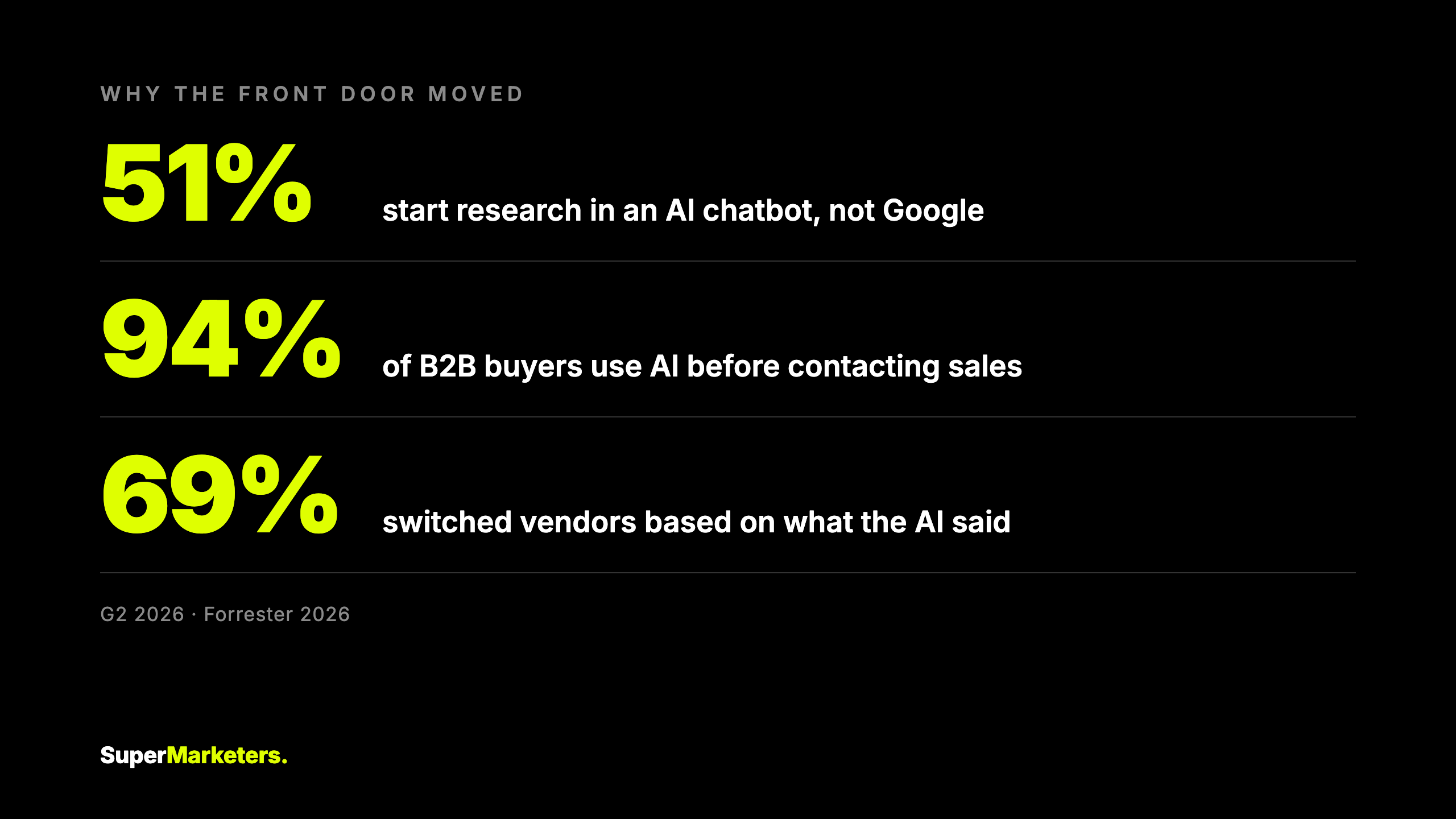
This is not a forecast. It is measured. G2 found 51% of B2B software buyers now start their research in an AI chatbot more often than Google, up from 29% a year earlier, and 69% chose a different vendor than they had planned to, based on what the AI said. Forrester found twice as many buyers named generative AI as their most meaningful research source than named anything else. And 6Sense found 83% define their requirements before they ever talk to sales.
Read those again. The AI is not sending traffic to the shortlist. The AI is the shortlist. The website visit and the sales call now happen after the decision is mostly made, to confirm a choice the buyer reached somewhere you never saw.
Answer-led growth.
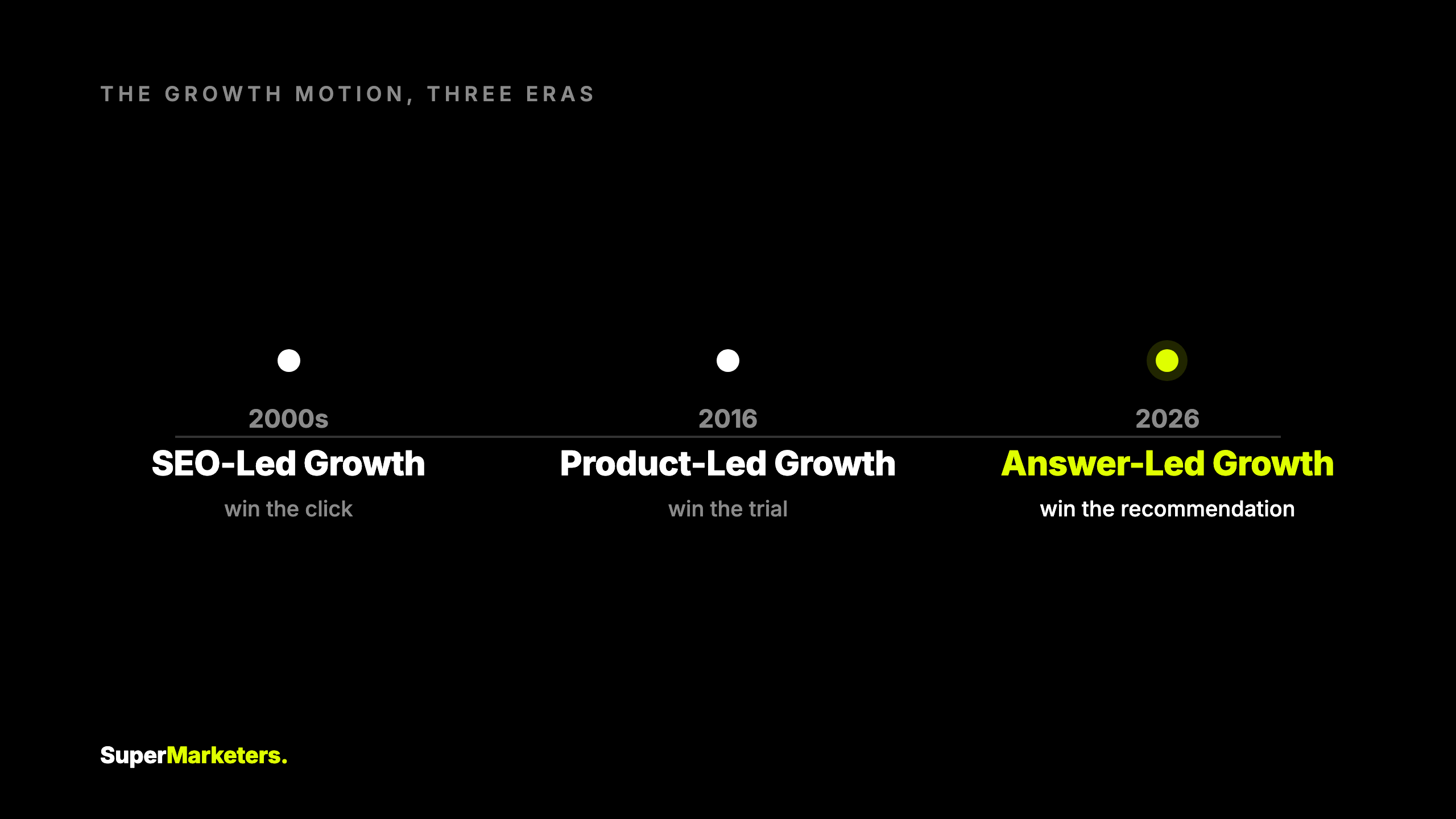
So here is the next entry in the list. SEO-led growth won the click on Google. Product-led growth won the trial. Answer-led growth wins the recommendation. You become the name AI engines give when a buyer asks.
Answer-Led Growth is a go-to-market motion where your pipeline comes from being the name AI engines recommend, not from ranking for a keyword or buying a click. It is the same shape as PLG. It does not invent a behavior. It names one that already happened.
And like PLG, it changes three things at once. That is what separates a motion from a tactic.
What you measure. Not rankings and sessions. You measure citations and presence: how often you show up in AI answers for the questions your buyers ask, and how you get described when you do.
What you build. Not pages that rank. You build answer infrastructure: content and entities structured so an AI can pull a clean, citable passage and trust it enough to repeat it.
How it compounds. A source cited once tends to get cited again. The engines re-crawl and favor sources they have already surfaced, so an early citation widens the lead. Answer-led growth builds on itself the way a Dropbox referral loop did, except the loop now runs inside the models that broker every buying decision.
How to run answer-led growth.
You do not need a content team for this. You need a system to run it, and about 30 minutes a month from you to point it and read what it finds. The five steps below are what the system does. Your job is to steer it.
- Find out if you are the answer. Pick the ten questions a buyer would ask to find a tool like yours. Ask them in ChatGPT, Claude, Perplexity, and Google AI Overviews. Write down where you show up, where a competitor shows up instead, and how each engine describes you. That is your baseline, and most founders are shocked the first time.
- Find the queries you are losing. Every question where a competitor is named and you are not is a specific, fixable gap. Rank them by how close the buyer is to a decision. "Best X for Y" beats "what is X," because it sits lower in the funnel and is worth more.
- Build the answer, not the article. For each priority query, publish a page built to be extracted: a direct recommendation in the first lines, specific numbers, named sources, a comparison the model can lift whole, and schema so the machine can parse it. The goal is not to rank the page. The goal is to be the passage the AI quotes.
- Build the trust signals the models read. AI engines lean on third-party sources like Reddit, G2, Wikipedia, and industry roundups. Seed the places they trust with accurate, specific information, and get your entity right everywhere it appears, so the model describes you the way you would describe yourself.
- Track it like a metric, not a vibe. Re-run your query set every month. Watch your presence move. Citations decay when competitors publish, so this is a loop, not a launch.
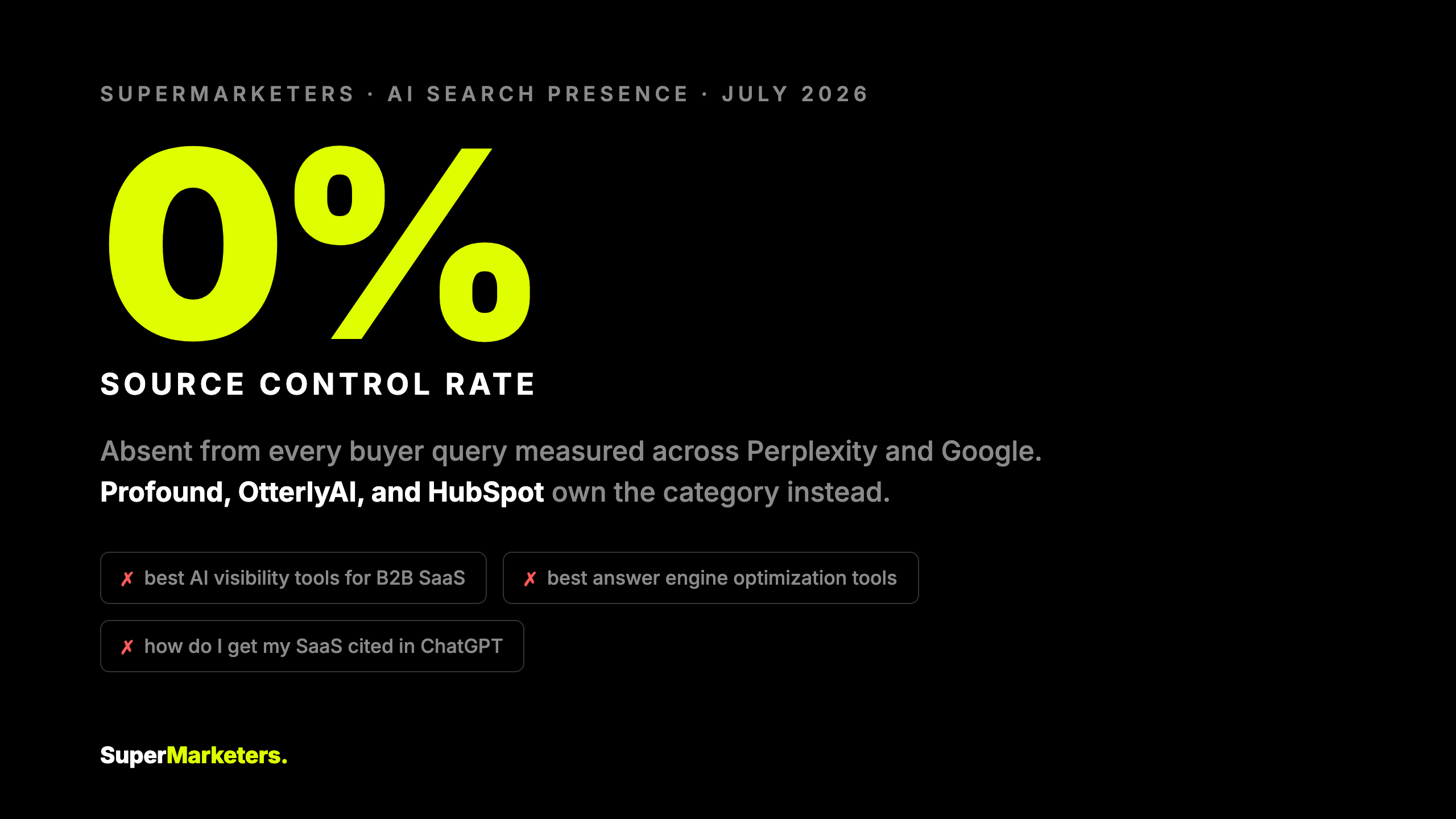
Before publishing this, we scanned SuperMarketers against its own category queries. Source Control Rate: 0%. Absent from every buyer query, while Profound, OtterlyAI, and HubSpot get named instead. So this is not theory we sell. It is the playbook we are running on ourselves, in public, from zero.
The window.
PLG had a window. The companies that named the motion and built for it early, the Slacks and the Calendlys, got a head start the laggards never closed.
Answer-led growth has the same window, and it is open right now. Half your buyers already start in AI. Most of your competitors are still publishing blog posts for a Google ranking fewer people see every quarter. The first companies to treat being the answer as their growth motion will own their categories inside AI the way PLG leaders owned theirs.