
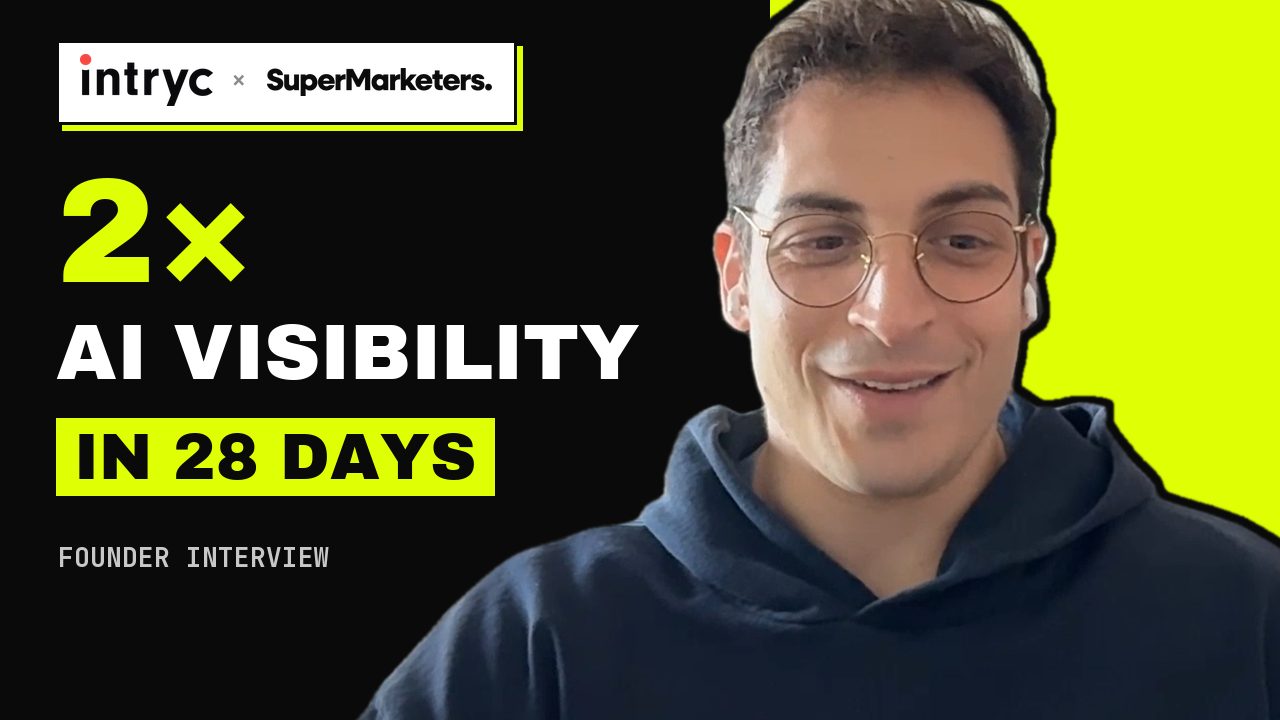
intryc SuperMarketers

Intryc grew its AI visibility 2× in 28 days.

A YC-backed QA platform for customer support had a strong product and a real content library, but AI wasn't naming it often enough when buyers asked. Four weeks later, AI named it in twice as many answers. No new funding, no new headcount. One system.

Watch Alex tell it · 8:41

Intryc's founder and CEO on why he hired SuperMarketers, how the work ran, and what changed.

Read the full interview transcript

0:00 Meet Intryc

My name is Alex Marantelos and I'm the founder and CEO of Intryc. Intryc is an AI native quality assurance and training platform for customer service and customer experience agents, human and AI. We see ourselves as a unified layer where organizations can monitor, audit and improve all of their customer interactions and their customer team's

0:23 Why Intryc needed help

performance. But then as we started growing, as we got more and more customers, as we started serving more than 15, 16 countries around the world, and the responsibilities really grew. I do need, I needed some help from somebody who could really help us not only scale our visibility but manage our presence on all the social media and online platforms. The most important thing was how do we show up when people look for a solution like ours or how do we show up when people look us online? We create our own website, but then as we're mature, we have now enterprise customers, multi-billion dollar customers. We do need to show exactly in the same way that we operate. We can't be as scrappy as we used to be. not that we don't move fast or anything like that, but the presence needs to be a world-class view of the business as we actually operate. So I was looking for somebody who has done this before. I was looking for somebody who can move really fast, who knows what they're doing. And I found Gen and Gen has been an exceptional partner.

1:21 Choosing SuperMarketers

Actually, you know, what really sold me is that I found Gen online. I spoke to many agencies, I interviewed a bunch of candidates and I was really trying to find this kind of like unicorn marketeer that can really understand the business, can understand the product can understand the landscape. It has the technical capabilities to deliver what we needed really fast. And then I found Gen online and then I'm like, okay, if that person convinced me to talk to them online, even though I'm being pitched by a million people to buy their service, I'm like, that person is doing something right. I want them to do that for me. And that's when we started talking to Gen. And then obviously he came like super organized with all of his playbooks, a lot of suggestions in depth analysis on my brand, my market, my competition, my visibility. A lot of those things that as a founder, it would take me many, many hours to do as a founder. I strongly believe that we should know every single metric of our organization, but then also we need to be strategic and we need to learn what resources to leverage, especially for things that people can be better than us. And, and Gen was like, you know, somebody who had done this a million times who could really bring me up to speed very fast to take the brand where

2:32 From SEO to GEO

I want to be. The most important thing as most businesses move now and the internet moves from SEO to GEO, that was a huge component. We want it to be very early on this want to be the first ones on this. Obviously we're competing with multi-billion dollar companies and other fast growing startups. It's always a race and we didn't want to stay behind on that race.

2:51 Competitors writing the story

At this point, I don't even want to say what exactly he did because I don't want my competitors to know that, but we, we really focused on creating a programmatic layer that would allow us to put our best content out there that resonates with our buyers that responds to what buyers are looking for that addresses things that competitors even sometimes say for us that are not true. You know, sometimes I would go and look at some articles online that would come up on GPT or Claude or whatever. And then a competitor will make a claim on one of their blogs and like, this is so untrue. This is like, this is so wrong because obviously, it benefited them saying that. So we needed to set the record straight. And then, you know, with the entire system that Gen helped us put together, we do that really fast like in kind of like same day,

3:38 How we worked together

even. But, but what was really helpful for me as a founder was that Gen allowed me to, or he enabled our team to build this entire system and manage it and launch it end to end with my oversight, my participation, great collaboration, very responsive. But it was a combination of a person who is very experienced knows the space, the industry understands how founders operate and does the, the, the upfront research and work to come prepared and then delivers really fast and has the technical capabilities to do that. So in my experience, that was very hard to find. And you know, we, we do have open positions. We hire for marketing. We're hiring for social media people in our business, but finding the right candidate to fit into that and be able to do a lot of those things. It's very hard. And Gen, you know, checked off that item from my list and was able to deliver on everything that we discussed initially, which was great. And we're still working together and it's all working great. So I'm very excited for all of the things that we have in plans right now.

4:42 The results

There are some, there are some measurable improvements that we saw. First of all, you know, we, we want to, we're going to put a lot of effort in that and we need to make some, some changes. So it needed some, some upfront investment in time, even though it was all white glove and super curated, but we need to be strategic about it. So we want to increase our visibility. How do we measure that? What we saw is that, you know, first of all, we, we realized what the floor was. So initially we're at 18% of visibility in AI answers and that, that grew up to 37% within the first month. similarly the AI Presence Score that we were monitoring went from 39.7 to 48-plus. within again, the, the first 28 days. and then what we put a lot of focus and effort on was how do we show up on head to head comparisons when people say, okay, how is Intryc versus X competitor? So we actually went from 38 to 57-plus win rate across some of our biggest competitors. This is an ongoing work that needs to keep on happening but this is very important and it goes back to the thing that I, that I was saying about us controlling the narrative and not our competitors controlling our product's narrative which can be really harmful for a business.

5:56 Credibility and inbound

Now, what does that mean? As a, as a young startup, you know, initially you, you, you're not shown anywhere. And then of course we do LinkedIn content, we do X content, like all of these different things, but everybody does content. So the challenge is how do you stay on top of mind? And that is very important, especially when you sell to enterprises, the first thing people are going to do, they're going to search you up. And they're going to be like, okay, that person promises the world. They say that they have the best product in the market. We do, but why would I believe them? They're a, they're very, very small startup. And I need to vet them. Okay. So I need to find their live use cases. I need to find their customer stories I need to find their G2 scores I need to find a lot of different things. So number one is increasing our credibility with our audience, which is improving really fast. the second thing was, when, when people search for a solution, how can we drive inbound pipeline? When we were getting started, we were predominantly outbound driven. I mean, we still are to a big extent, but now we have started seeing people coming to us from search engines or from, from LLM engines. And, and that shows us that we always ask, how did you find us? How did you get to us? Oh, you know, GPT recommended you or Claude recommended you, or we found you on Google's AI mode search. And then we saw that you had those differences against the competitors.

7:12 Founder time back

This definitely saved me, I would say 10 to 15 hours a week. in measurable founder time.

7:21 How Alex decides

And then, you know, we have so many more plans that is ongoing work and it's not only, you know, how long it takes to maintain that, but, but also the initial setup and how long would it have taken me to figure out everything again new from, from the very start that for me was great because as a founder, I, I always have to make the trade off how fast can something happen? But what is the impact that it, that it gives back to the business? But when you have an option that it can give you both that it can move fast and it can have immediately a measurable impact, then that's how I make decisions. That's when I say that, okay, that makes sense. I need to go for that. And I'm going to choose this over something else. that's how I decided specifically on Gen.

8:05 The recommendation

I would highly recommend Gen and SuperMarketers for any founder who's early stage, who's trying to figure out what their GEO, SEO, online presence, strategy looks like it's not just the execution, but also it's kind of like setting the pipeline up and, and, and understanding what your business needs to do because every business is different. We're a B2B AI SaaS. I would highly recommend Gen and SuperMarketers.

Baseline vs. day 28 · 1,100+ sampled AI answers per run
2.1×
Visibility in AI answers
On non-branded buying prompts.
48.3
AI Presence Score
Up across all four AI engines.
57%
Win rate vs. key competitors
Up from 38% in head-to-head comparison answers.
~485
AI citations repaired
Links in AI answers that pointed at retired pages now land on live ones.

The situation

Intryc sells AI quality assurance to customer support teams. Its buyers, VPs and directors of CX, increasingly start vendor research by asking an AI which QA platform to buy. The sentence the AI writes back is the new shortlist.

Intryc was already in that conversation, and AI engines already trusted its content. But that trust wasn't turning into recommendations often enough, and each engine told a different story about where Intryc stood.

A pre-engagement audit put the full picture on one page, and the conclusion was clear. The content existed. It just wasn't structured for machines to retrieve it.

Why Intryc brought in help

Intryc now serves customers in more than fifteen countries, including multi-billion-dollar enterprises. Go-to-market sits with the founder, and the scrappy early-stage web presence no longer matched how the company operates. Enterprise buyers vet a startup before they take a call, and more of that vetting now happens inside an AI answer.

The most important thing was how do we show up when people look for a solution like ours. We have enterprise customers, multi-billion dollar customers. We can't be as scrappy as we used to be. The presence needs to be a world-class view of the business, as we actually operate.
Alex Marantelos · Founder & CEO, Intryc

The options were the usual three: an agency, a full-time marketing hire, or the founder doing it himself. He spoke to agencies and interviewed candidates, looking for one person who understood the product, the landscape and the technical side of AI search, and who could ship fast.

I found Gen online, and I'm like, okay, if that person convinced me to talk to them online, even though I'm being pitched by a million people to buy their service, that person is doing something right. I want them to do that for me.
Alex Marantelos · Founder & CEO, Intryc

What was in the way

None of this was a content problem. It was the drift every fast-moving product accumulates, and it stays invisible until you measure AI answers directly.

  • Citations pointing at retired pages

    As the product evolved, pages moved. AI kept citing the old URLs, so hundreds of AI-referred buyers landed on pages that no longer existed.

  • Credit going to the wrong name

    AI was citing Intryc's own content in answers that recommended someone else.

  • Pages written for people, not machines

    Pages that read well to a buyer were hard for a model to parse, quote and attribute.

  • Competitors writing Intryc's story

    Competitor blogs made claims about Intryc that weren't true, and AI engines repeated them in answers to buyers.

Every one of those dead citations was a buyer who asked AI for a recommendation, clicked, and hit nothing.

Sometimes I would go and look at articles that would come up on GPT or Claude, and a competitor would make a claim on one of their blogs, and I'm like, this is so untrue. It benefited them saying that, so we needed to set the record straight.
Alex Marantelos · Founder & CEO, Intryc

The strategy: four decisions

  1. Treat each AI engine as a separate market

    Each engine builds its answers from different sources, so each needed a different fix. One blended "AI visibility strategy" would have wasted half the budget.

  2. Defend existing citations before chasing new ones

    Citations aimed at dead pages, plus more on pages AI could barely parse: hundreds of citations of leverage available without writing anything new. Net-new content is the expensive move. It came second.

  3. Attack where a competitor is present and the client is absent

    Not keyword volume or topic interest. The backlog was every tracked buying prompt where AI named a competitor and not Intryc. That is the whole addressable gap, and it is finite and countable.

  4. Take the contested ground directly

    Where AI recommended a competitor instead, more thought leadership wasn't the fix. Intryc got a dedicated, honest page built to win that exact answer. When a competitor publishes a false claim, the correction now ships the same day.

How we did it

  1. Measure what had never been measuredWeek 1

    A tracked query bank mapped to the real buying journey, an AI visibility scorecard, and a continuous benchmark sampling 1,100+ AI answers per run across ChatGPT, Claude, Gemini and Perplexity, with head-to-head tracking against the competitors buyers actually compare.

    The output was a frozen baseline. Nothing shipped until the starting point was on record. Without it, every later claim is a story.

  2. Fix the plumbing before writing a wordWeeks 1–2

    Dead citations redirected to live pages. Attribution fixed so AI credits the right vendor. Structure and markup added to the pages AI was already reading.

    Nobody sells this part because it is unglamorous. It is also the part with the shortest distance between the fix and measured movement.

  3. Build the claim spineWeek 2

    One source of truth for positioning, voice and verified customer proof, plus a winning narrative for every contested buying question: what AI says today, what is true, and the sentence that should be cited instead.

    Every page draws from it, so every page says the same thing the same way. That consistency is what AI rewards.

  4. Produce against ranked gaps, not a content calendarWeeks 2–4

    Every play is ranked by expected impact before it enters the queue. Wave 1 shipped 14 plays: new comparison and category pages, upgrades to pages AI already cited, and structural fixes.

    Every page clears quality gates for voice, structure and accuracy before it goes live, including review by a second, independent model. Those gates have already caught errors a human skim would have missed.

  5. CompoundContinuous

    Every correction becomes a permanent rule. The system that wrote page 30 is measurably better than the one that wrote page 1, because it can't repeat a mistake it has already made.

The results

Measured on the KnitKnot AI Presence benchmark: 1,144 sampled AI answers at baseline and 1,129 on day 28, across ChatGPT, Claude, Gemini and Perplexity.

Baseline vs. day 28 · all bars on a 0–100 scale
Visibility in AI answers (%)
Before
18.0%
After
37.1%
AI Presence Score
Before
39.7
After
48.3
Gemini score
Before
44
After
60
Perplexity score
Before
32
After
43

Visibility counts non-branded prompts only. Engine scores are per-engine averages on the same benchmark.

Core visibility metrics

MetricBaselineDay 28Move
AI Presence Score39.748.3+8.6 pts (+22%)
Visibility (non-branded)17.98%37.13%+19.2pp (2.1×)
Share of voice12.31%14.88%+2.6pp (+21%)
Sentiment when named96.597.0Holds
Average rank when listed2.02.5−0.5
Answers sampled1,1441,1294 engines

Sentiment was already 97 out of 100. AI liked Intryc fine. It just wasn't mentioning them. Average rank slipped because Intryc started appearing in answers it had never been in before. Being named fifth in an answer you used to be missing from is a gain.

Per-engine average score

EngineBaselineLatestMove
Gemini4460+16
Perplexity3243+11
Claude4751+4
ChatGPT3640+4

The baseline flagged Perplexity as the weakest surface with the most upside. It delivered the second-largest gain.

Head-to-head comparisons

The prompts that matter most are the direct ones: "How does Intryc compare to X?" Across Intryc's biggest competitors, its win rate in those answers went from 38% to 57%. This is the ground where a competitor's claim can become the answer a buyer reads, so it stays under weekly measurement.

Initially we were at eighteen percent of visibility in AI answers, and that grew to thirty-seven percent within the first month. On head-to-head comparisons we went from thirty-eight to fifty-seven plus win rate. It goes back to us controlling the narrative, and not our competitors controlling our product's narrative.
Alex Marantelos · Founder & CEO, Intryc

What changed for the business

The benchmark measures AI answers. These are the effects the founder reports seeing beyond it.

  • Inbound from AI engines

    Intryc started out mostly outbound. Now new prospects are arriving from search and from AI. When the team asks how they found Intryc, the answer is increasingly GPT recommended you, or Claude recommended you, or we found you on Google's AI Mode, and then we saw that you had those differences against the competitors.

  • Credibility at the vetting stage

    Enterprise buyers search a small vendor before they trust it. The first thing people are gonna do, they're gonna search you up. What they find in AI answers now reflects the product and the proof, not a competitor's version of it.

  • Founder time back

    Alex estimates the work saved him ten to fifteen hours a week of founder time, not counting what the initial setup would have cost him to figure out from scratch.

What got installed: the scoreboard is the deliverable

A baseline and a benchmark

Query bank, scorecard, a 4-engine benchmark that re-runs on its own, and head-to-head tracking against key competitors.

Structural repair

Dead-citation recovery, attribution fixes, schema, llms.txt and retrieval-chunk hygiene. Citations already earned, working again.

A claim spine

Brand brain, winning narrative, voice guide and a verified proof bank. Every future page draws on one source of truth.

A gated production pipeline

Ranked gap plays, quality gates and cross-model review. Pages built for the prompts where competitors win.

A compounding loop

A lessons store, weekly strategy reflection and decay monitoring. The client approves the claim bank, merges the PRs and makes the calls only a founder can make: a few hours a month. The system does the rest.

From the client
It was a combination of a person who is very experienced, knows the space, understands how founders operate, does the upfront research to come prepared, and then delivers really fast and has the technical capabilities to do that. In my experience, that was very hard to find.
Alex Marantelos
Founder & CEO · Intryc

AI already has an opinion about you. Do you know what it is?

We'll show you where you're named, where a competitor is named instead, and which citations are already pointing at dead pages.

Book a call →