Here is a decision I watch B2B SaaS companies make every month.
Marketing has become an engineering problem. Somebody on the team figures this out, usually a VP who is tired of briefing agencies and getting back work that could have been written about any company in the category. They take it to the CEO. The CEO agrees. And then the company does the thing companies do when they decide something is important: it opens a req.
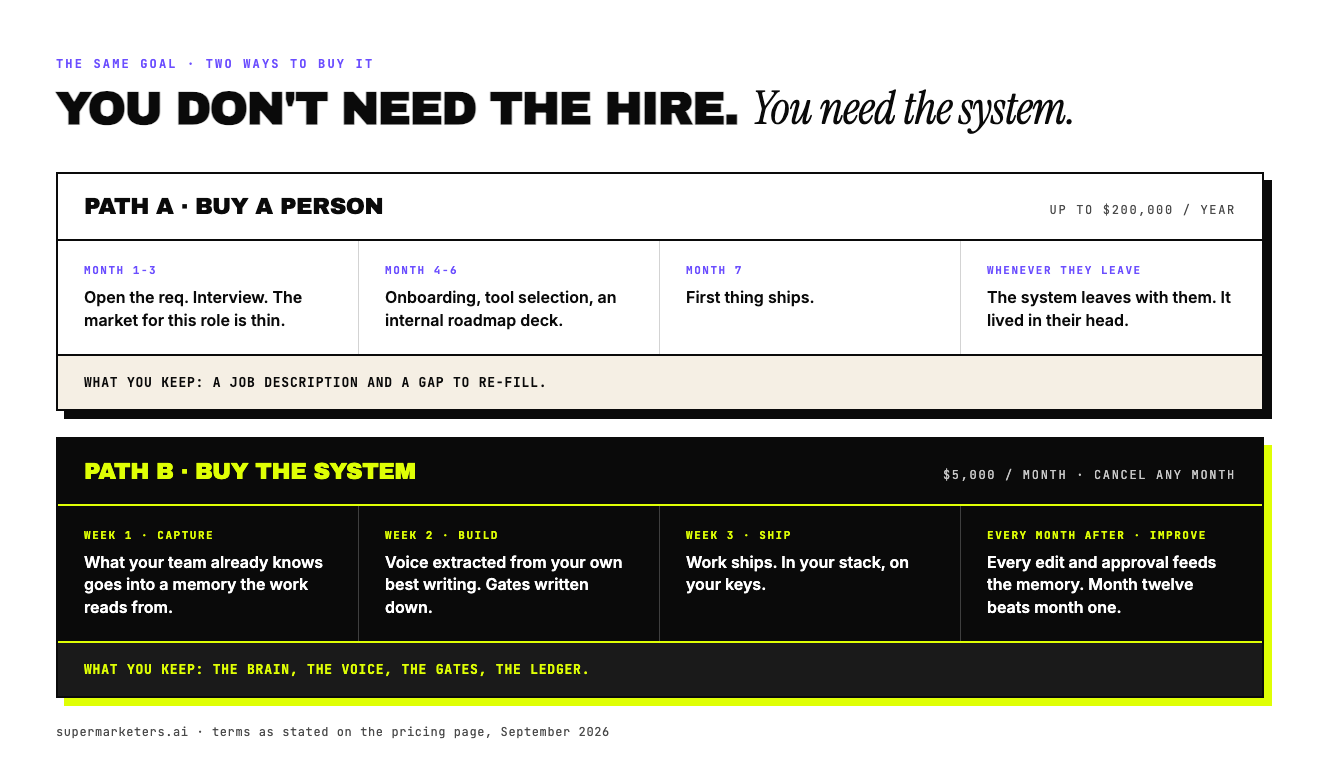
The going rate for a person who can actually wire the tools together and write the workflows is up to $200,000. The market for that person is thin, so the search takes a quarter. Onboarding and tool selection take another. The first real thing ships around month seven.
Then, eventually, that person leaves. And the system leaves with them, because it lived in their head and their browser tabs.
That is one door. The other door is an agency or a consultant who will sell you an AI marketing strategy instead, and the failure mode there is faster and cheaper and produces even less.
Both doors have the same thing on the other side: nothing shipped.
The category filled up in about eighteen months
Every marketing firm sells AI now. SEO agencies sell GEO. Content shops sell AI visibility. Fractional CMOs sell AI-powered strategy. Demand gen teams sell AI workflows.
You can measure the rush by the listicles. Search for the best agencies in this category and you will find one post counting seventeen of them, and at least eight more posts counting their own twelve, ten, or eight.
Most of the firms on those lists rebranded a practice they already had. That is not a scandal. It is what happens when a category grows faster than the ability to deliver in it, and it means the pitch got a new noun before the delivery got a new muscle.
The tell is not the noun. The tell is the deliverable.
Ask what you get, and count how many of the answers are documents. An audit. A readiness assessment. A roadmap. A workshop. A prompt library. A content calendar. A maturity model with your company plotted on it.
None of those are the work. They are descriptions of the work, sold at the price of the work.
The advice is not wrong. The advice is free.
This is the uncomfortable part, and it applies to me too.
Generic marketing advice collapsed in value the moment the models got good. Ask Claude or ChatGPT for a B2B SaaS content strategy and you get a reasonable one in sixty seconds. Ask for an AI search checklist, a founder-led posting plan, a competitive messaging audit, a comparison page outline. All reasonable. All free.
So when a firm charges you six figures to tell you that buyers research in AI tools now and you should publish things they can cite, you are not buying information. You already had the information. You are buying the feeling that a decision has been made.
The information itself is not in dispute, and the research is not subtle about it.
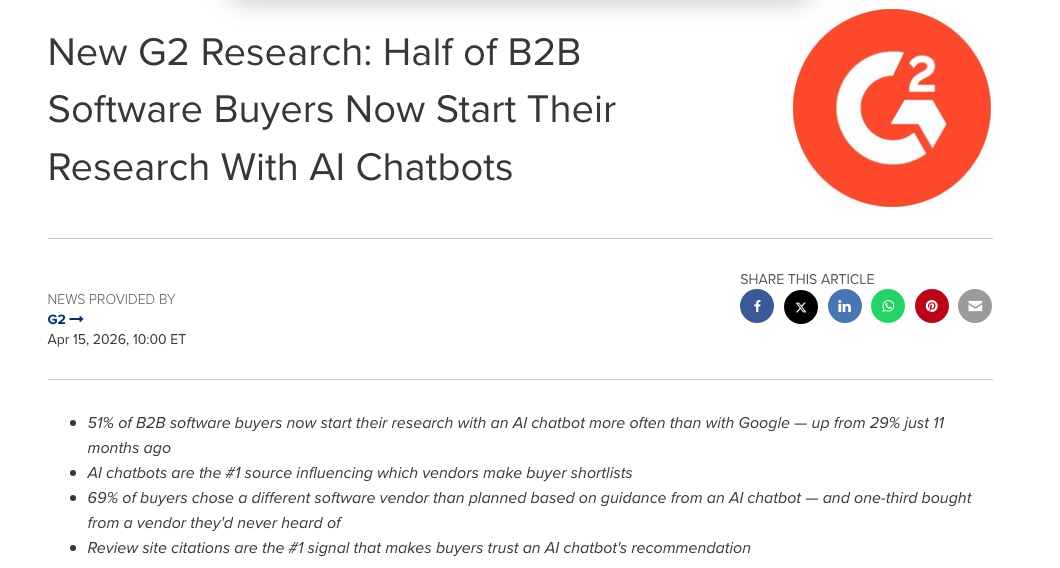
G2 surveyed 1,076 B2B software buyers in March 2026. 51% now start their software research in an AI chatbot more often than in Google, up from 29% eleven months earlier. 69% chose a different vendor than they had planned based on what the chatbot told them, and one in three bought from a company they had never heard of before that conversation.
Semrush asked 622 US B2B professionals the same kind of question around the same time and found 92% saying AI had shaped their vendor shortlist.
Nobody needs to pay for that finding. You can read it in an afternoon. The hard part was never knowing that buyers ask AI before they ask you. The hard part is that the answer they get is assembled from what already exists about you, and for most companies what exists is a homepage, some case studies nobody can find, and whatever a competitor wrote about the category three years ago.
The real bottleneck is the empty prompt
Here is what most AI marketing work actually looks like inside a company, once the strategy deck is filed.
Someone opens a chat window. They describe the company again. They paste in a few links, a positioning doc, maybe an old blog post. They ask for a draft. The draft comes back generic, because the input was generic, and it took twenty minutes to assemble an input that gets thrown away and reassembled from scratch tomorrow by somebody else.
That is the whole problem, and it is boring, which is why nobody sells against it. The model is not the constraint. Everyone has the same models. The constraint is that your company's knowledge, the part that would make the output specific, is scattered across call recordings, Slack threads, a founder's head, and the three people who have actually sat with customers.
An AI strategy does not fix this. A workshop does not fix this. A roadmap that says "operationalize your institutional knowledge" in phase two does not fix this.
What fixes it is building the thing, in the order it has to be built.
Capture, build, ship, improve
Four steps, and the order matters more than any one of them.
Capture comes first because everything downstream is worthless without it. What does the company know that nobody else knows. What do customers say, in their words. Which claims can you back up, and with what. This becomes the memory that every piece of work reads from before it produces anything. Same models everyone else is using, different input.
Build is where the voice comes out of your own best writing rather than a brand guideline nobody opens, and where the standards get written down as rules a machine can check. I wrote about that part in detail in the piece on why AI made reviewing expensive.
Ship is week three. Not month seven.
Improve is the part that compounds. Every edit you make and every draft you send back goes into the memory. Month two sounds more like you than month one. Month twelve draws on a year of customer language and your own corrections, and a competitor starting fresh cannot buy their way back into that.
The consultancy version runs this order backwards. A long diagnostic before anyone touches real work, a program justified by projected benefit, and success measured in workshops held and slides delivered.
The dependency test
The question that separates a partner from a vendor is not what they will do. It is what is left when they stop.
A firm whose model depends on you never building the capability will hand you outputs and keep the system. A firm that builds for your independence hands you the system and lets you decide whether to keep them.
Here is what I hand over, and it is the same list whether you stay one month or two years.
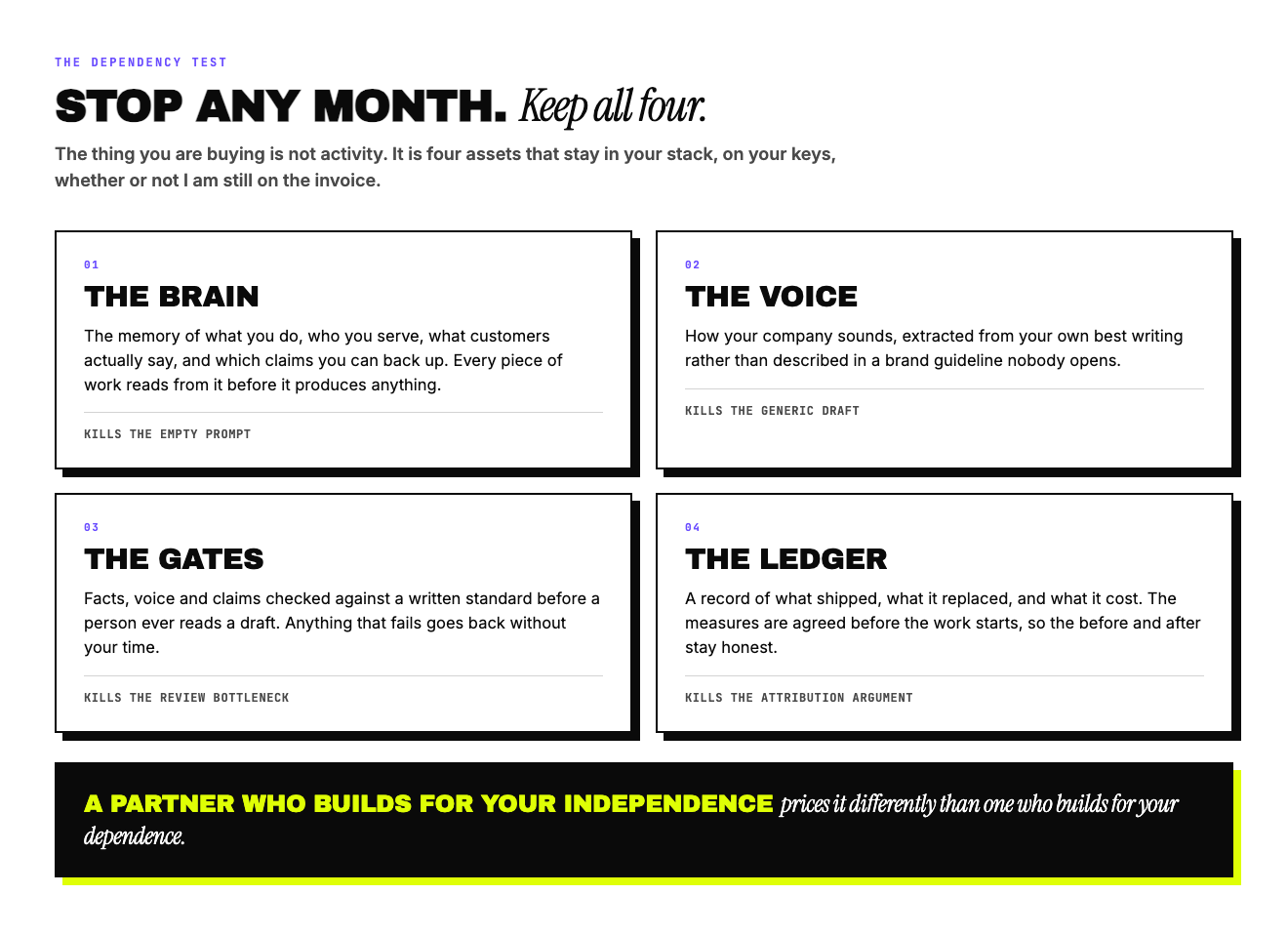
The Brain is the memory: what you do, who you serve, what customers say, what you can prove. The Voice is how you sound, pulled from your own work. The Gates are the written standards that check facts, voice and claims before a person ever reads a draft. The Ledger is what shipped, what it replaced, and what it cost.
Everything lives in your stack, on your keys, from the first week. If I disappear, nothing breaks.
Five questions to ask any AI marketing partner
Run these on any vendor, in one call, before you sign. Each has a clean answer and a tell. Note where they dodge, because the dodges tell you more than the answers do.
| # | Ask this | The tell |
|---|---|---|
| 01 | What exists after the first thirty days that did not exist before? | If the honest answer is research, interviews and a roadmap, you are funding their learning curve at your rate. |
| 02 | Show me work you ship on a schedule without you in the room. | Not a demo they drive by hand. Something that runs and writes to a real system. Vendors who do not operate their own work will not operate yours. |
| 03 | Where does the system live, and whose keys is it on? | If the answer is their platform, their account, their seat, you are renting your own marketing back from them. |
| 04 | What is the single number we agreed on before starting? | It has to be one you already track, agreed before any work begins, or the before and after become whatever they need them to be at renewal. |
| 05 | If we stop next month, what do we keep? | No named owner on your side and no assets that survive the engagement means you bought activity, not capability. |
Question five is the one nobody prepares for.
My terms, since I am asking you to demand them
It would be cheap to write all this and then make you book a call to find out what I charge.
$5,000 a month. Month to month, cancel any month. No cap on what gets made, one new build a month. Everything lives in your stack, on your keys. Your team learns to run it. About two hours a week of your time. Work ships in week three.
I take three clients a quarter. Not a team, not an account manager, not a pod that grows as the account grows. One operator and a fleet of agents, which is the only reason those numbers work at all.
Before you decide anything, you watch it run on your own material. I do not bill for that, because discovery is my learning curve, not yours.
And some companies are wrong for this. Teams that want to hand it off and never look at it. Teams where nobody will own it. Companies with nothing worth capturing yet. Anyone who wants a guaranteed pipeline number, which I will not give you, because nobody honest can.
What this comes down to
The AI marketing trap is paying for a description of the work while your company stays invisible in the exact conversations where buyers now build their shortlist.
Your buyers are asking. They are getting an answer. That answer is assembled from what exists about you, and right now somebody else's material is doing the assembling.
The fix is not a better deck about it. The fix is the system that produces what gets cited, running in your own stack, in week three.
Open a chat window and ask it the question your buyers ask. See who it names. If it is you, close this tab and go build. If it is not, you already know what the next thirty days are for.