I'm Gen Furukawa, founder of SuperMarketers. Every number below links to the page I read it on, with the survey date and sample size next to it. Where a number is ours, it says so and shows how we computed it.
What the research says: short answers
These are the questions people ask AI assistants and Google about this topic, answered in one or two sentences each. Copy them with the source attached.
More than 80% sourced software recommendations from an AI chatbot in the last two years. Half of those buyers say AI had its greatest influence during shortlisting and evaluation.
Buyers use AI assistants heavily. 94% of business buyers report using AI during their buying process, and 45% of B2B buyers used GenAI, primarily to gather information on vendors and products. Neither source breaks the numbers out by product, so no ChatGPT-only figure is quoted here.
They take the assistant's recommendation as the starting list. 69% chose a different vendor than they initially planned because of a chatbot recommendation, and one in three bought from a vendor they had never heard of. In the June survey, AI chatbots (37%) were nearly level with review sites (38%) as top shortlist influences.
51% start research with an AI chatbot more often than with Google, up from 29% in G2's 2025 report. 71% rely on AI chatbots at some point, and 61% use AI search alongside Google, so most buyers use both.
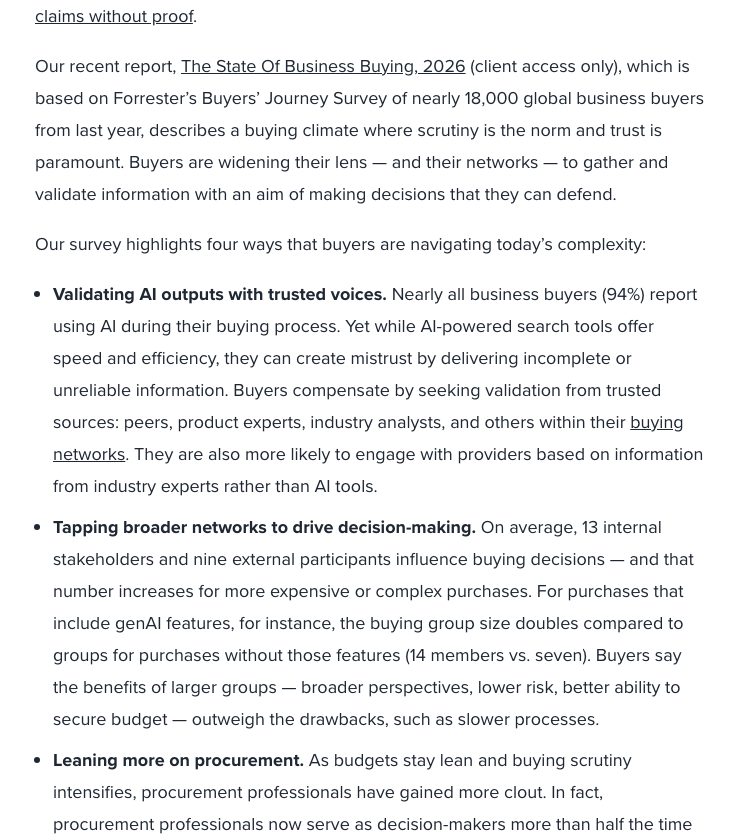
They check it with people. Forrester says buyers compensate for incomplete or unreliable AI output by seeking validation from peers, product experts and industry analysts. Gartner found 69% of B2B buyers prefer to validate AI-generated insights with sales reps.
Rarely. Users who saw a Google AI summary clicked a traditional result in 8% of visits, versus 15% without one, and clicked a link inside the summary in 1% of visits.
The latest numbers, with dates and samples
| Finding | Figure | Source | Sample and date |
|---|---|---|---|
| Sourced software recommendations from an AI chatbot in the last two years | More than 80% | G2 2026 Buyer Behavior Report | 1,038 B2B decision makers, June 2026 |
| Top shortlist influences | Review sites 38%, AI chatbots 37% | G2 2026 Buyer Behavior Report | 1,038 B2B decision makers, June 2026 |
| Evaluation is the longest stage of buying | 40% of buyers (research 36%, decision 22%) | G2 2026 Buyer Behavior Report | 1,038 B2B decision makers, June 2026 |
| Start research with an AI chatbot more often than Google | 51% (29% in the 2025 report) | G2 Answer Economy | 1,076 B2B software buyers, March 2026 |
| Rely on AI chatbots at some point in research | 71% | G2 Answer Economy | 1,076 B2B software buyers, March 2026 |
| Use AI search alongside Google | 61% | G2 Answer Economy | 1,076 B2B software buyers, March 2026 |
| Chose a different vendor than planned because of a chatbot | 69% | G2 Answer Economy | 1,076 B2B software buyers, March 2026 |
| Bought from a vendor they had never heard of | One in three | G2 Answer Economy | 1,076 B2B software buyers, March 2026 |
| Think more highly of a vendor AI includes in an answer | 85% | G2 Answer Economy | 1,076 B2B software buyers, March 2026 |
| Use AI during the buying process | 94% | Forrester, The State of Business Buying 2026 | Buyers' Journey Survey, nearly 18,000 global business buyers, reported Jan 21, 2026 |
| Used GenAI, primarily to gather information on vendors and products | 45% | Gartner press release | 645 B2B buyers, Aug to Sep 2025, published May 20, 2026 |
| Prefer to validate AI-generated insights with sales reps | 69% | Gartner press release | 645 B2B buyers, Aug to Sep 2025, published May 20, 2026 |
| Clicked a traditional result, AI summary shown vs not shown | 8% vs 15% | Pew Research Center | 68,879 searches by 900 U.S. adults, March 2025 |
| Start buying with at least one vendor in mind; one preferred vendor | 92%; 41% | Forrester 2024 Buyers' Journey Survey, as reported by Digital Commerce 360 | Sample not stated in the article; reported July 7, 2025 |
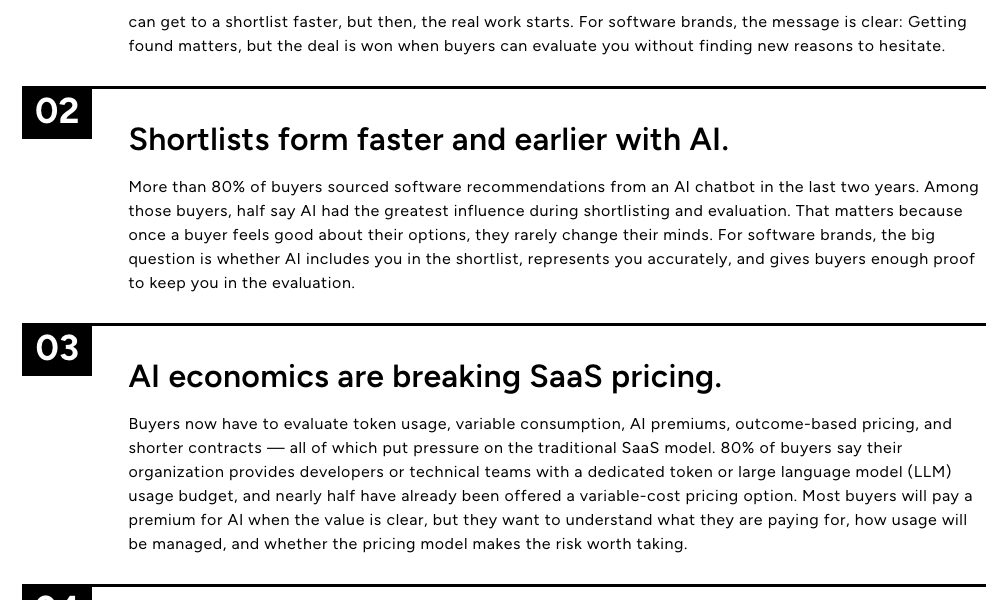
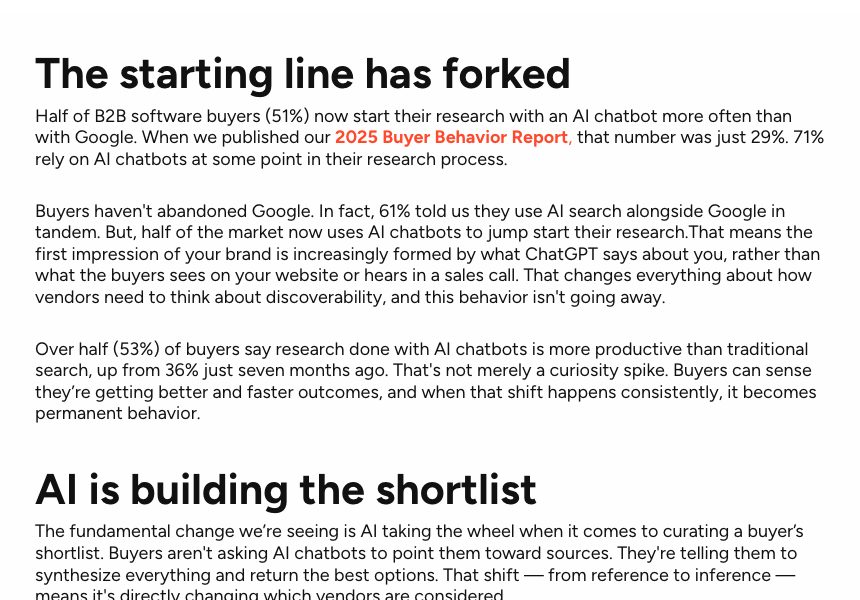
Two G2 surveys three months apart point the same way. In March, 51% started in a chatbot more often than in Google. In June, more than 80% said they had sourced software recommendations from one in the last two years. The questions differ, so the two figures do not show a change in one measure. They show the same direction from two angles.
Forrester and Gartner cover business and B2B buyers in general, not only software buyers. Forrester's 94% and Gartner's 45% use different wording and different samples, which is why we show each with its own date and sample size instead of merging them into one number.
What buyers do with the answer
The assistant builds the list and the buyer checks it. G2 found that buyers who used AI chatbots were more likely to buy from their initial shortlist: 80% did so in at least three of their last five purchases, compared with 65% of buyers who had not used one. Forrester found buyers validate AI outputs with peers, product experts and analysts. Gartner found 69% prefer to validate AI-generated insights with a sales rep.
That gives you two jobs. Get named in the answer, and have proof ready when the buyer checks it. G2 puts it directly: evaluation is now the longest stage for 40% of buyers, so being on the list is where the work starts.
An earlier version of this page cited a ChatGPT-specific share (63%) and an OpenAI weekly-user figure. We could not re-confirm either on a primary page, so we removed them. We re-confirmed Gartner's 45% in its May 20, 2026 release. We found no AI-use statistic on 6sense's 2025 Buyer Experience report page, and we did not verify figures from TrustRadius, Wynter, Bain or McKinsey, so none of those are quoted.
Our own data: buyers ask whole questions
The questions that bring people to this page in Google are long and conversational. We pulled our own Google Search Console export for Oct 10 to Nov 6, 2026 and counted words per query.
Across the whole site the export has 8 clicks. Seven came from queries shorter than 8 words and one from a long one. Search Console does not say what appeared above the results for those queries. The pattern fits Pew's finding below: most of this page's queries rank between positions 1.5 and 6.7 and still earn no click.
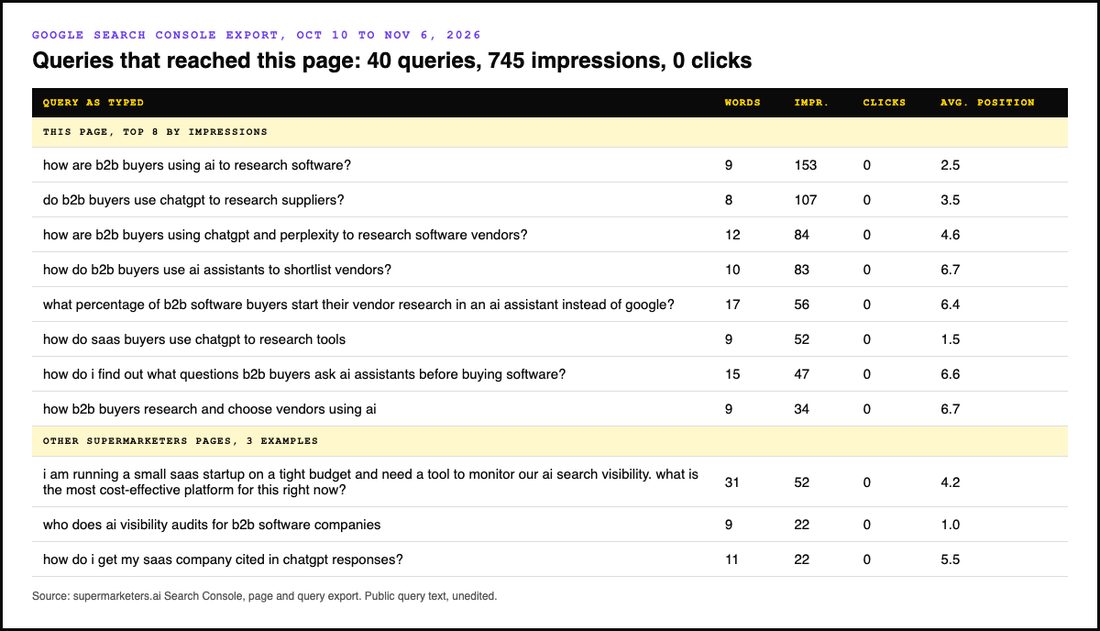
| Query as typed | Words | Impressions | Avg. position |
|---|---|---|---|
| how are b2b buyers using ai to research software? | 9 | 153 | 2.5 |
| do b2b buyers use chatgpt to research suppliers? | 8 | 107 | 3.5 |
| how are b2b buyers using chatgpt and perplexity to research software vendors? | 12 | 84 | 4.6 |
| how do b2b buyers use ai assistants to shortlist vendors? | 10 | 83 | 6.7 |
| what percentage of b2b software buyers start their vendor research in an ai assistant instead of google? | 17 | 56 | 6.4 |
| how do saas buyers use chatgpt to research tools | 9 | 52 | 1.5 |
| how do i find out what questions b2b buyers ask ai assistants before buying software? | 15 | 47 | 6.6 |
| who does ai visibility audits for b2b software companies (another SuperMarketers page) | 9 | 22 | 1.0 |
Search Console shows the words typed into Google, not who typed them. A buyer, an AI assistant searching on a buyer's behalf, or a monitoring tool can all produce a long query. Some long queries on our other pages repeat a fixed template, which points to automated prompts, so treat the 61.6% as a measure of how people and tools phrase questions. We do not publish AI answer rates here because that data is unreviewed.
How we computed it: the export has one row per page and query. We counted words by splitting each query on spaces, grouped by query for the site-wide figures, and filtered rows to this page's URL for the page figures. The script is below.
import json
rows = json.load(open("gsc_page_query.json"))   # page, query, clicks, impressions, position
words = lambda q: len(q.split())
PAGE = "https://www.supermarketers.ai/aeo/how-buyers-research-in-ai"
for name, r in (("page", [x for x in rows if x["page"] == PAGE]), ("site", rows)):
    long = [x for x in r if words(x["query"]) >= 8]
    print(name, len(r), len(long), round(100 * len(long) / len(r), 1),
          sum(x["impressions"] for x in long), sum(x["impressions"] for x in r))
Find the questions your buyers ask AI
You can run the same analysis on your own site in about 30 minutes. The worksheet below is what we use.
- Pull your long queries from Search Console.Open Performance, set the last 28 days, add a Query filter, choose Custom (regex), and enter
^(\S+\s){7}\S+for queries of 8 words or more. Export the table and sort by impressions. - Add questions from real conversations.Add the exact wording from sales calls, demo requests and support tickets. Use the buyer's words, not yours.
- Tag each question by buyer stage.Tag it as problem, options, comparison or proof. Our guide to choosing buyer prompts shows how to pick the ten that matter.
- Test each question in the assistants your buyers use.Ask it logged out, record who is named and whether you are one of them, and save a screenshot. Answers vary by day, so date each test. The 30-minute AI visibility audit walks you through a first pass.
- Map each gap to a page.Write which of your pages should answer the question, then give that page a short, sourced answer in its first 100 words, as this page now does.
- Re-run the same list every month.Keep the wording fixed so changes come from the answers. Tools that track this can automate it once the list is set.
| Question (exact words) | Source | Words | Impressions | Buyer stage | Assistant tested | Date | Are we named? | Who is named | Page that should answer |
|---|---|---|---|---|---|---|---|---|---|
| how do saas buyers use chatgpt to research tools | Search Console | 9 | 52 | Problem | /aeo/how-buyers-research-in-ai | ||||
| (your sales-call question) | Sales call | Comparison |
We are running this same process on ourselves in the Lab, where the goal is to get SuperMarketers recommended for 10 real buyer questions.
What this means for your shortlist
Forrester's 2024 Buyers' Journey Survey, as reported by Digital Commerce 360, found that 92% of B2B buyers start buying with at least one vendor in mind and 41% have a single preferred vendor before formal evaluation. G2's June data says AI chatbots now sit beside review sites as a top influence on that list. If the assistant does not name you, you are working to change a preference that formed without you.
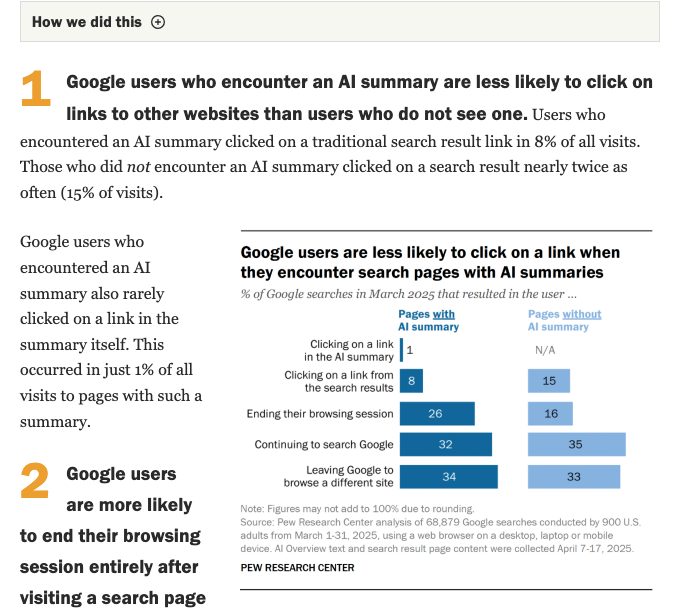
Clicks will not tell you this is happening. Pew's numbers and our own zero-click page show the answer resolves inside the AI surface. Measure it by asking the questions and recording who is named. For the method see the 30-minute AI visibility audit and citation rate, and for budget see SEO vs AEO for B2B SaaS.
Sources and methodology
Each figure was read on the linked page on November 10, 2026. G2 Answer Economy: 1,076 B2B software buyers and decision makers, March 2026. G2 2026 Buyer Behavior Report: 1,038 B2B decision makers, June 2026 (the page does not state a publication date). Forrester: Buyers' Journey Survey of nearly 18,000 global business buyers, in a blog post dated January 21, 2026. Gartner: 645 B2B buyers surveyed August to September 2025, press release dated May 20, 2026 (Gartner's own page blocked our fetch, so we confirmed the wording on a republished copy of the release). Pew: 900 U.S. adults, 68,879 searches, March 2025. Forrester 2024 survey figures come from Digital Commerce 360's report, which does not state the sample. First-party figures are from our Google Search Console export, Oct 10 to Nov 6, 2026.