

How to Build a Marketing Content System with Claude Code (No Engineering Required)


Most marketers use AI to write blog posts. I use it to build systems that run my entire marketing operation.
There's a difference. A big one.
Writing a blog post with ChatGPT is a task. Building a system that audits prospects, generates branded content, and produces a week of social posts from a single command is leverage.
That's what Claude Code lets you do. And you don't need to know how to code.
I'm going to walk you through exactly how I built a marketing operating system with Claude Code. The same system I use to run content operations for B2B SaaS clients at Supermarketers. No engineering team. No developers on retainer. Just me, a terminal window, and clear instructions.
What Claude Code Actually Is
Let's clear something up first. Claude Code is not ChatGPT. It's not a chatbot you talk to in a browser window.
Claude Code is a terminal-based AI coding agent. You open your computer's terminal, type a natural language instruction, and it writes code, creates files, runs scripts, and builds tools. It lives in your file system. It reads your project folders. It understands context.
Think of it like having a developer sitting next to you who can see your entire project and build whatever you describe.
You say: "Create a Python script that crawls a website and checks for schema markup."
It writes the script. Saves the file. Runs it. Shows you the output. If there's an error, it fixes it and runs it again.
The key insight: you don't need to write code. You need to describe what you want clearly. That's a marketing skill, not an engineering one.
Why Marketers Should Care
Here's what most people miss about AI and marketing.
The value isn't in generating content. Content is a commodity now. Every marketer has access to the same LLMs producing the same generic output.
The value is in building systems.
Systems that take raw inputs and produce consistent, branded outputs. Systems that run audits in seconds instead of hours. Systems that enforce your positioning, voice, and strategy across every piece of content.
Claude Code builds systems. Not one-off outputs. Systems.
Here's what that looks like in practice:
- You describe what you want in plain English
- Claude Code writes the code to make it happen
- It creates the files, connects the APIs, handles the logic
- You run it whenever you want with a single command
The marketer who builds systems will outperform the one who writes prompts. Every time.
Real Example: Building a Prospect Audit System
Let me show you something I actually built.
When a B2B SaaS company comes to us, the first thing we do is audit their AI visibility. Are they showing up in ChatGPT responses? Does their site have proper schema markup? Is their content structured for LLM consumption?
This used to take hours of manual checking. Now it takes seconds.
Here's how I built it with Claude Code.
I opened my terminal and typed:
claude "Build a prospect audit tool. It should take a company URL as input, crawl
their marketing pages, check for schema markup, test whether they appear in AI
search results for their core keywords, and generate a formatted markdown report."
Claude Code got to work. In about 30 minutes of back-and-forth refinement, it produced:
- A Python script that crawls a website and extracts page structure
- Schema markup detection across all crawled pages
- An AI citation checker that queries multiple LLMs for the company's target keywords
- A report generator that outputs a clean markdown file with scores and recommendations
The file structure it created:
/audit-tool/
├── run_audit.py
├── crawlers/
│   ├── site_crawler.py
│   └── schema_checker.py
├── analyzers/
│   ├── ai_citation_test.py
│   └── content_scorer.py
├── reports/
│   └── template.md
└── config.yaml
Now when a prospect books a call, I run one command:
python run_audit.py --url "https://prospect-company.com" --keywords "data pipeline, ETL tool"
Thirty seconds later, I have a professional audit report. The prospect gets a deliverable that would have cost them $2,000 from a consultant. We get a qualified lead who's already seen the value we provide.
Total build time: 30 minutes. Time to run each audit: under a minute.
That's the difference between using AI and building with AI.
Real Example: The Content Pipeline
This is where it gets interesting.
I've built a full content operating system using Claude Code's project structure. The trick is understanding how Claude Code reads and uses files in your workspace.
CLAUDE.md: The Brain
Every Claude Code project starts with a file called CLAUDE.md. Think of it as the routing file. The brain of your operation. When Claude Code opens your project, it reads this file first and follows its instructions.
Here's a simplified version of what mine looks like:
# CLAUDE.md - Marketing Content System

## What This System Does
This is a B2B SaaS content production system for Supermarketers clients.
When given a task, reference the appropriate skill file and client directory.

## How to Route Tasks

### Blog Posts
Read: /skills/write-blog-post.md
Apply client brand from: /clients/[client-name]/

### Social Posts
Read: /skills/generate-social-posts.md
Apply client brand from: /clients/[client-name]/

### Prospect Audits
Read: /skills/run-audit.md
Output to: /reports/[client-name]/

## Rules
- Always read the client's voice.md before generating any content
- Match the founder's tone exactly
- No generic SaaS speak
- Every piece ties back to the client's core positioning
This file is the single most important piece of the system. It tells Claude Code how to think about your marketing operation.
Skill Files: One File Per Task
Each task gets its own skill file. These are detailed instruction sets that tell Claude Code exactly how to execute.
Here's what /skills/write-blog-post.md looks like:
# Skill: Write Blog Post

## Inputs Required
- Topic or brief from the user
- Client name (to load brand files)

## Process
1. Read /clients/[client-name]/voice.md for tone and style
2. Read /clients/[client-name]/positioning.md for key messages
3. Read /clients/[client-name]/audience.md for target reader
4. Research the topic using web search if needed
5. Write the post following these rules:
   - Open with a hook that challenges conventional thinking
   - Use short paragraphs (2-3 sentences max)
   - Include specific examples and data points
   - End with a clear CTA from the client's CTA library
   - Target 1500-2000 words
   - Structure with H2s every 200-300 words

## Output
Save to: /output/[client-name]/blog-posts/[slug].md
Include front matter with title, meta description, and target keywords
Client Brand Directories
Every client gets a directory with their brand DNA:
/clients/acme-saas/
├── voice.md          # How the founder talks, phrases they use, things they'd never say
├── positioning.md    # Core value prop, differentiators, competitive angles
├── audience.md       # ICP details, pain points, language they use
├── keywords.md       # Target keywords and topics
└── cta-library.md    # Approved calls to action
The voice.md file is critical. Here's what one looks like:
# Voice Guide: Acme SaaS

## Founder: Sarah Chen

### How Sarah Writes
- Direct and technical but accessible
- Uses concrete numbers ("we reduced churn by 34%")
- Never uses buzzwords like "synergy" or "leverage"
- Favors short sentences
- Often starts paragraphs with "Here's the thing" or "Look"
- References specific customer conversations

### Phrases Sarah Uses
- "The data doesn't lie"
- "We built this because we were tired of..."
- "Every engineering hour counts"

### Things Sarah Would Never Say
- "Best-in-class"
- "Cutting-edge"
- "Revolutionary"
- Any sentence with more than one adjective
Running the System
With all of this in place, generating content is one command:
claude "Write a blog post for Acme SaaS about why data pipeline
observability matters more than speed. Use their brand files."
Claude Code reads CLAUDE.md, routes to the blog post skill, loads Acme's brand directory, and produces a post that sounds like Sarah wrote it.
Want a week of social posts? Same idea:
claude "Generate 5 LinkedIn posts for Acme SaaS based on their latest
blog post at /output/acme-saas/blog-posts/observability-over-speed.md"
It reads the blog post, applies the social post skill, matches Sarah's voice, and outputs five posts ready to schedule.
One person. One system. Output that used to require a content strategist, a writer, a brand manager, and an editor.
Why This Matters for B2B SaaS
Let's talk numbers.
A mid-level content marketing hire costs $80,000 to $120,000 per year. A small content team with a strategist, writer, and editor runs $150,000 or more. Add freelancers and you're pushing $200,000.
A Claude Pro subscription costs $20 per month. Claude Code is included.
I'm not saying AI replaces people. I'm saying one person with a system replaces a team without one.
The math is simple. The marketer who knows how to build these systems becomes 10x more valuable. They're not just writing content. They're building machines that produce content at scale, on brand, on strategy.
This is the shift that's happening right now in B2B marketing. The operators who figure it out first will have a structural advantage that's hard to close.
The Skill Gap Nobody's Talking About
Most marketing leaders are still thinking about AI as a writing assistant. They're asking "which tool writes the best blog post?"
Wrong question.
The right question is: "How do I build a system that produces all of my marketing content, maintains brand consistency, and runs with a single command?"
That requires a different kind of thinking. Not engineering. Systems thinking.
You need to understand how to:
- Break your marketing operation into repeatable tasks
- Document your brand deeply enough for an AI to replicate it
- Structure files and instructions so Claude Code can navigate them
- Build once and run forever
This isn't prompt engineering. This is marketing operations architecture. And it's the most valuable skill a B2B marketer can develop right now.
Getting Started
If you want to build your own system, here's where to start.
Step 1: Install Claude Code. It takes five minutes. You need a Claude account and a terminal.
Step 2: Create your project folder structure. Start simple:
/marketing-system/
├── CLAUDE.md
├── skills/
│   └── write-blog-post.md
├── clients/
│   └── your-company/
│       ├── voice.md
│       └── positioning.md
└── output/
Step 3: Write your CLAUDE.md. Start with the basics: what this system does, how to route tasks, what rules to follow.
Step 4: Create one skill file. Pick your most common content task and document every step.
Step 5: Build your brand directory. This is the hard work that pays off forever. Document your voice, positioning, and audience in detail.
Step 6: Run your first command. Start small. One blog post. See what comes out. Refine your skill file. Run it again.
You'll be surprised how fast the system starts working. And once it does, every new skill file you add multiplies your output.
FAQ
Do I need to know how to code?
No. You need to know how to describe what you want clearly. Claude Code writes the code. You provide the strategy, brand knowledge, and quality standards.
How is this different from using ChatGPT?
ChatGPT is a conversation in a browser. Claude Code is an agent that operates in your file system. It creates files, writes scripts, reads your project structure, and builds tools that persist. You're building infrastructure, not having conversations.
What does this cost?
Claude Pro is $20/month and includes Claude Code access. If you're running heavy workloads, Claude Max at $100/month gives you more capacity. Compare that to any other content production cost in your budget.
Can I use this for client work?
Yes. That's exactly what I do. Each client gets their own brand directory. The system scales horizontally. Adding a new client means creating a new folder with their brand files.
How long does it take to set up?
A basic system takes a few hours. A production-quality system with multiple skill files, detailed brand directories, and custom audit tools takes a week or two of building and refining. But once it's built, it runs indefinitely.
What if the output isn't good enough?
Refine your skill files and brand documentation. The quality of the output is directly proportional to the quality of your instructions. Bad voice.md equals bad content. Detailed, specific brand files produce content that's hard to distinguish from the founder's own writing.
Is this just for content? What about other marketing tasks?
I've built systems for prospect audits, competitive analysis, SEO gap reports, email sequence generation, and landing page copy. Anything you can describe as a repeatable process, you can systematize with Claude Code.
The Bottom Line
The future of marketing isn't better prompts. It's better systems.
The marketers who understand this are going to build operations that produce more output, with higher quality, at a fraction of the cost. And they're going to do it without writing a single line of code themselves.
I'm building a live cohort course on exactly this. How to go from zero to a fully operational marketing content system using Claude Code. No engineering background required. Just clear thinking and a willingness to build.
I'm teaching a live cohort on this. Join the waitlist at supermarketers.ai.
Most founders spend 5-10 hours per week on content and get inconsistent results. Here is the three-layer system that cuts that to 30 minutes.


A data-backed guide to Answer Engine Optimization for B2B SaaS. Based on audits of 24 companies. Includes a 90-day implementation timeline.
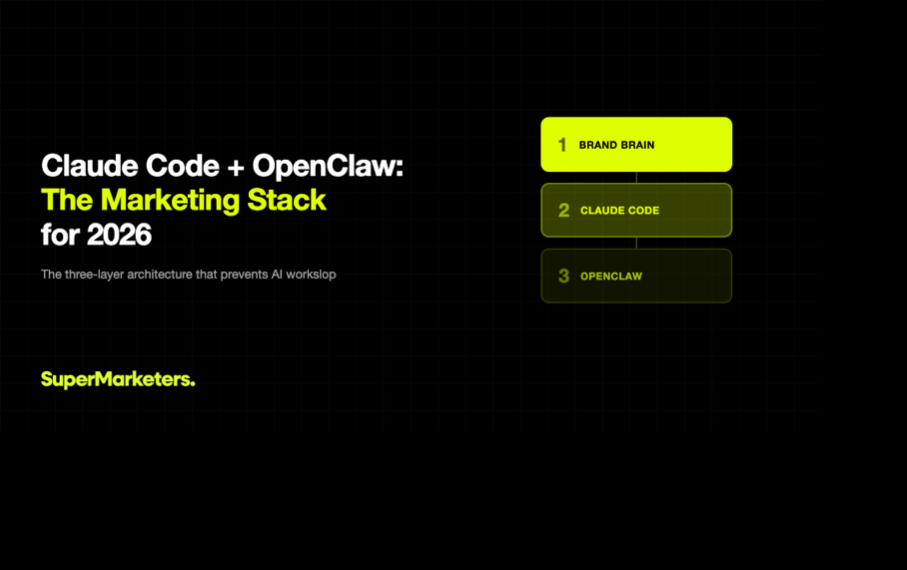
Ready to Build Visibility
That Drives Pipeline?
Book a strategy call. We'll audit where you're invisible, show you where competitors are winning, and map out exactly what a visibility system would look like for your business—even if we're not the right fit.
.svg)