

Claude Code + OpenClaw: The Marketing Stack for 2026

Every marketing team now uses AI. Most of them produce the same output.
The blog posts read alike. The LinkedIn content blurs together. The "AI-powered" campaigns feel indistinguishable from the competition's. Researchers at BetterUp and Stanford's Social Media Lab have a word for this: workslop — AI-generated content that appears polished but lacks the substance to meaningfully advance any task.
The problem isn't the tools. Claude Code is exceptional at structured content creation. OpenClaw is exceptional at autonomous distribution and monitoring. The problem is what's missing between them.
The Layer Nobody Talks About
Search "Claude Code vs OpenClaw" and you'll find 8-10 articles comparing them as developer tools. Features, pricing, capabilities. None of them address the question that actually determines whether your marketing output is differentiated or generic:
Where does brand intelligence live?
Not your brand guidelines PDF that nobody reads. Not the style guide collecting dust in Google Drive. The operational intelligence that determines your positioning, constrains your voice, and prevents every piece of content from defaulting to the same AI-smoothed mediocrity.
Without this layer, here's what happens:
- Claude Code generates content that's technically correct but strategically empty
- OpenClaw distributes it on schedule, amplifying the problem
- Your "AI-powered content engine" produces volume without differentiation
- Every competitor running the same stack produces identical output
The tools work. The architecture doesn't.
The Three-Layer Marketing Stack
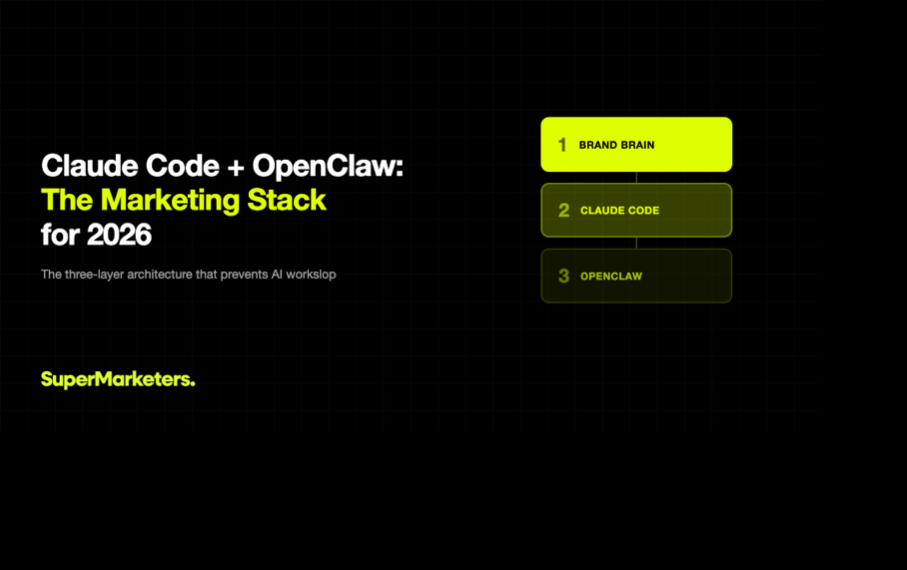
The stack that actually prevents workslop has three layers, and most teams are missing the first one entirely.
Layer 1: Brand Intelligence (The Brand Brain)
This is the governance layer — the strategic foundation that every piece of content passes through before it exists. It's not a document. It's a structured system with 12 sections that encode your positioning, voice, constraints, and competitive differentiation.
A Brand Brain includes:
- Positioning architecture — not taglines, but the strategic territory you own
- Voice constraints — what you sound like AND what you never sound like
- Competitive boundaries — claims you can make, claims you can't, claims only you can
- Audience intelligence — not demographics, but the specific problems, language, and mental models your buyers use
- Content principles — the rules that make your content recognizably yours even without a logo
Without a Brand Brain, you're giving AI tools a blank canvas and hoping the output doesn't look like everyone else's blank canvas.
Layer 2: Execution (Claude Code + CLAUDE.md)
Claude Code handles structured content creation with persistent brand context. The key mechanism is CLAUDE.md — a markdown file that lives in your project root and loads automatically every time Claude Code starts a session.
This is where the Brand Brain becomes operational:
# CLAUDE.md — Marketing Execution Context

## Brand Voice
- Write in short, declarative sentences
- Lead with the counterintuitive observation
- Never use "leverage," "utilize," or "cutting-edge"
- Our tone: direct, slightly contrarian, backed by data

## Positioning
- We are a visibility systems company, not a content agency
- Every piece connects to the 9-step system
- Competitors create content. We install infrastructure.

## Content Rules
- Every blog post includes at least one original data point
- No claims without evidence
- Internal link to pillar content within first 300 words
The CLAUDE.md file means Claude Code doesn't start from zero every session. It starts from your brand. Every output is already constrained by your positioning, filtered through your voice, and structured according to your content architecture.
This is the difference between "write a blog post about AEO" and "write a blog post about AEO that reinforces our position as the visibility systems company, uses our data from 24 audits, and connects to our pillar content architecture."
Same tool. Radically different output.
Layer 3: Automation (OpenClaw + SOUL.md)
OpenClaw handles distribution, scheduling, monitoring, and the ongoing operations that turn content creation into a content system. Its equivalent of CLAUDE.md is SOUL.md — a persistent identity file that defines how the agent behaves across every interaction.
Where Claude Code is session-based (you open it, work, close it), OpenClaw is persistent. It runs on your infrastructure, maintains memory across sessions, and can autonomously:
- Distribute content across channels on schedule
- Monitor brand mentions and competitive movements
- Run audits and surface opportunities
- Manage editorial calendars
- Execute multi-step publishing workflows
The SOUL.md file ensures all of this happens within your brand's strategic boundaries. The agent doesn't just post — it posts as an extension of your brand intelligence layer.
Why the Order Matters
Most teams adopt these tools bottom-up:
- Start with OpenClaw or Claude Code (execution/automation)
- Realize the output is generic
- Try to fix it with better prompts
- Cycle through prompt iterations forever
The correct order is top-down:
- Build the Brand Brain — encode your positioning, voice, and constraints
- Configure Claude Code — CLAUDE.md inherits from the Brand Brain
- Deploy OpenClaw — SOUL.md inherits from both layers above
Each layer feeds the next. The Brand Brain is the source of truth. Claude Code operationalizes it for content creation. OpenClaw operationalizes it for distribution and monitoring.
What This Looks Like in Practice
Here's the without/with contrast:
Without the three-layer stack:
- Monday: Prompt Claude to write a LinkedIn post about AEO → get a generic post that could be from anyone
- Tuesday: Prompt Claude to write a blog post → get 2,000 words of correct-but-undifferentiated content
- Wednesday: Manually post to LinkedIn, hope the timing works
- Thursday: Realize the blog post contradicts something you said last month
- Friday: Start over with "better prompts"
With the three-layer stack:
- The Brand Brain defines this week's content themes based on your pillar architecture
- Claude Code generates all five pieces in one session, each constrained by your voice rules, linked to your content clusters, and consistent with your positioning
- OpenClaw publishes on schedule, monitors engagement, and surfaces what's resonating for next week's planning
- Total founder time: 30 minutes per week
The volume is the same. The differentiation is not.
The Workslop Prevention System
The term "workslop" was coined to describe content that looks professional but doesn't advance anything. In marketing, workslop is the blog post that ranks for nothing, the LinkedIn post that generates no conversations, the email sequence that converts at 0.1%.
Workslop isn't a content quality problem. It's a brand intelligence problem. The content is well-written. It's just not distinctly yours.
The three-layer stack prevents workslop structurally:
- Brand Brain catches strategic drift before content is created
- CLAUDE.md enforces voice and positioning constraints at the execution layer
- SOUL.md ensures distribution follows the same strategic logic
No amount of prompt engineering replaces architectural thinking. You can't prompt your way to brand differentiation — you have to build it into the system.
Getting Started
If you're already using Claude Code or OpenClaw (or both), the gap is almost certainly Layer 1. Here's how to close it:
Step 1: Audit your current output. Pull your last 10 pieces of content. Remove your logo and brand name. Could you tell them apart from a competitor's content? If not, you have a Brand Brain problem.
Step 2: Build the Brand Brain. Start with positioning architecture and voice constraints. These two sections alone will transform your output. The remaining 10 sections (audience intelligence, competitive boundaries, content principles, etc.) can be built iteratively.
Step 3: Create your CLAUDE.md. Translate the Brand Brain into operational instructions that Claude Code loads every session. Be specific. "Write in our brand voice" is useless. "Never use passive voice, lead with data, cap sentences at 20 words" is useful.
Step 4: Configure your SOUL.md. If you're running OpenClaw, this defines how your agent behaves. The Brand Brain feeds the strategic direction. SOUL.md turns it into persistent behavior.
Step 5: Test the system, not the content. Don't evaluate individual pieces. Evaluate whether the system produces consistently differentiated output over 30 days. That's the real test.
Frequently Asked Questions
Can you use Claude Code and OpenClaw together?
Yes. They serve different functions in the stack. Claude Code handles session-based content creation — you open it, generate content, and close it. OpenClaw handles persistent operations — distribution, monitoring, scheduling, and autonomous workflows. They complement each other when connected through a shared Brand Brain.
How do you prevent AI workslop in marketing?
Workslop is a structural problem, not a prompting problem. It happens when AI tools generate content without brand intelligence constraints. The fix is building a Brand Brain (positioning, voice, competitive boundaries) and encoding it into your tools via CLAUDE.md and SOUL.md files. This ensures every piece of output is filtered through your strategic positioning before it exists.
What is a Brand Brain for AI marketing?
A Brand Brain is a structured system (typically 12 sections) that encodes your brand's positioning, voice, constraints, audience intelligence, and content principles in a format that AI tools can operationalize. Unlike a traditional brand guidelines PDF, a Brand Brain is designed to be machine-readable and integrated directly into your AI content stack.
What is CLAUDE.md and how does it work?
CLAUDE.md is a markdown file that lives in the root of any project directory. Claude Code automatically loads it at the start of every session, giving the AI persistent context about your brand voice, content rules, positioning, and constraints. It's the mechanism that translates your Brand Brain into operational instructions for content creation.
How much time does the three-layer stack save?
Teams running the full three-layer stack typically reduce founder content time to roughly 30 minutes per week while increasing output volume by 10x or more. The time savings come not from faster writing, but from eliminating the revision cycles caused by undifferentiated first drafts.
The Shift That's Coming
HBR reported this month that AI is displacing websites as the primary way people discover products. Microsoft's AI CEO says marketing will be fully automated within 18 months. The question isn't whether your marketing stack includes AI — it's whether your AI stack includes brand intelligence.
Every team that skips Layer 1 will produce more content, faster, that sounds like everyone else's content. The teams that build the Brand Brain first will be the ones whose content is actually recognizable, citable, and commercially valuable.
The tools are available to everyone. The architecture is what separates the signal from the workslop.
Most founders spend 5-10 hours per week on content and get inconsistent results. Here is the three-layer system that cuts that to 30 minutes.


A data-backed guide to Answer Engine Optimization for B2B SaaS. Based on audits of 24 companies. Includes a 90-day implementation timeline.
Ready to Build Visibility
That Drives Pipeline?
Book a strategy call. We'll audit where you're invisible, show you where competitors are winning, and map out exactly what a visibility system would look like for your business—even if we're not the right fit.
.svg)