

Your Content Brief Is an API (Here's How to Design It)

You've shipped product. You know what happens when a developer gets a Slack message that says "build the settings page" with no spec, no acceptance criteria, no context.
They build something. It's probably wrong.
Your content works the same way.
If your briefs are vague — or nonexistent — your output will be inconsistent. Different writers produce different things. Different days produce different quality. You can't debug a system that has no specification.
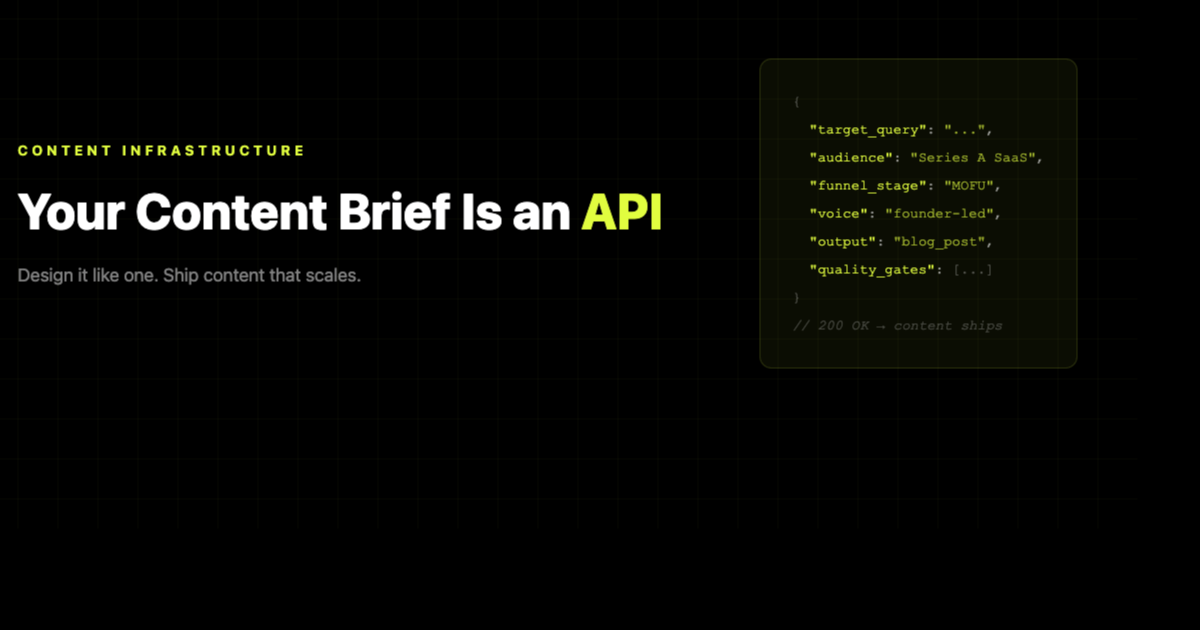
A content brief is the API contract between strategy and execution. Design it like one, and your content becomes predictable, scalable, and auditable.
Why Briefs Fail: The "Just Write About X" Problem
Here's the brief most SaaS companies use:
"Can you write a blog post about onboarding best practices?"
That's not a brief. That's a vibe.
It has no target query. No audience definition. No success criteria. No structure. The writer fills in every blank with their own assumptions — and assumptions compound.
This is the equivalent of calling an API with no parameters and expecting a useful response. You'll get a 200 OK, but the payload is anyone's guess.
The problem isn't the writer. It's the interface.
Vague briefs produce three failure modes:
- Scope creep. The writer covers everything and says nothing.
- Audience mismatch. The tone is wrong because you never defined who it's for.
- Unmeasurable output. You can't evaluate quality when you never specified what quality means.
Every inconsistent piece of content traces back to an underspecified brief. Fix the brief, fix the system.
The Brief-as-API Framework
Think of your content brief as an API endpoint. It needs four things: input parameters, processing rules, an output spec, and error handling.
Input Parameters
These are your required fields. Without them, the request should fail.
- Target query: The primary keyword or question this content answers. One query, one piece of content.
"How to reduce SaaS churn"— not"churn stuff." - Audience segment: Who specifically reads this.
"VP of CS at Series B SaaS, managing a team of 5-15, dealing with logo churn above 5% monthly"gives a writer something to work with."CS leaders"doesn't. - Funnel stage: Where the reader is in their journey. Top-of-funnel (problem-aware), mid-funnel (solution-aware), or bottom-funnel (product-aware). This determines depth, CTAs, and competitive positioning.
- Key message: The single takeaway. If the reader remembers one thing, what is it? Force yourself to write this in one sentence. If you can't, the brief isn't ready.
Processing Rules
These are your middleware — the constraints that shape how inputs become outputs.
- Voice guidelines: Link to your style guide. If you don't have one, create a minimum viable version: tone (conversational vs. formal), sentence length, jargon policy, POV (first person vs. second person).
- Structure template: H2/H3 outline, or at minimum the required sections.
"Use the Problem → Framework → Example → CTA structure"is better than"make it flow well." - Word count: A range, not a guess.
1,200-1,500 wordssignals depth expectation. This prevents 500-word fluff and 4,000-word novels. - AEO requirements: If you're optimizing for AI engine visibility, specify it. Include: the question to directly answer (for featured snippets), any FAQ requirements, and structured data needs.
Output Spec
This is your response schema. What does a successful response look like?
- Expected deliverable: Blog post? LinkedIn thread? Comparison page? Be explicit. Include format details: does it need a meta description, OG title, internal links?
- Quality gates: What must be true before this publishes? Examples: "Includes at least one original data point," "Links to product feature X," "Passes Hemingway Grade 8 readability."
- Success criteria: How will you measure this in 90 days? Organic traffic, conversion to signup, ranking position? Pick 1-2 metrics. Content without success criteria is content without accountability.
Error Handling
Every good API has error handling. Your brief should too.
- Ambiguity protocol: When the writer hits a gap in the brief, what do they do? Options: flag and wait, make a decision and document it, use a default from the style guide. Pick one and document it.
- Revision scope: What's in-scope for revisions vs. a new brief? "Change the audience from VP to IC" isn't a revision — it's a different endpoint.
- Escalation path: Who approves edge cases? If the writer finds that the target query has zero search volume, who decides whether to proceed?
The Complete Brief Template
Copy this. Use it. Modify it for your team.
## Content Brief: [Working Title]

### Input Parameters
- Target query:
- Secondary queries (2-3 max):
- Audience segment:
- Funnel stage: [ ] TOFU  [ ] MOFU  [ ] BOFU
- Key message (one sentence):
- Internal links required:

### Processing Rules
- Voice/style guide: [link]
- Structure: [template name or outline]
- Word count range:
- AEO: Direct-answer target question:
- FAQ questions to include:
- Competitor content to beat: [URLs]

### Output Spec
- Deliverable: [blog post / landing page / etc.]
- Includes: [ ] Meta title  [ ] Meta description  [ ] OG image brief
- Quality gates:
  - [ ]
  - [ ]
- Success metric:
- Target publish date:

### Error Handling
- Ambiguity protocol: [flag and wait / decide and document]
- Revision scope: [what counts as a revision vs. new brief]
- Approver:
This isn't theoretical. We use a version of this for every piece of content at Supermarketers.
Before and After: The Output Difference
The vague brief:
"Write a blog post about content distribution for SaaS companies."
What you get: A generic 1,800-word post that covers social media, email, paid ads, and SEO in surface-level paragraphs. It reads like a college essay. It ranks for nothing. It converts no one.
The API brief:
- Target query: "content distribution strategy B2B SaaS"
- Audience: Head of Marketing at Series A SaaS ($2-8M ARR), team of 1-3, doing distribution themselves
- Funnel stage: MOFU (knows they need distribution, looking for a system)
- Key message: Distribution isn't about more channels — it's about a repeatable system that compounds
- Structure: Problem → Framework (the 3-layer distribution system) → Implementation example → CTA to template
- Word count: 1,400-1,700
- AEO target: "What is a B2B SaaS content distribution strategy?"
- Quality gates: Must include one real example with metrics, must link to distribution template, Hemingway Grade 7
What you get: A focused, opinionated post that speaks directly to an early-stage marketer drowning in channels. It has a clear framework they can implement. It answers the AEO target question in the first 100 words. It ranks. It converts.
Same writer. Same topic. Different spec, different output.
How AI Makes This 10x More Powerful
Here's where it gets interesting.
A well-structured brief isn't just a document for human writers. It's a prompt architecture for AI.
When your brief has explicit input parameters, processing rules, and output specs, you can feed it directly to an LLM and get consistent, high-quality first drafts. The brief is the prompt.
This changes the economics:
- Speed: First drafts in minutes, not days.
- Consistency: The same brief produces structurally similar output every time. No more variance between writers or between Tuesday-you and Friday-you.
- Scale: You can run 10 briefs in parallel. The bottleneck shifts from writing to strategy — where it should be.
The founders who figure this out aren't choosing between quality and volume. They're getting both because the system is specified correctly.
But — and this matters — AI with a vague brief produces vague content faster. Garbage in, garbage out, at scale. The brief is the leverage point.
Frequently Asked Questions
How detailed should a content brief be?
Detailed enough that two different writers (or an AI) would produce structurally similar outputs from the same brief. If your brief leaves room for wildly different interpretations, it's underspecified. The template above takes 15-20 minutes to complete. That investment saves hours of revisions and misaligned output.
Who should write the content brief — the strategist or the writer?
The strategist owns the brief. They define the inputs, processing rules, and success criteria. The writer can suggest structural changes or flag gaps — that's your error handling protocol. But the brief is a strategy document, not a writing document. Separating these roles is what makes the system work.
Can I use AI to generate the brief itself?
Yes, partially. AI can research competitor content, suggest secondary keywords, and draft structural outlines. But the strategic decisions — audience segment, key message, funnel stage, success criteria — must come from someone who understands the business. Use AI for the research layer. Keep humans on the strategy layer.
How many briefs should I create per month?
Match your briefs to your publishing capacity, not the other way around. If you can produce and promote four posts per month well, create four briefs. Ten half-promoted posts lose to four well-distributed ones. The brief is the spec — don't write specs for features you won't ship.
Your content isn't a creative exercise. It's a system. Design the interface, specify the inputs, define the outputs. The content takes care of itself.
Most founders spend 5-10 hours per week on content and get inconsistent results. Here is the three-layer system that cuts that to 30 minutes.


A data-backed guide to Answer Engine Optimization for B2B SaaS. Based on audits of 24 companies. Includes a 90-day implementation timeline.
Ready to Build Visibility
That Drives Pipeline?
Book a strategy call. We'll audit where you're invisible, show you where competitors are winning, and map out exactly what a visibility system would look like for your business—even if we're not the right fit.
.svg)