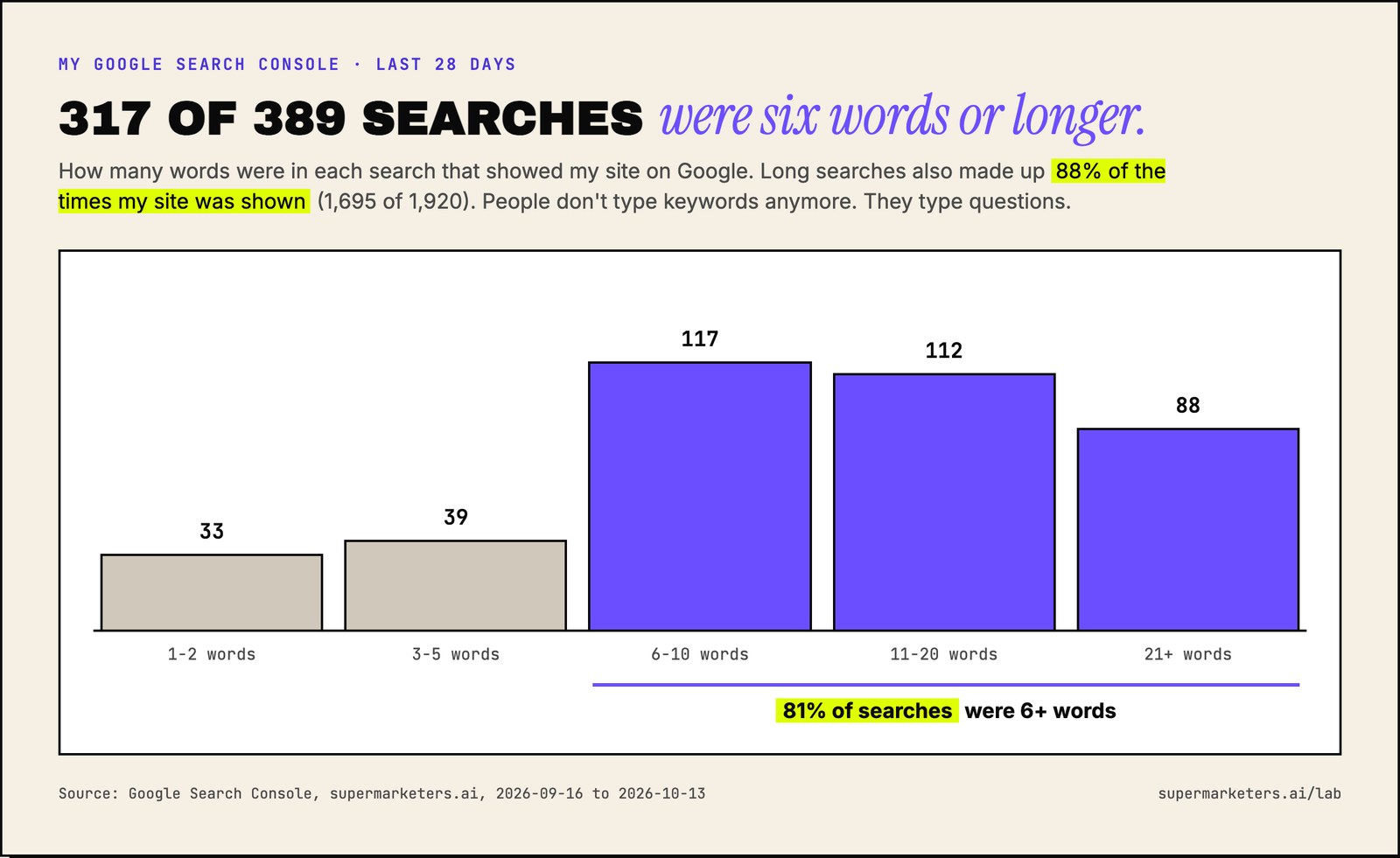
Last month, 389 different searches found my website on Google.
317 of them were six words or longer. The longest was 57 words. Together, those long searches made up 88% of the times my site was shown.
People don't search in keywords anymore. They type full questions, with context, the way they'd ask a colleague. Or the way they'd ask ChatGPT.
That changes what "showing up" means. So for the next 10 weeks I'm running an experiment in public, called Earning the Shortlist: can a small, honest B2B company get recommended when buyers ask AI who to hire?
Before I ask any AI a single question, I'm publishing which questions I'll track, how I chose them, and what I expect to find.
---
Why decide the questions before seeing any answers
If I pick questions after I see the answers, I can make any result look like a win. Just keep the questions where I show up and drop the rest.
So I'm doing it in this order:
- Choose the questions and write down why.
- Lock the exact wording, with a date.
- Write down my predictions.
- Only then, start asking.
If I ever change a question, it becomes a new, separately dated list. Old and new results never get mixed.
---
What I found when I looked at who was actually searching
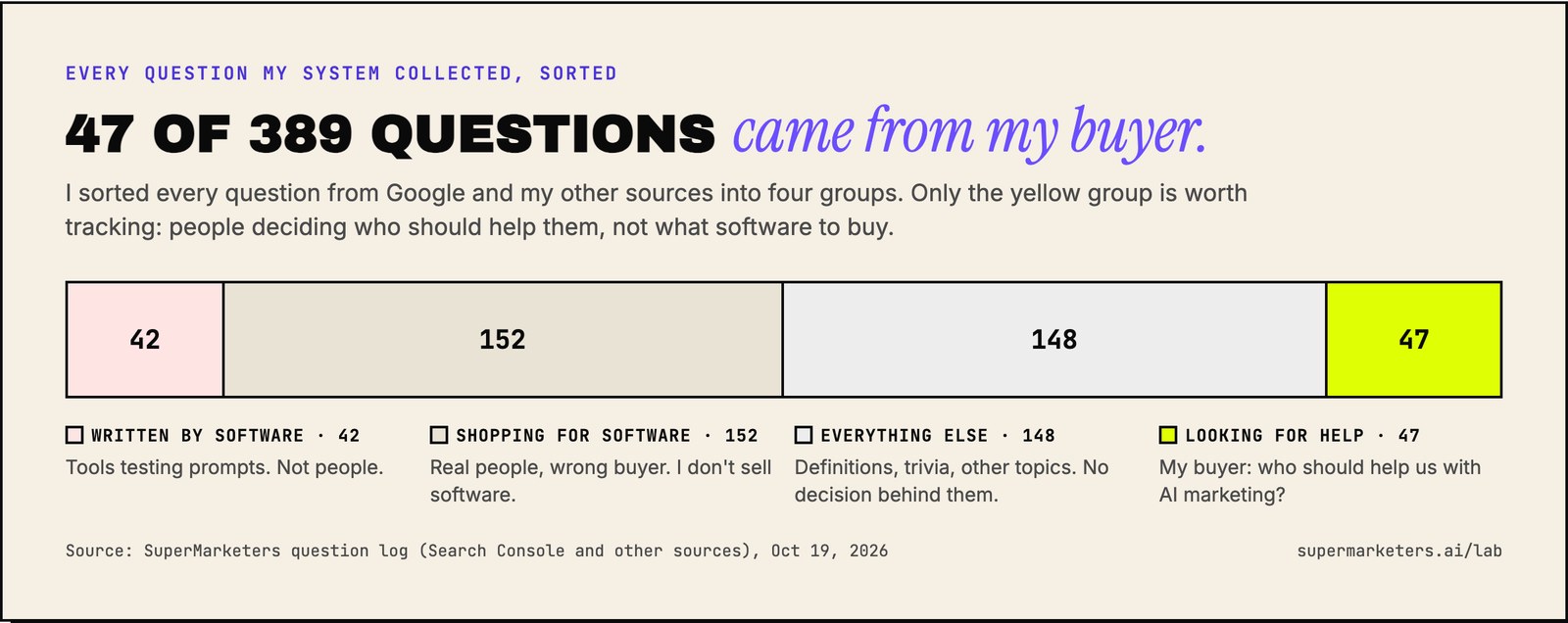
I started with every question my system has collected from Google and other sources, as of October 19: 389 of them. Three things jumped out.
1. Some of the "people" searching aren't people
42 questions were written by software, not buyers. In last month's Google data, 56 searches had the same fingerprint. Here's a real one that found my site:
"i'm looking for a tool to track brand coverage across a broad range of llms and answer engines. which is better for this use case, profound or peec ai? provide a definitive answer, along with a list of pros and cons..."
Nobody types "provide a definitive answer" into Google. These are AI visibility tools running test prompts through search engines to measure their clients. They show up in Search Console looking exactly like buyers.
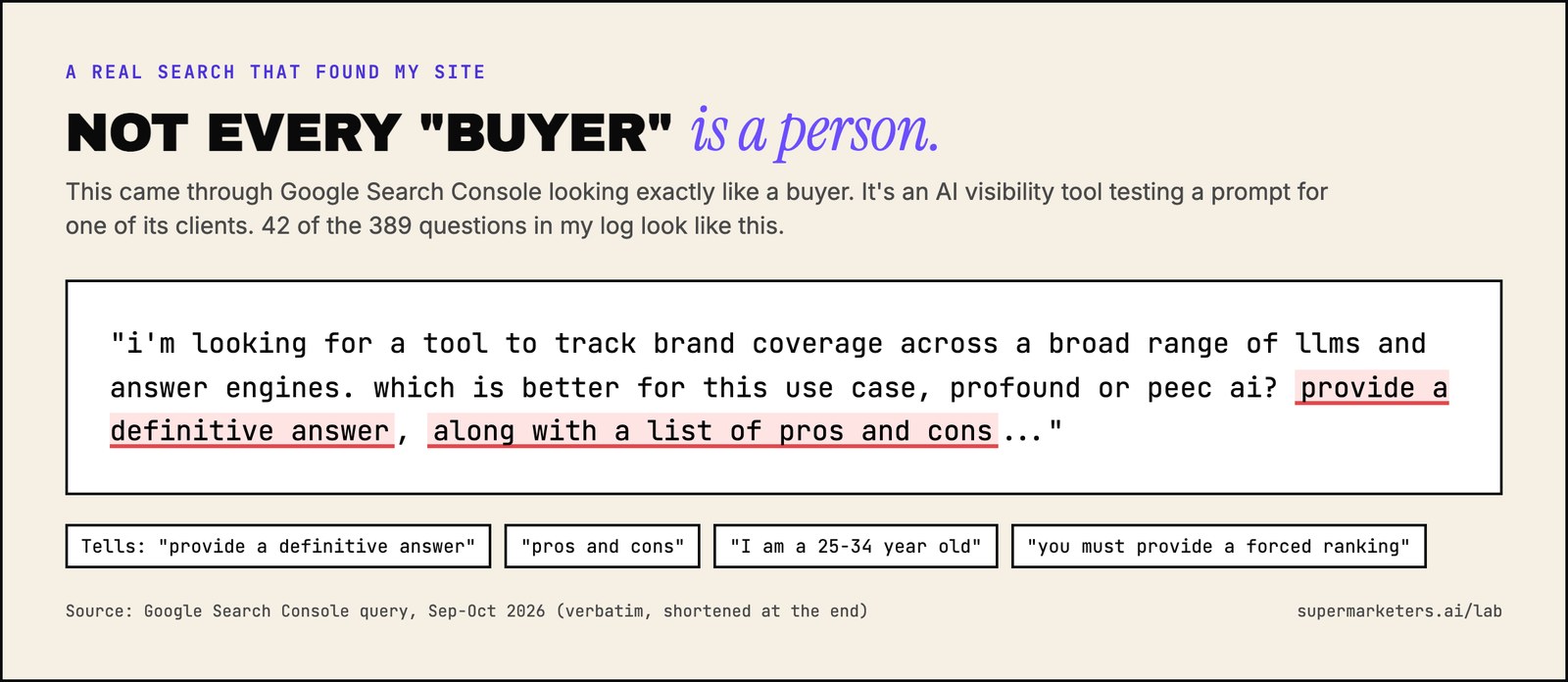
What you can do: search your Search Console queries for phrases like "provide a definitive answer", "pros and cons", or "I am a 25-34 year old". Count them before you trust your question data.
2. Most of the real people were shopping for software
152 of the remaining 347 questions were about tools. "Is Peec AI worth it for a B2B SaaS company." "Most affordable AI visibility tools for B2B SaaS startups." "AthenaHQ vs Peec AI."
These people are real. They're just not my buyer. I don't sell software.
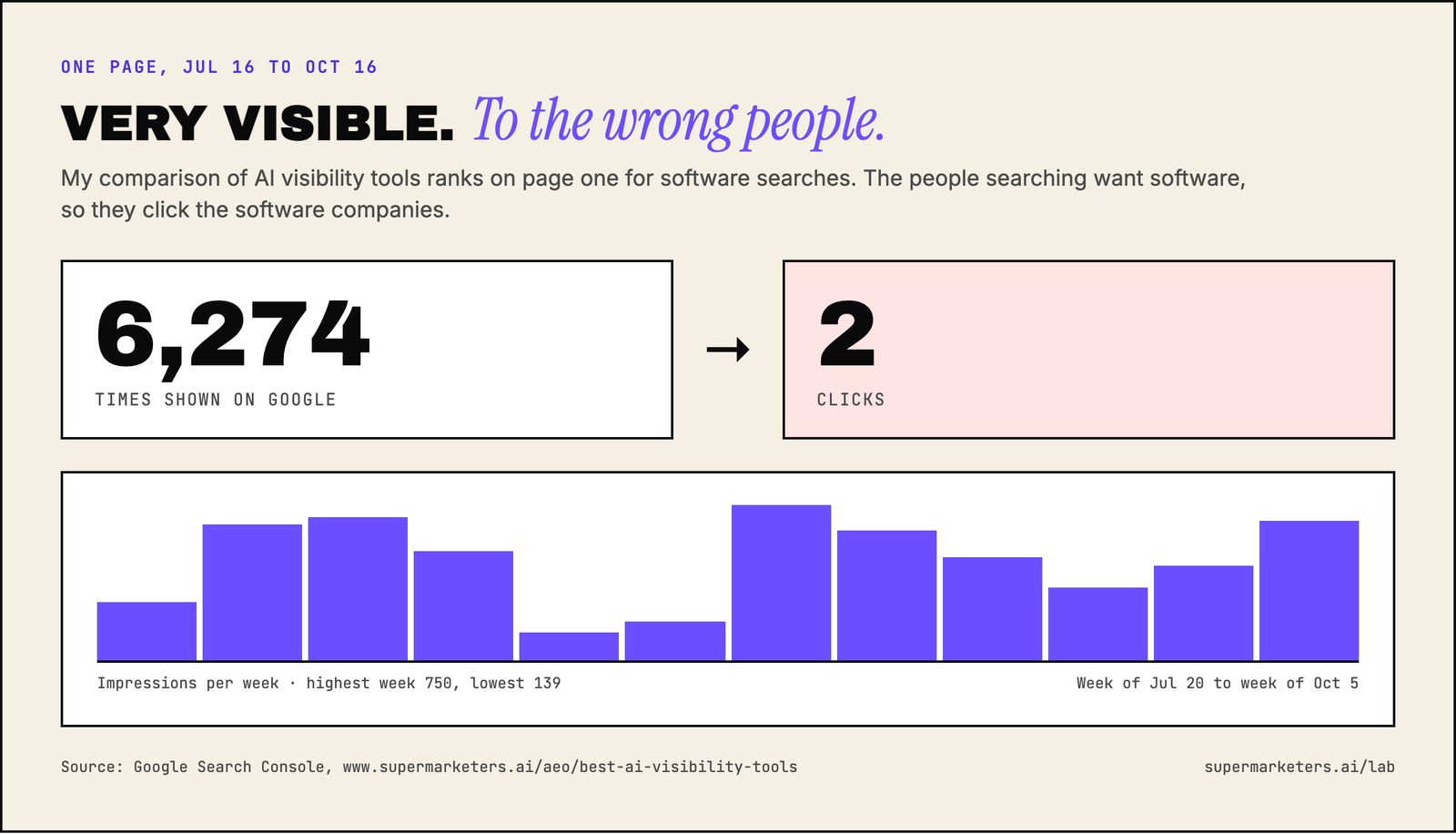
And it shows. My page comparing AI visibility tools was shown 6,274 times on Google between July 16 and October 16. It got 2 clicks. People shopping for software click the software companies, not me.
That's the trap: a page can be very visible and still be visible to the wrong people.
3. A small group was asking the right question
47 questions were about getting help. These sound like my buyer:
"Who can help a small B2B SaaS company improve its visibility in ChatGPT and Google?"
"What's the best way to implement AI across a B2B marketing team without it turning into a pile of disconnected tools and prompts nobody maintains?"
"We've had a content marketing role open for over two months and can't justify the hire. What are the alternatives?"
47 out of 389. About 12%. That's the group worth measuring.
---
The one rule I used to pick
Every question had to pass three tests:
- Who asks it? A marketing leader at a B2B SaaS company (roughly seed to Series C) deciding who should build and run AI marketing for their team.
- When do they ask it? Close to a decision, or while researching the problem that leads to one.
- Would a yes change my business? If AI recommended me for this question every time, would it bring me a client?
If a question failed any of the three, it didn't make the list, no matter how often it's asked.
---
How to do this yourself in about an hour
This is the exact process. You only need Google Search Console and a spreadsheet.
Step 1: Pull the questions people actually type
In Search Console, go to Performance → Search results → Queries. Add a query filter, choose Custom (regex), and paste:
^(who|what|which|how|why|is|are|should|can|best|compare)\b|\?$|(\S+\s+){5,}That keeps searches that start like a question, end with a question mark, or are six words or longer. Set the date range to the last 3 months and export.
Step 2: Sort every row into four buckets
| Bucket | How to spot it | Real example from my data | Keep? |
|---|---|---|---|
| Machine-written | "Provide a definitive answer", "pros and cons", personas like "I am a 25-34 year old" | "...which is better for this use case, profound or peec ai? provide a definitive answer..." | No |
| Shopping for a product you don't sell | Names of tools, "software", "platform", "pricing" | "most affordable ai visibility tools for b2b saas startups" | No |
| No decision behind it | Definitions, trivia | "what is answer engine optimization aeo for saas" | Not for tracking (fine for content) |
| Your buyer | Hire, help, implement, agency, consultant, alternatives, "should we" | "Who can help a small B2B SaaS company improve its visibility in ChatGPT and Google?" | Yes |
Step 3: Rewrite keywords into the way buyers ask
People type fragments into keyword tools and full questions into AI. So I wrote each keeper the way a buyer would actually ask an assistant. Here is the difference, using typical keyword phrasings:
| The keyword version | How a buyer asks AI |
|---|---|
| ai marketing agency b2b saas | What's the best AI marketing agency for a B2B SaaS company? |
| ai marketing implementation | Who can implement AI marketing workflows for our SaaS marketing team? |
| fractional cmo ai | We need a fractional AI marketing lead for a Series A SaaS company. Who should we talk to? |
Where real people had already typed the full question, I stayed as close to their words as I could. Two of my 10 come from real Google searches.
Step 4: Balance the list
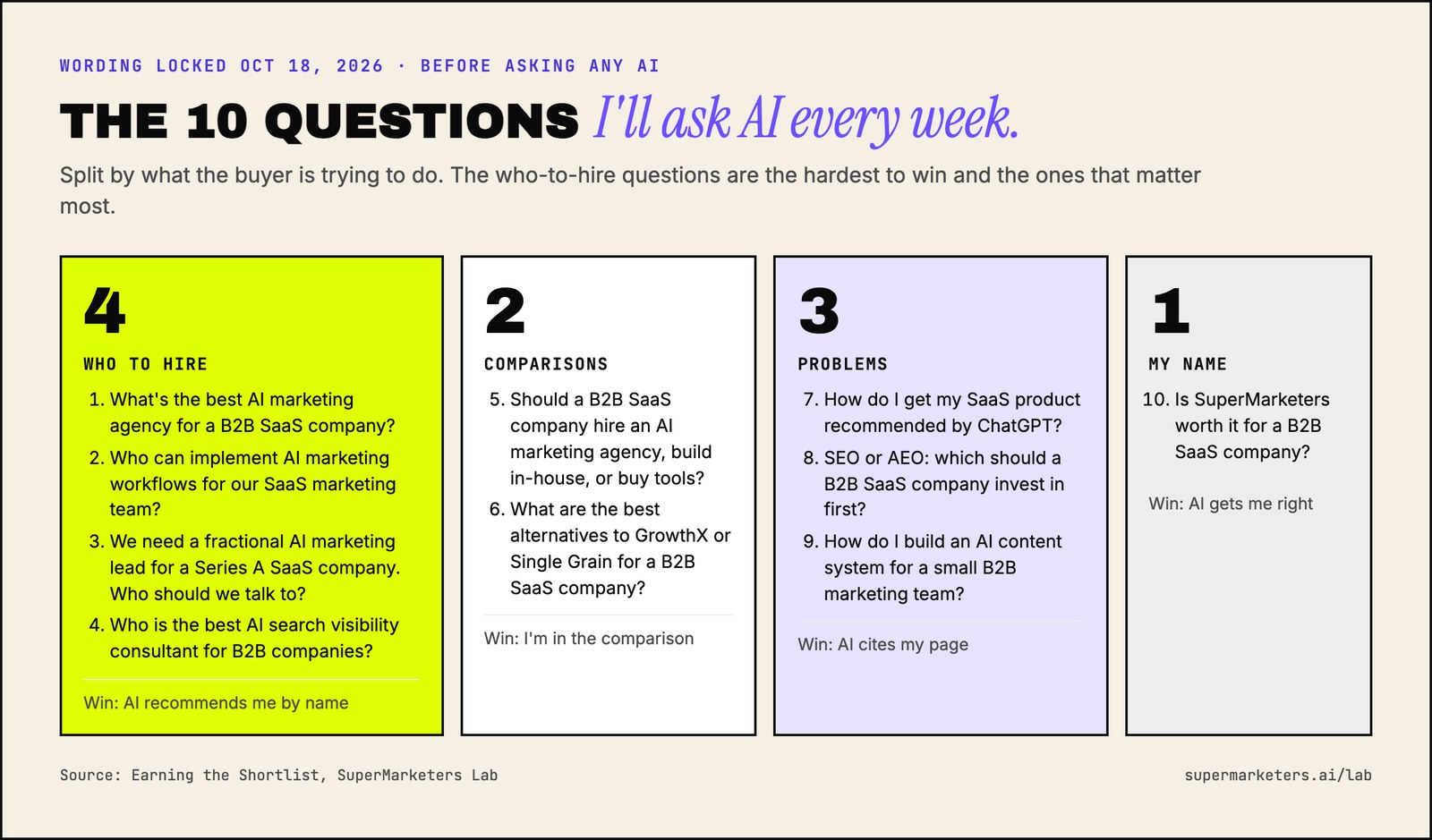
Ten questions is enough to see a pattern and few enough to check every week. I split them by what the buyer is trying to do:
| Type | How many | What a win looks like |
|---|---|---|
| Who to hire | 4 | AI recommends me by name. The hardest win, and the one that matters most. |
| Comparisons | 2 | I'm included when buyers weigh their options. |
| Problems | 3 | AI cites one of my pages as the source. More achievable, and it builds trust earlier. |
| My own name | 1 | AI describes SuperMarketers correctly. If it can't get that right, nothing else matters. |
Step 5: Lock the wording and date it
Write the final list down with today's date, and don't edit it. Mine is locked as of October 18, 2026.
---
My 10 questions
Who to hire
- What's the best AI marketing agency for a B2B SaaS company?
- Who can implement AI marketing workflows for our SaaS marketing team?
- We need a fractional AI marketing lead for a Series A SaaS company. Who should we talk to?
- Who is the best AI search visibility consultant for B2B companies? (from a real Google search: "best ai search visibility consultant for b2b companies")
Comparisons
- Should a B2B SaaS company hire an AI marketing agency, build in-house, or buy tools?
- What are the best alternatives to GrowthX or Single Grain for a B2B SaaS company?
Problems
- How do I get my SaaS product recommended by ChatGPT?
- SEO or AEO: which should a B2B SaaS company invest in first? (from a real Google search: "seo vs aeo: which should a b2b saas invest in first")
- How do I build an AI content system for a small B2B marketing team?
My own name
- Is SuperMarketers worth it for a B2B SaaS company?
---
What I threw out, and why
The cuts say as much about the method as the keepers do.
| Candidate | Why it's out |
|---|---|
| "Is Peec AI worth it for a B2B SaaS company?" | Real person, wrong buyer. They want software. |
| "Most affordable AI visibility tools for B2B SaaS startups" | Same. It's also the kind of search that gave me 6,274 views and 2 clicks. |
| "...which is better, profound or peec ai? provide a definitive answer..." | Written by a tracking tool, not a person. |
| "What is SuperMarketers?" | I'd win it, and winning it proves nothing. |
| "What is answer engine optimization (AEO) for SaaS?" | A real search, but no decision behind it. Good for an article, not for measuring a shortlist. |
| "Where can I get a package that includes AI search visibility and share of voice optimization?" | The closest call. It's my most-shown search on that tools page, and it could be a buyer. But "package" could mean software too, so I kept it as a candidate for the next list instead of guessing. |
---
How I'll check the answers
Where: ChatGPT, Perplexity, Claude, and Google's AI Mode.
How often: every question, 3 times on each, every week. That's 120 answers a week.
Why 3 times: AI gives a different answer each time you ask. Ask ChatGPT the same question three times and you can get three different shortlists. One answer could be a fluke. "Recommended in 2 of 3 tries, three weeks in a row" is a pattern.
What I record for every answer:
- Mentioned: SuperMarketers appears anywhere.
- Recommended: the answer suggests SuperMarketers as an option to pick.
- Cited: the answer links to one of my pages as a source.
- Who else shows up: every company named and every source linked.
I'll always show the count behind a number, like "3 of 30 answers", never a bare percentage.
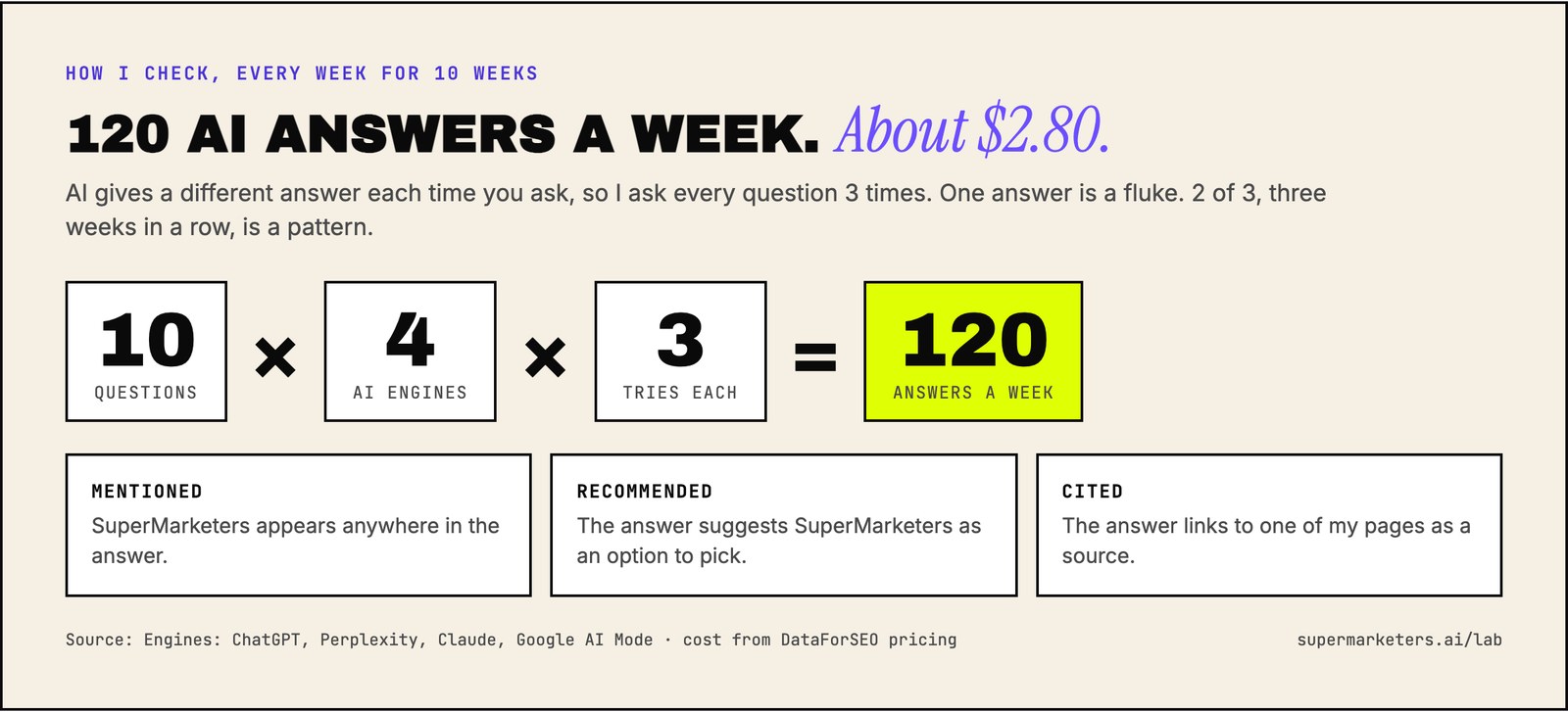
What it costs: about $2.80 a week, through an API that runs the questions for me. About $28 for the whole 10 weeks. I'll publish the actual spend.
---
What I expect to find
I wrote my predictions down before running anything, each with how confident I am. A few of them:
- 85% confident AI recommends me in 2 or fewer of the 48 who-to-hire answers. I'm small and new, and those answers lean on what other people say about you.
- 55% confident one of my pages gets cited in at least 3 of 36 answers to the problem questions. I already have pages on two of them.
- 20% confident I get recommended for a who-to-hire question, two weeks running, by week 10.
The full list goes up on the Lab before my first check. I'll score myself in public at week 2 and week 10, without editing the predictions.
---
What happens next
- Weeks 1-2: I measure where I stand and change nothing. Every AI answer gets published in full.
- Weeks 3-9: focused work aimed at whatever the answers show: rebuilding my most citable page, an honest alternatives page, a test of whether list-style articles reach buyers, and earning mentions from other people.
- Week 10: I score my predictions and decide whether to keep going. If nothing moved, I stop and publish why.
The whole plan, week by week, is going up on the Lab this week.
---
What you can do this week
- Export your long searches from Search Console with the filter above. You'll likely find people asking full questions about your category right now.
- Count the machine-written ones. If you're using that data to choose content, take them out first.
- Check which of your pages are visible to the wrong people. High impressions and almost no clicks usually means the audience is wrong, not the headline.
- Pick 10 questions, lock them, and write down what you expect. It costs nothing, and it's the best protection against fooling yourself with your own dashboard.
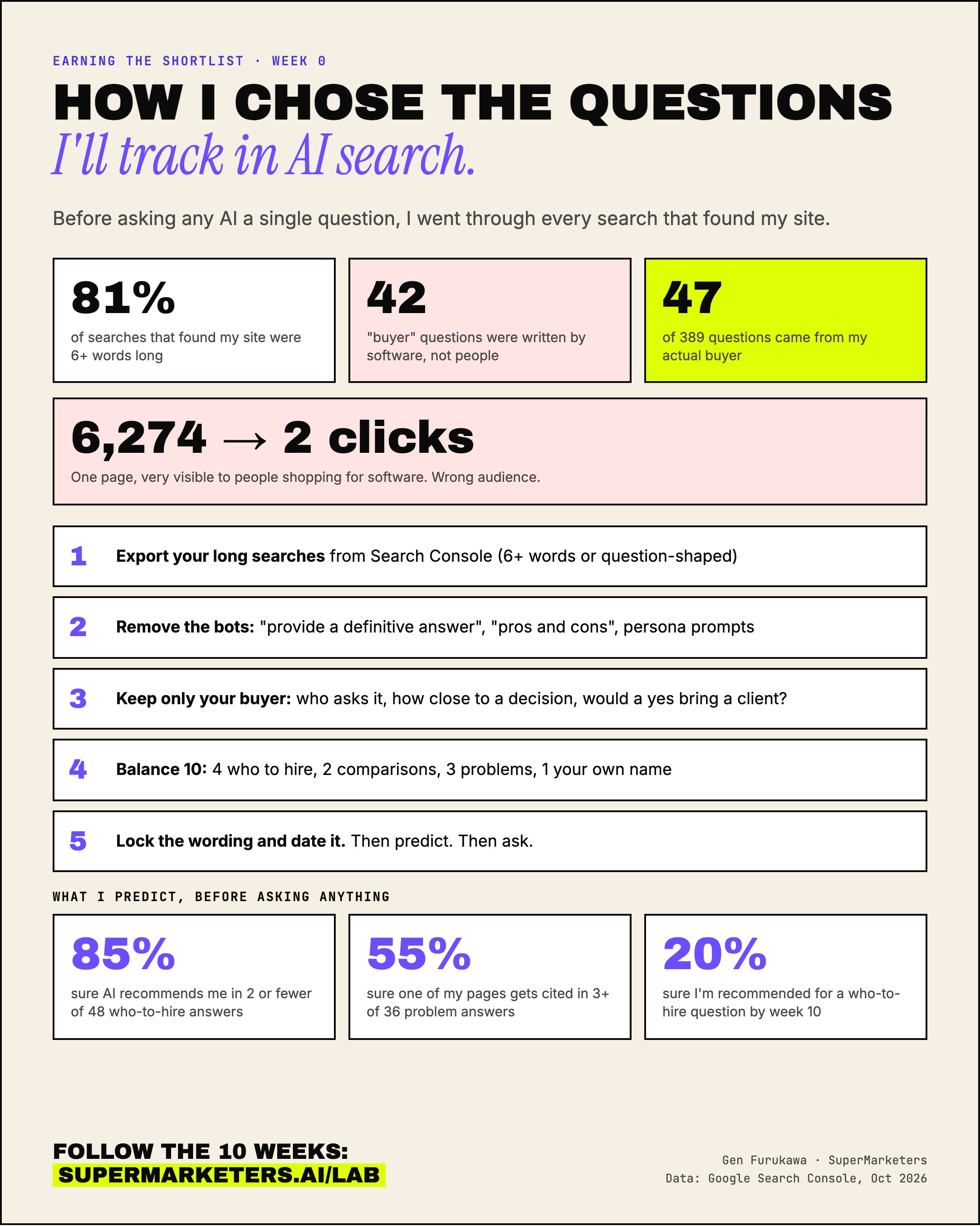
The whole method on one page. Save it or share it:
---
I'm documenting every week of this in The SuperMarketer, my newsletter. One email every other week: what I shipped, what changed, and what you can copy. Sign up at the bottom of this page.
What are the questions you'd want AI to recommend you for?