Here's a helpful lesson I've learned: the root cause of AI slop is in the standards and context you set, not the writing or the model.
The same model (Claude's Sonnet works here about as well as OpenAI's GPT-5.6 Terra) produces good work the moment you give it something specific to pass.
And when the output is subpar, it doesn't disappear. It shifts the work downstream into edits, rewrites, and QA, which lands on whoever is most expensive and least available.
Drafting got incredibly cheap, reviewing got expensive, and I think that gap keeps widening as production cost moves toward zero.
It isn't a better prompt or a better model. It's writing down what good actually means, in a form something other than you can check.
What that looks like in our setup
Every piece starts from a brief instead of a topic, so the agent knows who the buyer is, the problem in that buyer's own words, the one thing we're arguing, and the proof behind it. That part matters more than people expect, because most of what gets called an AI writing problem is really a context problem that showed up three steps earlier.
Then it drafts, and instead of handing that draft to me, it grades its own work against a written standard, one rule at a time.
The check standard, current version
1. Every factual claim needs a source link. No link, the claim comes out.
2. No sentence stays if it would still be true with a competitor's name swapped in.
3. Something in the piece has to be ours alone: a customer's exact words,
   or a number from our own data.
4. Every fail must be logged: quote the offending line, rewrite it,
   run the check again.
When it fails a rule, it quotes its own offending line, rewrites it, and runs the check again. So I never see draft one or draft two. I see the version that already cleared the bar, and the only thing left for me is the call the standard can't make: whether this is the right thing to say to this market right now.
The loop, in full
That's the system underneath every piece we ship. Six steps, one place where a human has to weigh in.
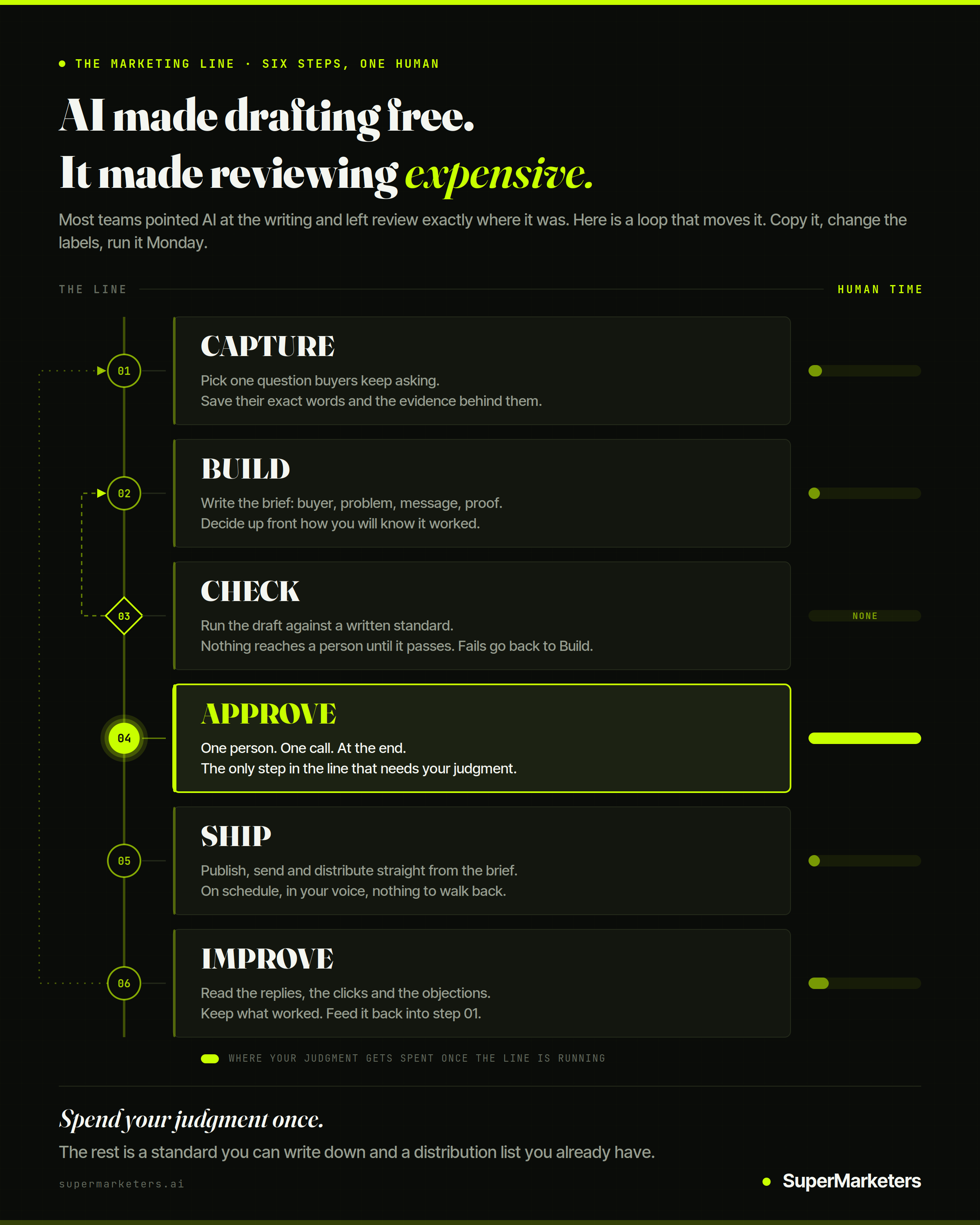
| Step | What happens | Human time |
|---|---|---|
| 01 · Capture | Pick one question buyers keep asking. Save their exact words and the evidence behind them. | Light |
| 02 · Build | Write the brief: buyer, problem, message, proof. Decide up front how you'll know it worked. | Light |
| 03 · Check | Run the draft against a written standard. Nothing reaches a person until it passes. Fails go back to Build. | None |
| 04 · Approve | One person, one call, at the end. The only step in the loop that needs your judgment. | Full |
| 05 · Ship | Publish, send, and distribute straight from the brief. On schedule, in your voice, nothing to walk back. | Light |
| 06 · Improve | Read the replies, the clicks, and the objections. Keep what worked. Feed it back into step 01. | Light |
The value isn't only that it's faster, though it is. A loop holds onto the three things a content calendar throws out every Monday: the brief, the standard, and what you learned. Run the same format ten times and the tenth run starts from everything the first nine taught you.
Where the idea came from
It came from watching Ras Mic explain how he ships software on Greg Isenberg's podcast. His agent records the broken state, does the work, records the fixed state, and puts both in the pull request as proof. A second agent scores it out of five, and anything under a five goes back automatically without a person involved.
Marketing never built this because a weak blog post doesn't crash the way broken code does, so we substituted a senior person with taste and called it quality control. That works until volume goes up, and AI made volume go up a lot.
Start this week: the five-day plan
Don't build the whole system. Open the last ten drafts you left comments on and read what you actually wrote. The four or five notes you keep repeating are already your standard, and you've been enforcing them by hand for years because they were never written anywhere a machine could read them.
- Pull the last ten drafts you edited. List every repeat note, word for word.
- Turn the three to five notes you see most often into pass/fail rules an agent can check mechanically.
- Write one brief for the format you produce most on a schedule (buyer, problem, message, proof).
- Run capture → build → check on the next piece in that format. Read what fails and why before you touch it.
- Approve, ship, and start counting how many drafts reach you before they're ready.
The brief template
This is the whole input. If the agent can't answer all four, it doesn't draft yet.
Buyer — who this is for, specifically, not "marketers" · Problem — the question in the buyer's own words · Message — the one thing we're arguing, not three · Proof — the source, data point, or quote backing it
Then count how many drafts reach you before they're ready. That's the number I'd watch.