Agentic marketing is marketing where AI agents run the repeatable work across your systems, like research, drafting, audits, reporting and monitoring, on a schedule, with checks, and a person approves what ships. Strategy, positioning and taste stay with you. Execution moves to agents.
I've run my own marketing this way all year, and I sell the same system to B2B SaaS teams. It's the system behind Intryc doubling its AI visibility in 28 days, Oyster getting 11× more AI citations without a new page, and Talkadot winning 19 of its 20 priority searches.
This post is the field guide I wish I had in January: what changed, which use cases hold up, the architecture, and then step by step how to build it, run it and grow it.
The clearest example on my own site: three scheduled routines track my AI visibility every week, a job that AI visibility tools charge $29 to $399 a month for. I read the report. I don't run it.
At the end there's a free starter kit: 19 files you can drop into a repo, with the skills, subagents, hook, gate script and prompts from this post.
What is agentic marketing?
An agent is a model that can read files, use tools and take actions until a job is done. Agentic marketing puts agents on the jobs a marketing team repeats every week, and wraps them in three things a chat window doesn't have: shared context, a schedule and a gate.
The difference shows up in how you work. With a chatbot, you prompt, read, fix and prompt again. With an agentic system, you write down what done looks like once. The agent works until a check passes, and you review the output. I wrote about that shift in loop engineering: the unit of work is the loop, and the prompt is just one part of it.
Agents win when the work crosses systems, needs judgment and repeats. A weekly AI visibility report pulls from trackers, compares against last week, and writes the story. That's a great agent job. A one-off LinkedIn post you'll rewrite anyway isn't.
What changed in 2026 that makes this practical?
Two years ago you could build this, but you had to babysit it. Five changes this year made unattended agents something you can trust with client work:
- Models. Anthropic shipped Fable 5.1, Opus 5.5, Sonnet 5.5 and Haiku 5.5 in five weeks. Each tier now has a clear marketing job, so you can mix them inside one workflow.
- Agents at scale. Claude Code added an agent view (
claude agents), background sessions,/goaland dynamic workflows, which are scripts that run many subagents at once. You can run ten client jobs in parallel and triage them from one screen. - Scheduling. Routines run agents in Anthropic's cloud on a schedule, an API call or a GitHub event, with your laptop closed. Desktop scheduled tasks and Cowork cover jobs that need local files.
- Customization. Skills, plugins and Mods let you package a whole marketing system and install it per client.
- Operations. Auto mode, sandboxing, permission rules and safety telemetry make an unattended agent governable. That's what lets you run agents for clients, not only for yourself.
Here's how I route the models. Default to Sonnet, step up for judgment, step down for volume:
| Model | Marketing jobs I give it | Watch out for |
|---|---|---|
| Sonnet 5.5 | The daily driver: drafts, audits, running skills, scripts, Office documents | High effort burns tokens; cost per task can pass Opus |
| Opus 5.5 | Positioning, GTM strategy docs, audit synthesis, coordinating a fleet of subagents | Slow at max effort on long tasks |
| Haiku 5.5 | Classifying prompts, tagging, parsing citations, subagent grunt work | Less judgment; never final client prose |
| Fable 5.1 | The hardest multi-step builds, and a second opinion on strategy | The heaviest tier; save it for hard problems |
A split that works: Opus plans, Sonnet writes, Haiku searches and tags. Retest your core skills every time a new model ships, because a model swap changes token use and output style.
Which agentic marketing use cases actually hold up?
These are the ones I run, with where each one shows up in my own work or a client's:
| Use case | What the agent does | Where I've run it |
|---|---|---|
| AI visibility audits | Asks AI engines your buyers' questions, logs which brands and sources get cited, scores pages, writes a fix list | Intryc: about 485 broken AI citations repaired before any new writing |
| Content refresh at scale | Restructures existing pages so AI can extract them: answer-first blocks, FAQs, schema, sources | Oyster: 11× AI citations and +110% organic clicks from pages it already had |
| Founder-voice content | Mines source material, drafts in your voice, runs reviewer agents, repurposes to LinkedIn and email, logs every correction | The Voice: rules extracted from real writing and sales calls, checked on every draft |
| Weekly reporting | Pulls tracker, Search Console and analytics data, compares to last week, writes the narrative | Three scheduled routines that replace a $29 to $399 a month tool |
| Competitive intelligence | Watches competitor pricing, docs, changelogs and careers pages, summarizes what changed | What to watch on a SaaS competitor's site |
| Video production | Cuts a testimonial, adds captions and cards, makes clips and a thumbnail, uploads | A client testimonial edited with Claude Code |
| Visual and site production | Builds pages and visuals from one design spec and one data file | My whole system as 30 web pages |
| Prospect research | Researches an account, checks how AI describes it, drafts a personal audit for a human to send | My own outbound; a person approves every send |
What doesn't work: asking an agent for generic posts with no data, no workflow and no system of record. Letting agents publish or send without a gate. And one giant prompt where a chain of small skills with checkpoints would do.
You'll see "300% ROI" and "8 hours down to 2" all over vendor blogs. Most show no method. My numbers above come from client tracking with a stated baseline, and each case study shows the pages that didn't win too. Use outside numbers as direction, never as a promise to your boss or your client.
The architecture: four layers, one gate, one loop
Every durable agentic marketing system I've built or studied has the same shape. The gate and the feedback loop are what separate a system from a pile of prompts.
/goal, dynamic workflows, agent view, Routines, desktop tasks, /loop.In my system, those layers have names. The Brain is the memory every agent reads first. The Voice is how the client sounds, written as rules. The Gates are six checks every piece passes before a human reads it. The Ledger records what shipped and what it produced. All four live in the client's own repo, so they keep them when we stop working together.
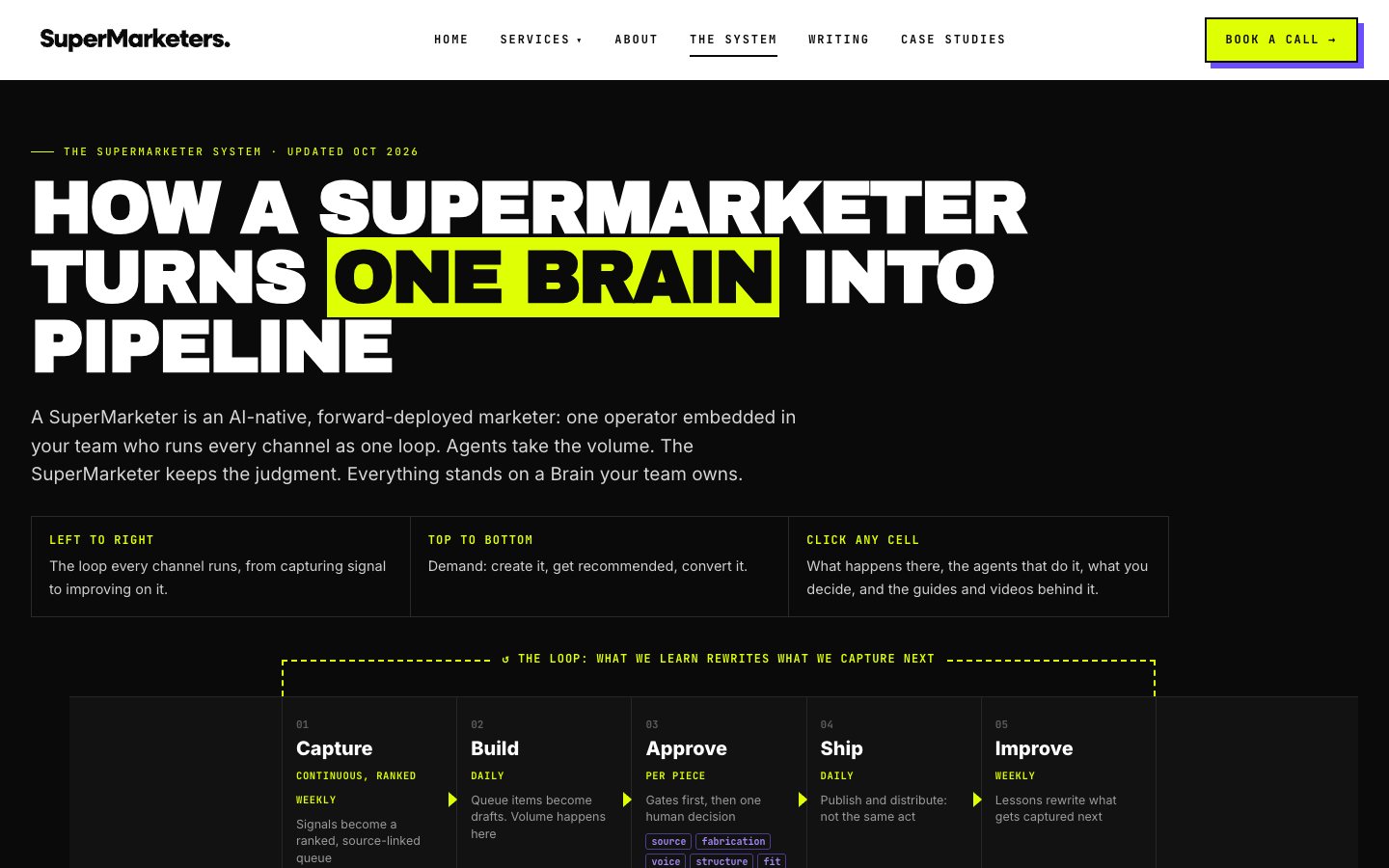
On top of that foundation, every channel runs the same five-stage loop: Capture, Build, Approve, Ship, Improve. You can click through every stage and every agent on the system map, and read the actual files in the open-source repo.
How to do agentic marketing, step by step
This is the build order I use with every client. It avoids rework, because each step depends on the one before it. Do them in order and don't skip ahead.
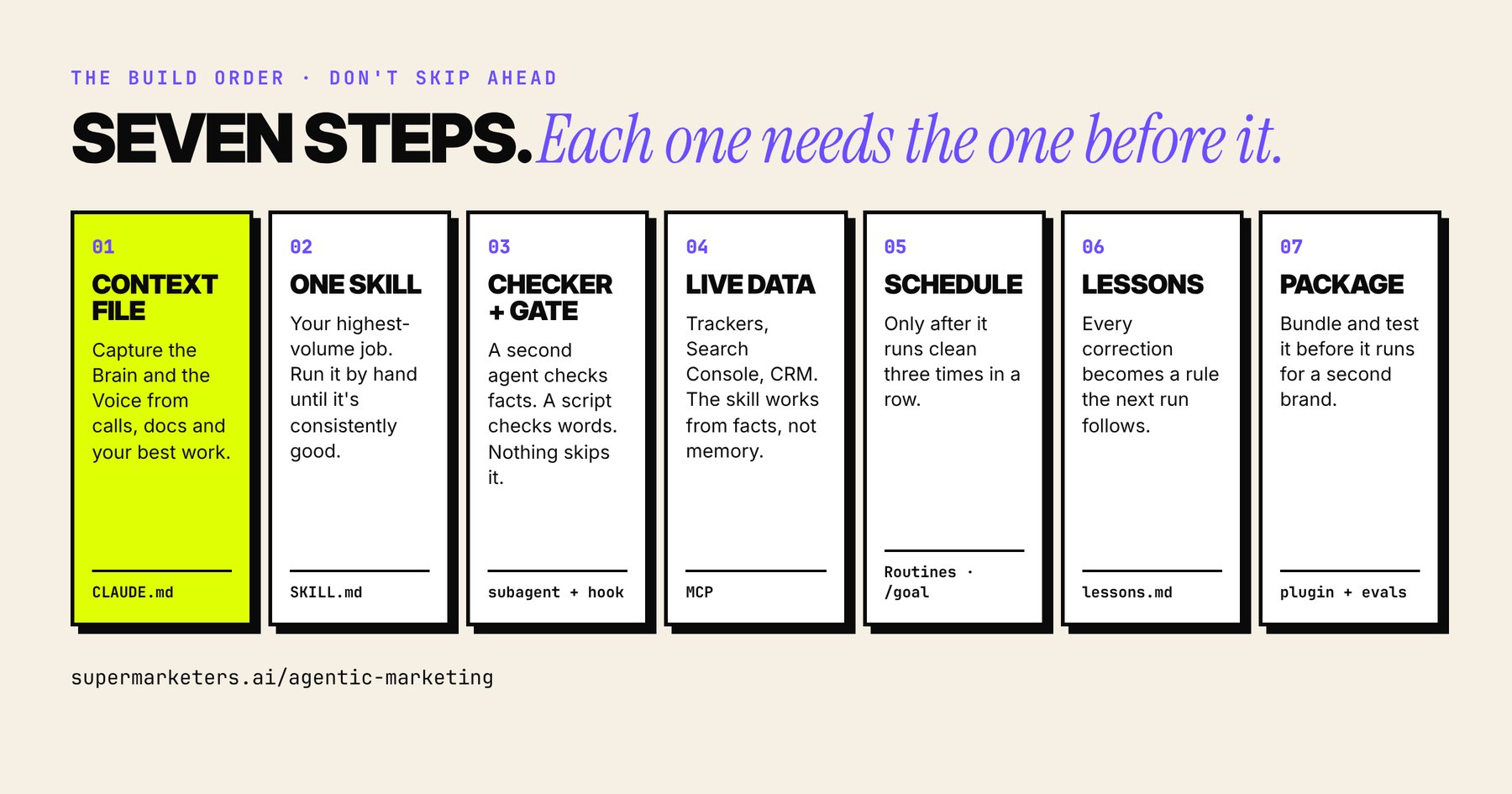
Step 1: Write the context file first
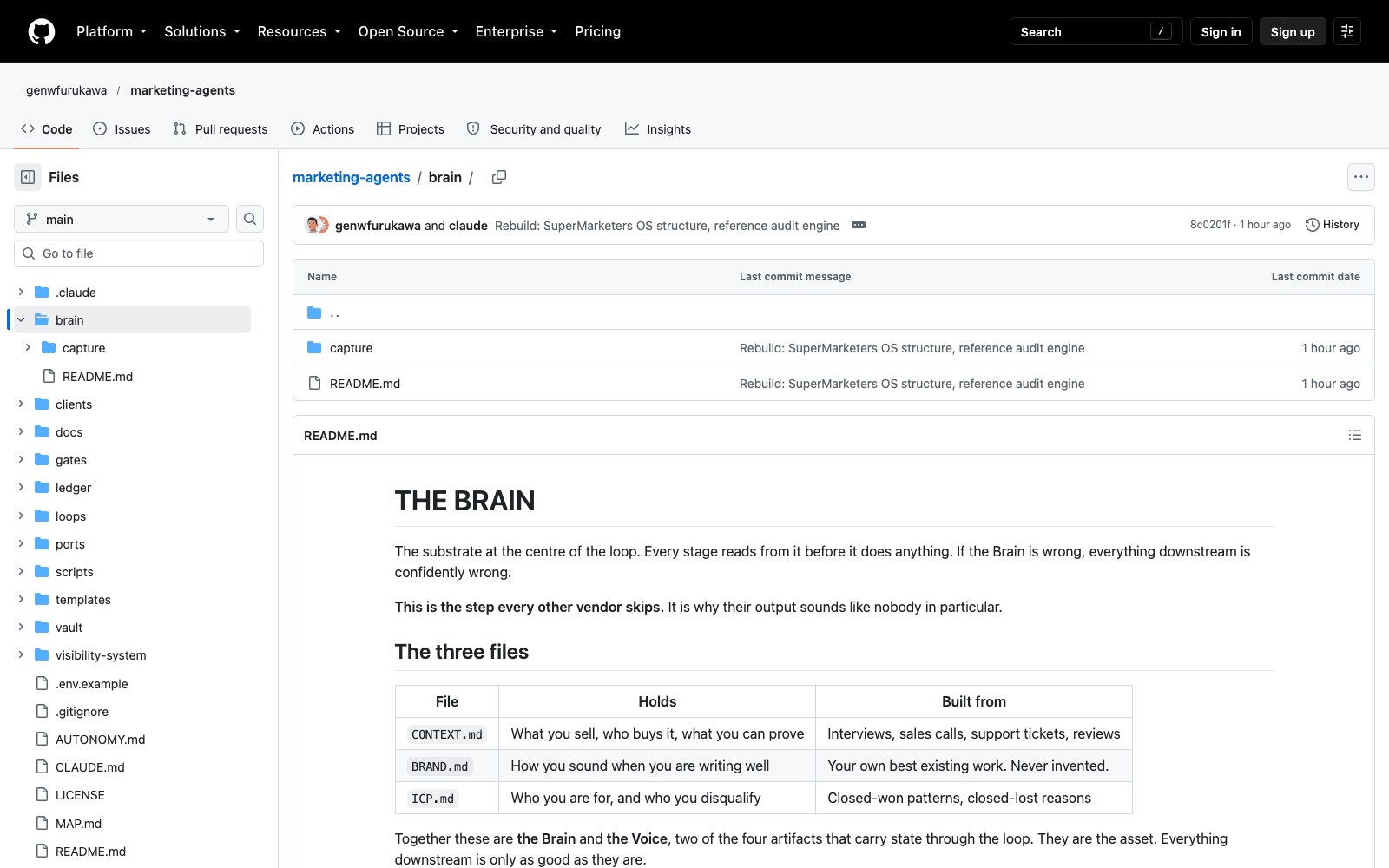
Before any agent writes anything, it needs to know who you sell to, what you believe, how you sound and where your sources live. That's the Brain. Skip it, and every agent improvises, and everything downstream ends up confidently wrong.
Don't brief it from scratch. Capture it: interview the founder, read sales calls, support tickets and reviews, and pull what the team already published. With Talkadot, we started from one strategy doc, nine articles the cofounder had written and one industry report. That became the brain, the voice guide, the query bank and the data layer before we wrote a single new page.
Organize it in three folders any AI can use, then put one routing line in CLAUDE.md, the file Claude Code reads at the start of every session:
# CLAUDE.md
Read brain/icp.md, brain/positioning.md and config/voice-guide.md
before you write anything in our voice. The voice guide wins over
every other style note.
Every claim, number and quote must trace to a file in brain/sources/.
If it doesn't, mark it [CHECK] and don't invent one.
Never publish, send email or change ad spend without my approval.
With Oyster, consolidating product, brand, legal and positioning facts into one knowledge base came before touching a single page. It was the least glamorous step and the highest-leverage one: it turned a positioning change into one operation instead of forty.
If you don't have a Brain yet, this prompt builds the first version from what you already have:
Read everything in brain/sources/: sales call transcripts, support tickets,
our best posts, the strategy doc. Build three files:
brain/icp.md (who buys, in their exact words, with the file each quote came from),
brain/positioning.md (what we believe, each point with its proof file),
brain/questions.md (every question a buyer asked, in their words, ranked by how
often it comes up and how close it is to a purchase).
Don't invent anything. Mark gaps [CHECK]. Stop after the top 10 questions
and ask me to approve them before you continue.
Step 2: Build one skill for your highest-volume job
A skill is a folder with a SKILL.md file that Claude loads when the job comes up, or when you type /skill-name. One skill, one job, one output format. Chain skills; don't stuff everything into one.
Pick the job you repeat most. For most B2B SaaS teams, that's an AI visibility audit or a content refresh. Not sure which? Ask Claude:
List every marketing task I did in the last two weeks: [paste].
Score each 1 to 5 on how often it repeats, whether it uses data from a tool,
and how much judgment the final call needs. Rank them. The best first agent
job repeats weekly, uses real data and needs judgment only at the end.
Recommend one, and say what "done" looks like as something a script could check.
Then write the steps the way you'd train a new hire. Save it as .claude/skills/page-refresh/SKILL.md:
---
name: page-refresh
description: Refresh an existing page so AI engines can extract and
  cite it. Use when asked to refresh, update or optimize a page.
---
1. Read the page and the buyer questions it should answer (brain/questions.md).
2. Put a 40 to 60 word direct answer under each question heading.
3. Add an FAQ from real sales-call questions. No invented questions.
4. Cite a source in brain/sources/ for every number.
5. Output: the revised page, plus a change log of what moved and why.
Then run it by hand until the output is consistently good. This is where your taste goes into the system. Every time you fix a draft, ask why, and write the answer into the skill.
Step 3: Add a checker and a gate
The agent that did the work never gets to declare it done. Add a separate checker subagent with different instructions, and often a cheaper model:
---
name: fact-checker
description: Checks a draft against brain/sources/. Use after any draft.
tools: Read, Grep, Glob
model: haiku
---
For every claim, number, name and quote in the draft, find the source
file that supports it. Return a table: claim, source, pass or fail.
Fail anything you can't trace. Don't rewrite the draft.
Then make the gate hard to skip. Banned words, em dashes and broken links go to a script, because AI checkers miss words. In my own system, an AI checker once passed a draft that contained a phrase on its own banned list. A Claude Code hook runs your script every time Claude writes or edits a draft, so nothing reaches you without passing it. This goes in .claude/settings.json:
{
  "hooks": {
    "PostToolUse": [
      {
        "matcher": "Write|Edit",
        "hooks": [
          { "type": "command",
            "command": "python3 \"$CLAUDE_PROJECT_DIR\"/gates/check_draft.py --hook" }
        ]
      }
    ]
  },
  "permissions": {
    "deny": ["Bash(git push:*)"]
  }
}
The script reads one banned list, then flags em dashes, hedges, figures with no source, leftover [CHECK] markers, and answers longer than 60 words under a question heading. When it exits with code 2, Claude sees the findings and fixes the draft itself. Here it is on a deliberately bad draft:
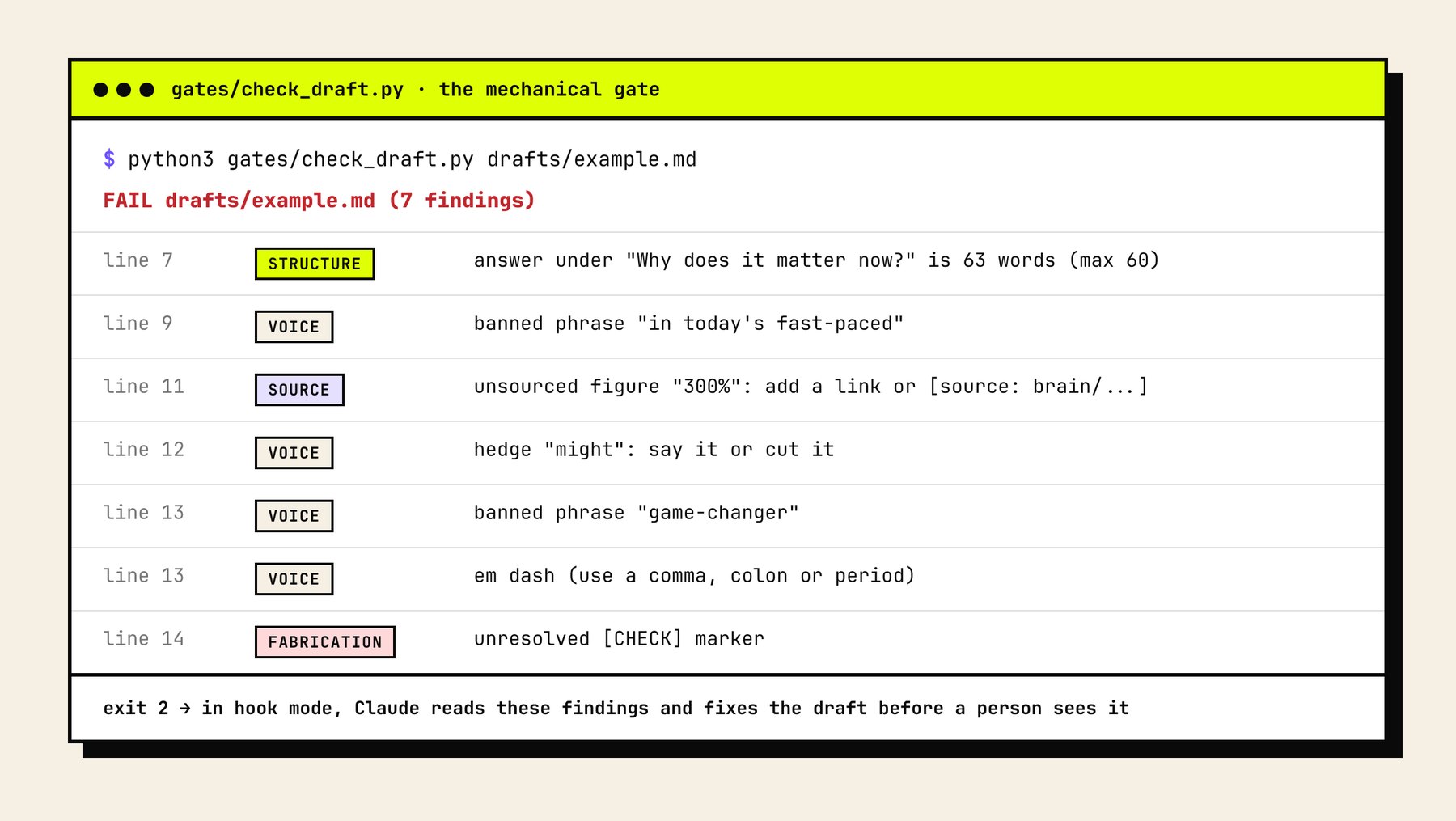
My six gates run in this order: source (every claim traces to the Brain), fabrication (no invented numbers, names or quotes), voice, structure, fit (it serves the buyer, not only reach) and risk (legal and competitive claims go to a named owner). Then one person decides.
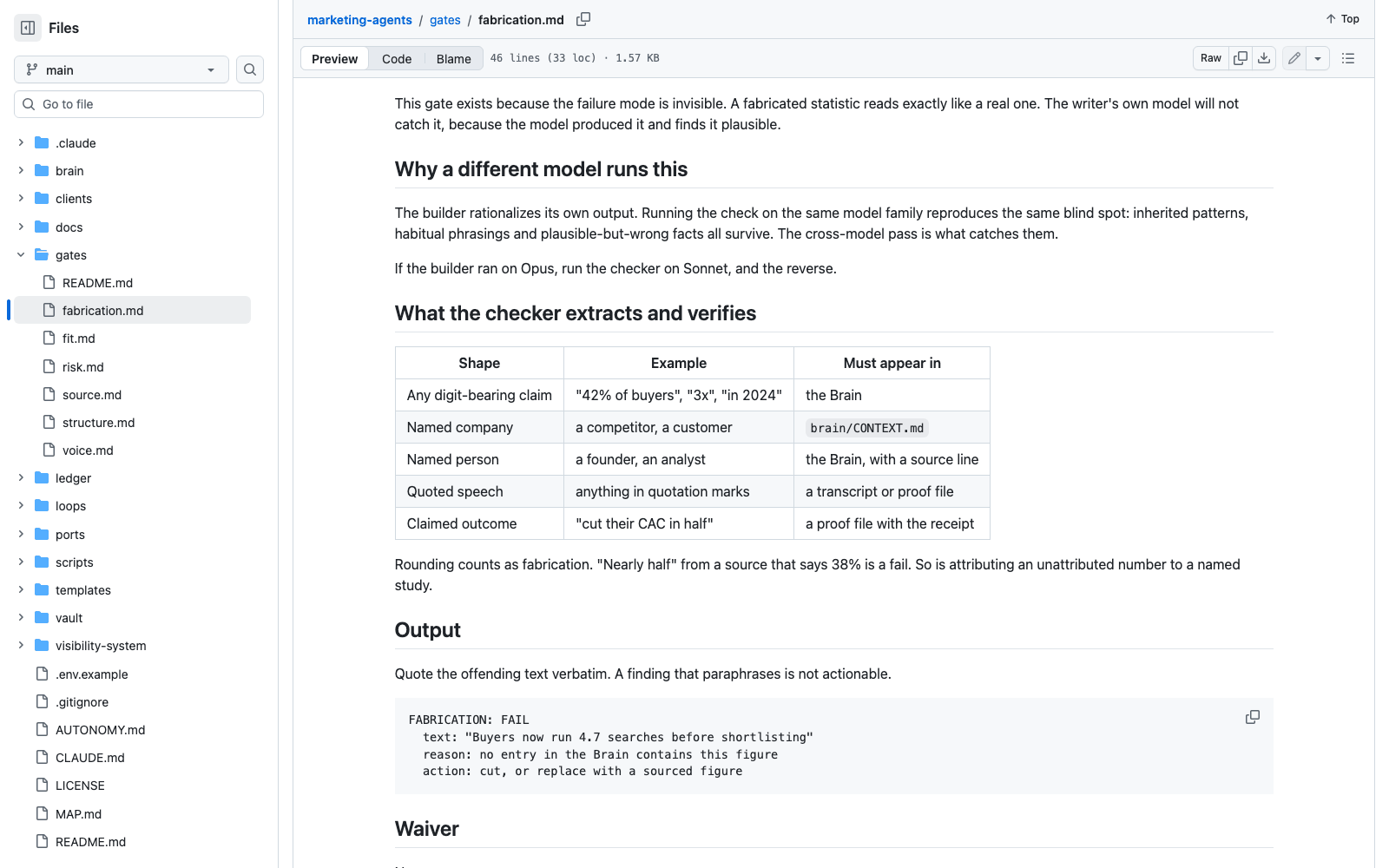
The gates catch the typos and made-up stats, so your review time goes to judgment.
Step 4: Connect live data through MCP
An agent working from memory guesses. An agent working from your data reports. MCP connectors give Claude your AI visibility tracker, Search Console, GA4, CRM and docs, so the skill works from facts. Adding one is a single command:
claude mcp add --transport http notion https://mcp.notion.com/mcp
claude mcp list
This is where agentic marketing starts finding work you didn't list. With Oyster, connecting tracked prompts and their sub-queries made citation rate a real metric per page, market and topic. It surfaced a core commercial topic sitting near a 5% citation rate: a reason buyers choose Oyster, where Oyster was almost never the answer. That became a scoped workstream instead of a hunch.
With Intryc, the data set the backlog. The priority list was every tracked buying prompt where AI named a competitor and not Intryc. That gap is finite and countable, so the agents always knew what to work on next. Here's the prompt that builds that backlog from your tracker data:
From this week's AI visibility data, list every tracked buying prompt where an
AI engine names a competitor and doesn't name us. For each one: the prompt, the
engine, which competitor, which source the engine cited, and the page of ours
that should answer it (or "no page"). Sort by how close the prompt is to a
purchase. This is the backlog. Don't propose new topics outside it.
Step 5: Put it on a schedule once it runs clean three times
Don't schedule anything you'd still babysit. Once a skill and its gate run clean three times in a row, move it to a schedule. Pick the scheduler by where the files live and whether your laptop will be open:
| Scheduler | Runs where | I use it for |
|---|---|---|
/loop | Inside an open session only | Polling rankings or an inbox while I work |
| Desktop scheduled tasks | My machine, awake | Jobs that need local files or my notes vault |
| Routines | Anthropic's cloud, laptop closed | The weekly AI answer round, the daily changed-page check, the monthly buyer-question pass |
| Cowork scheduled tasks | The desktop app, no terminal | Recurring reports and briefs for teammates who don't code |
Give every loop a stopping condition a script can check. "Improve the page" never ends. "Keep going until every page scores 90+ on the rubric and every claim passes the fact-checker" does. That's what /goal is for:
/goal Refresh every page in brain/refresh-queue.md with /page-refresh.
Done when every draft in drafts/ passes python3 gates/check_draft.py with
exit code 0 and the fact-checker returns PASS for each one. Don't publish.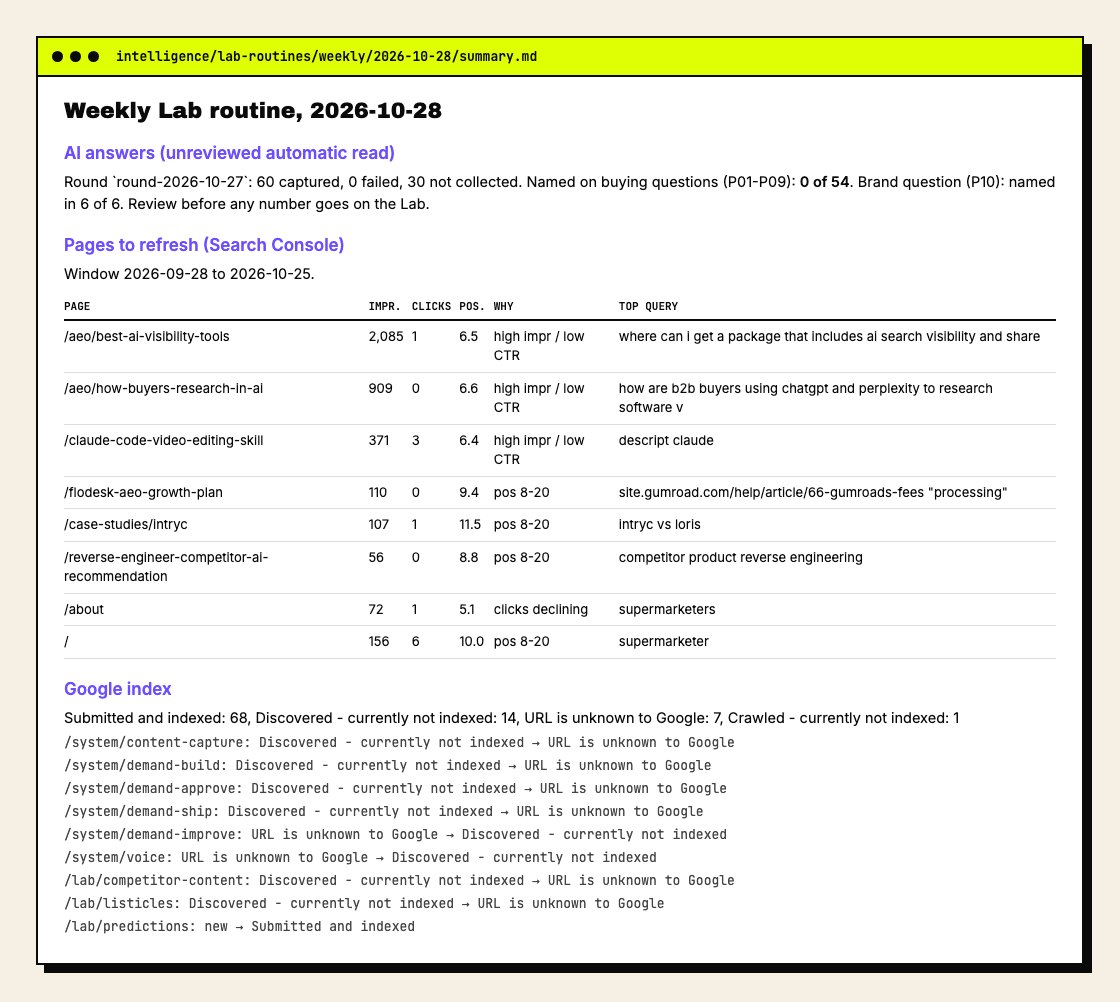
Once agents run unattended, turn on the safety controls: auto mode, permission rules that block publishing and sending, and the sandbox. Publishing, sending email and spending ad budget always stay behind a person.
Step 6: Add the lessons file
This is the step that makes the system compound. Every time someone corrects a draft at the gate, log the old line, the new line and the rule it shows. Feed that back into the skills and the voice guide.
My own voice guide is built mostly from those corrections, and it's why my drafts stopped drifting. The Voice works the same way for clients: extracted from their best writing and sales calls, then written down as rules every draft is checked against. Keep a lessons file per client, and read it before you change a skill. This prompt does the logging:
Here's your draft and the version I approved: [paste both].
List every change I made. For each one, write the rule it shows, with the
reason and the before and after. Add them to lessons.md with today's date.
Then tell me which skill or voice-guide section each lesson should change,
and propose the exact edit.
Step 7: Package it, test it, install it
When a system works for one brand, bundle its skills, subagents, hooks and connectors as a Claude Code plugin. Test it with claude plugin eval before you install it for a client, the same way you'd test code. That's how one system runs across several clients without drifting.
This step is optional if you only market your own company. It's required if you run agents for anyone else.
How to run it: the weekly rhythm
Building is the easy part. Running it every week is where the results come from. Each stage of the loop has its own cadence:
| Stage | Cadence | Agents do | You do |
|---|---|---|---|
| Capture | Continuous, ranked weekly | Scan AI engines, sales calls, competitors and analytics; turn signals into a ranked, source-linked queue | Pick what gets made this week |
| Build | Daily | Turn queue items into drafts, refreshes, clips and reports | Add the insight only you have |
| Approve | Per piece | Run the six gates | Make the final call on every piece |
| Ship | Daily | Publish, update the ledger, link from pages that already rank | Distribute. Posting and replying stay human |
| Improve | Weekly | Compare results to the baseline, write the Monday report | Decide what changes next |
My Monday looks like this: open the agent view, read the report the weekend routines wrote, approve or kill the queue, and spend my real time on the two or three pieces that need my judgment.
Two habits keep it healthy. Run /usage monthly and prune skills, plugins and connectors that burn limits without paying back. And skim the Claude Code changelog weekly, because it ships almost daily, and a new feature often replaces a workaround you built.
How to grow it: a 30/60/90 plan
You become good at agentic marketing by shipping one real system and hardening it. Touring every feature won't get you there. Each phase ends with a gate. Don't start the next phase until you pass it.
- Capture the Brain and the Voice
- Write CLAUDE.md
- Build 3 skills by hand
- Connect data through MCP
- Add the checker subagent
- Hook the gate before publish
- Schedule it with a routine
- Tune cost with
/usage
- Add a second channel to the loop
- Run a workflow for bulk audits
- Package it as a plugin with evals
- Write down the playbook
Growth comes from the loop. Here's what that looked like for three clients:
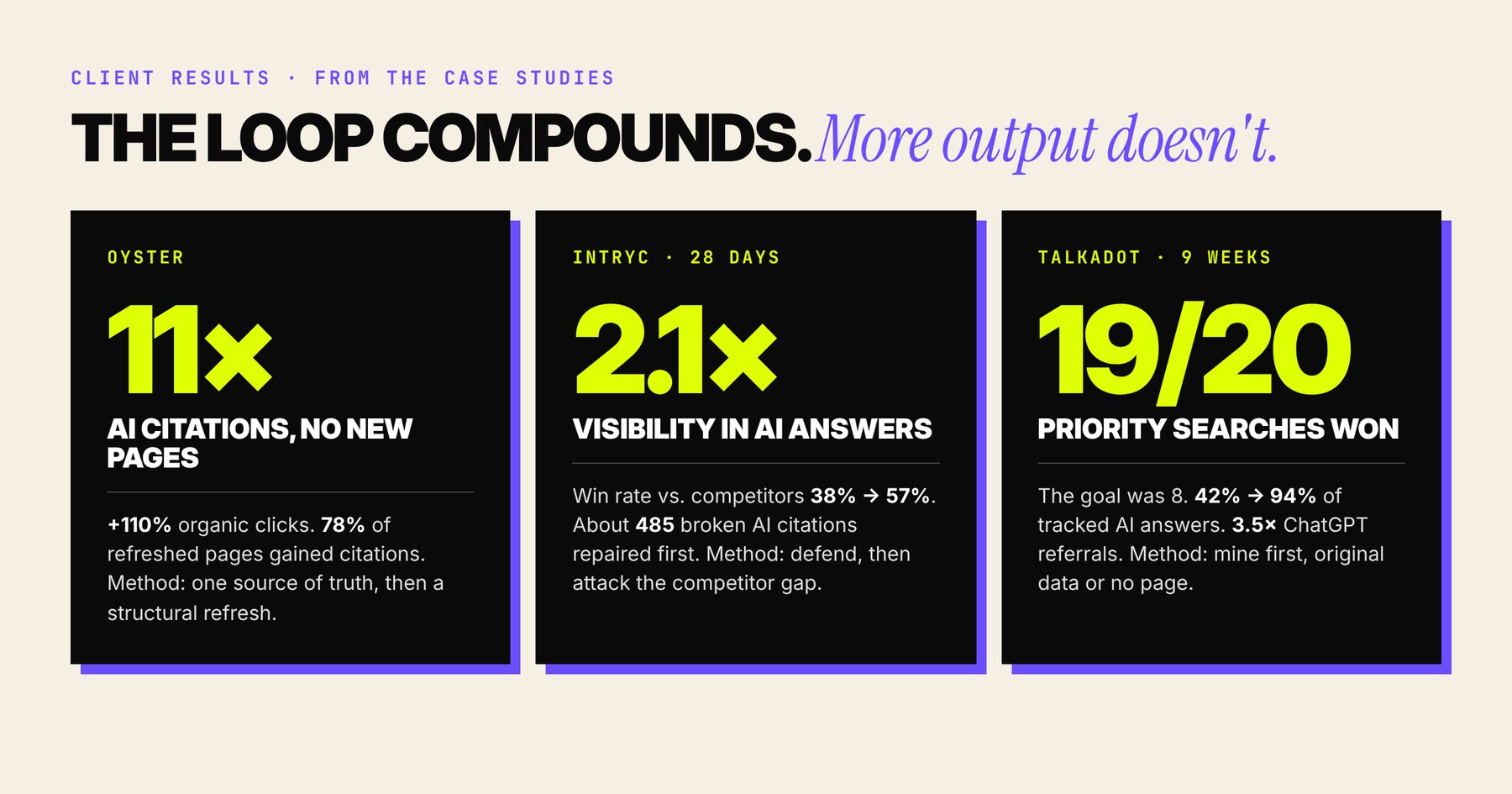
- Oyster grew by refreshing pages it already had: 11× more AI citations, +110% organic clicks, and 78% of refreshed pages gained citations. The first step was a single source of truth for product, legal and positioning facts. That turned a positioning change into one operation instead of forty.
- Intryc doubled its AI visibility in 28 days by defending existing citations first, then attacking every prompt where a competitor showed up and Intryc didn't. Its win rate against key competitors went from 38% to 57%.
- Talkadot set a goal of showing up in 8 of 20 priority searches. It won 19 of 20 in 9 weeks, went from 42% to 94% of tracked AI answers, and saw 3.5× more ChatGPT referral traffic. Every page used Talkadot's own data or was clearly the cofounder's opinion.
In all three, agents measured, found the gap and did the repetitive fixes. A person made the calls.
Where Claude Code fits, and where it doesn't
Use Claude Code when the job combines structured data, real tools and repeatable logic. Use the writing surfaces when the output is a document a person will edit. The handoff that works: build and run the system in Claude Code, publish the human-facing output as a doc, deck or dashboard, and let the client redline it in Word.
| Surface | Best for in marketing | Skip it for |
|---|---|---|
| Claude Code | AI visibility audits, content systems, data pipelines, reporting, site and schema changes, internal tools | One-off drafts you'll rewrite anyway |
| Cowork | Recurring reports, competitor briefs, decks and spreadsheets, daily briefings from email and Slack | Heavy engineering or large repos |
| Claude for Word, Excel, PowerPoint | Redlining proposals and client reports, budget models, turning notes into decks | Anything that runs without a person present |
| Chat and Projects | Brainstorming, quick analysis, one-off copy | Multi-step work that touches your files |
| Agent SDK | Shipping an agent as a product, like a visibility monitor | Personal productivity |
Get the starter kit
Every file in this post, ready to drop into a repo: CLAUDE.md, a Brain template, three skills, the fact-checker and voice-editor subagents, the hook and permission rules, the gate script with a sample draft that fails it, a ledger, a lessons file and eight prompts. MIT licensed.
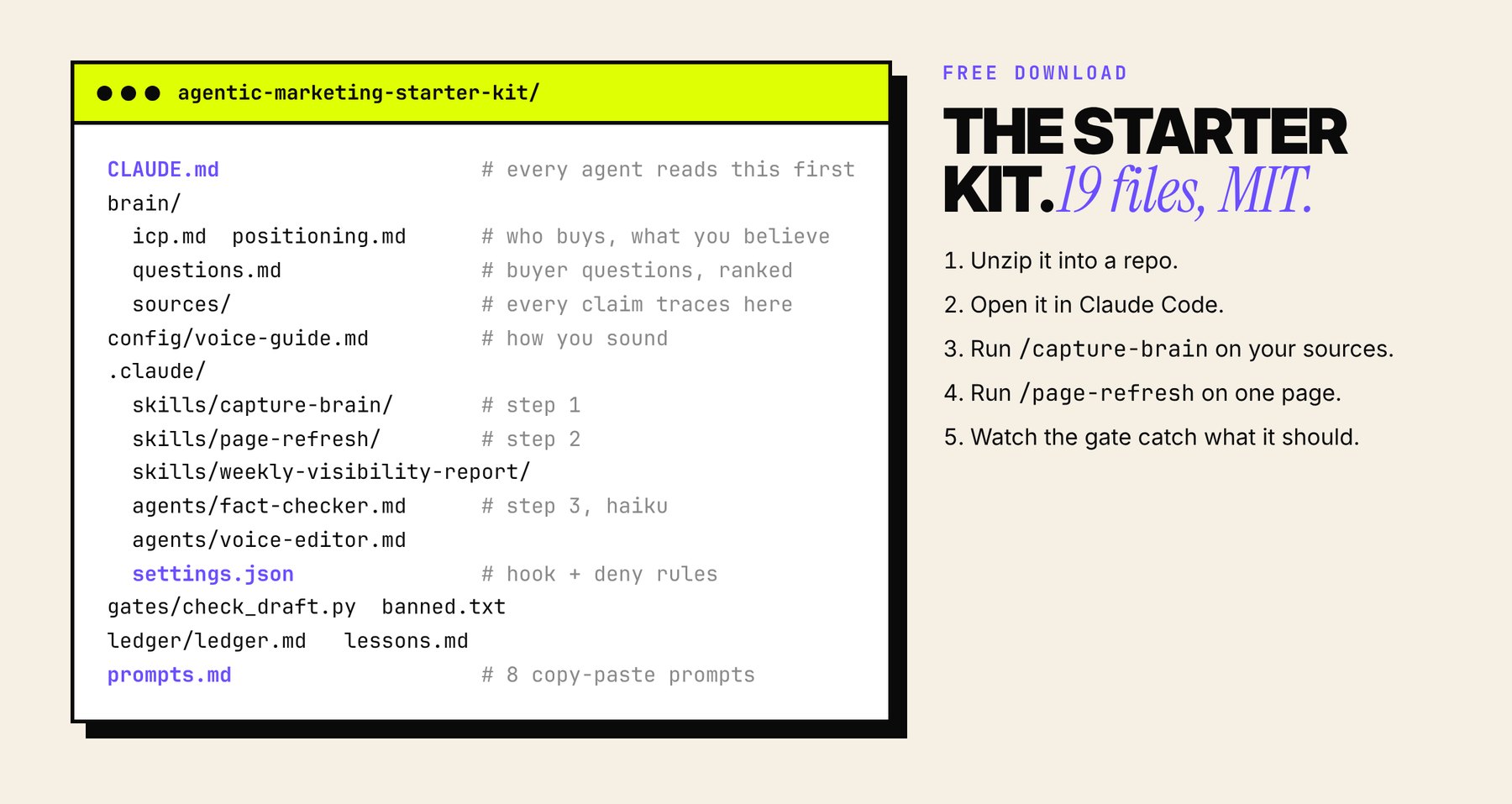
Download the starter kit (.zip) · Read the eight prompts (.txt)
Where to go next
Everything above is public. Start here:
- The marketing-agents repo: the full version of the starter kit, with the Brain, the Gates, the Ledger and a loop per channel. Here's a walkthrough if you've never opened GitHub.
- The system map: every channel, stage and agent on one page.
- Loop engineering: how to write a goal an agent can finish, plus a free skill for Claude Code.
- The free AI visibility check: see where you stand before you build anything.
How SuperMarketers runs this for clients
I'm one operator embedded in your team, running every channel as one loop. In month one, I capture your Brain and Voice from your founder, sales calls and best work, and set up the gates. From then on, agents take the volume across content, AI search, social and demand gen, and I keep the judgment. The Brain, the skills and the ledger live in your repo, and you keep them. It's $5,000 a month, month to month.
FAQ
What's the difference between agentic marketing and marketing automation?
Marketing automation runs a fixed script, like "send email 2 three days after email 1." An agent reads the current state and chooses its next action. It can find work you didn't list, skip what's already handled and stop when a goal is met.
Do I need to code to do agentic marketing?
No. Skills, CLAUDE.md and subagents are plain-text files. Cowork runs scheduled tasks without a terminal. You'll get further in Claude Code, but you don't need to write software to start.
What should I automate first?
The job you repeat most that already has data behind it. For B2B SaaS, that's usually an AI visibility audit or a weekly report. Avoid starting with net-new content: it needs the most judgment and has the most ways to go wrong.
Will agents replace my marketing team?
They replace the volume work. Strategy, positioning, taste, relationships and the final call stay with people. In every client system I run, a person approves every piece before it ships.
How much does it cost to run?
Mostly model usage, and it depends on routing. Put cheap models on volume steps, check /usage monthly, and cut anything that burns limits without paying back.
Start with one loop
Don't try to automate your whole marketing team this month. Pick one job, write the context file, build one skill and one gate, and run it until it's boring. Then schedule it, and pick the next job. If you'd rather have it built and run for you, book a 30-minute call and I'll show you what the first loop would be for your team.