I do not only want to know where a brand ranks in Google anymore.
I want to know where buyers are asking AI systems for recommendations, comparisons, implementation advice, pricing context, and risk evaluation.
That means I need to monitor more than keywords.
I need to monitor buyer prompts.
AI visibility is not only whether a brand appears in an answer. It is whether the brand appears in the right buying moments, near the right competitors, supported by the right sources, with the right sentiment, and attached to a recommendation the buyer can trust.
A buyer does not always ask, “What is the best software in this category?”
Sometimes they ask about alternatives, use cases, risks, pricing, implementation, or which tool is best for their role.
Each of those prompts exposes a different part of the buyer journey.
If I only monitor one or two generic category prompts, I miss the actual market conversation.
The goal is not to “show up in AI”
“Show up in AI” is too vague to be useful.
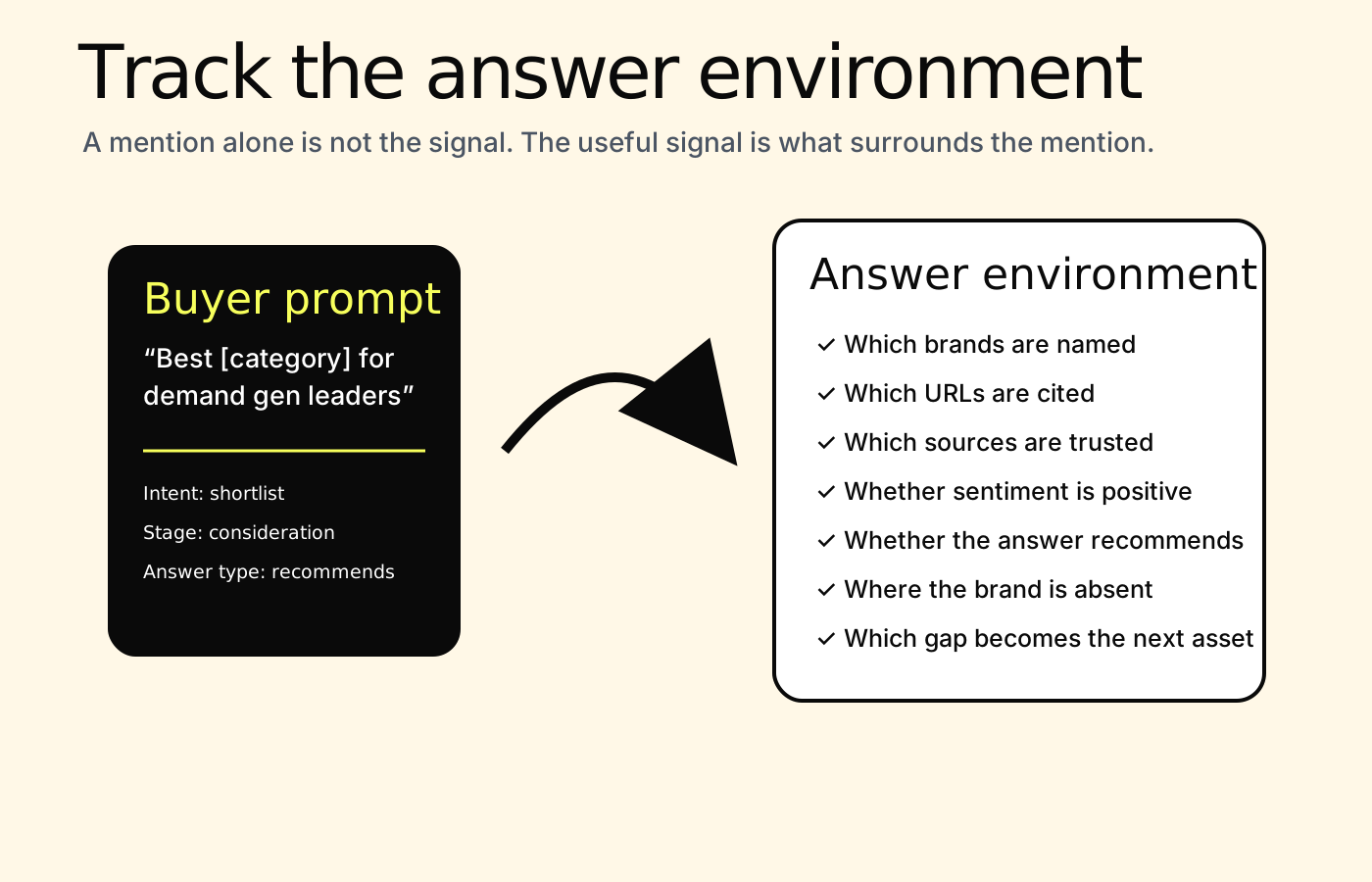
The better goal is to understand the answer environment around a category.
When a buyer asks an AI system for help, the answer engine has to decide which brands to mention, which sources to cite, how to frame the tradeoffs, and whether the answer should recommend, compare, educate, or warn.
That environment is full of signals.
Some signals are obvious, like whether the brand is mentioned.
Others are more important, like which third-party domains keep getting cited and which competitors appear when the brand does not.
The 8 prompt categories I monitor
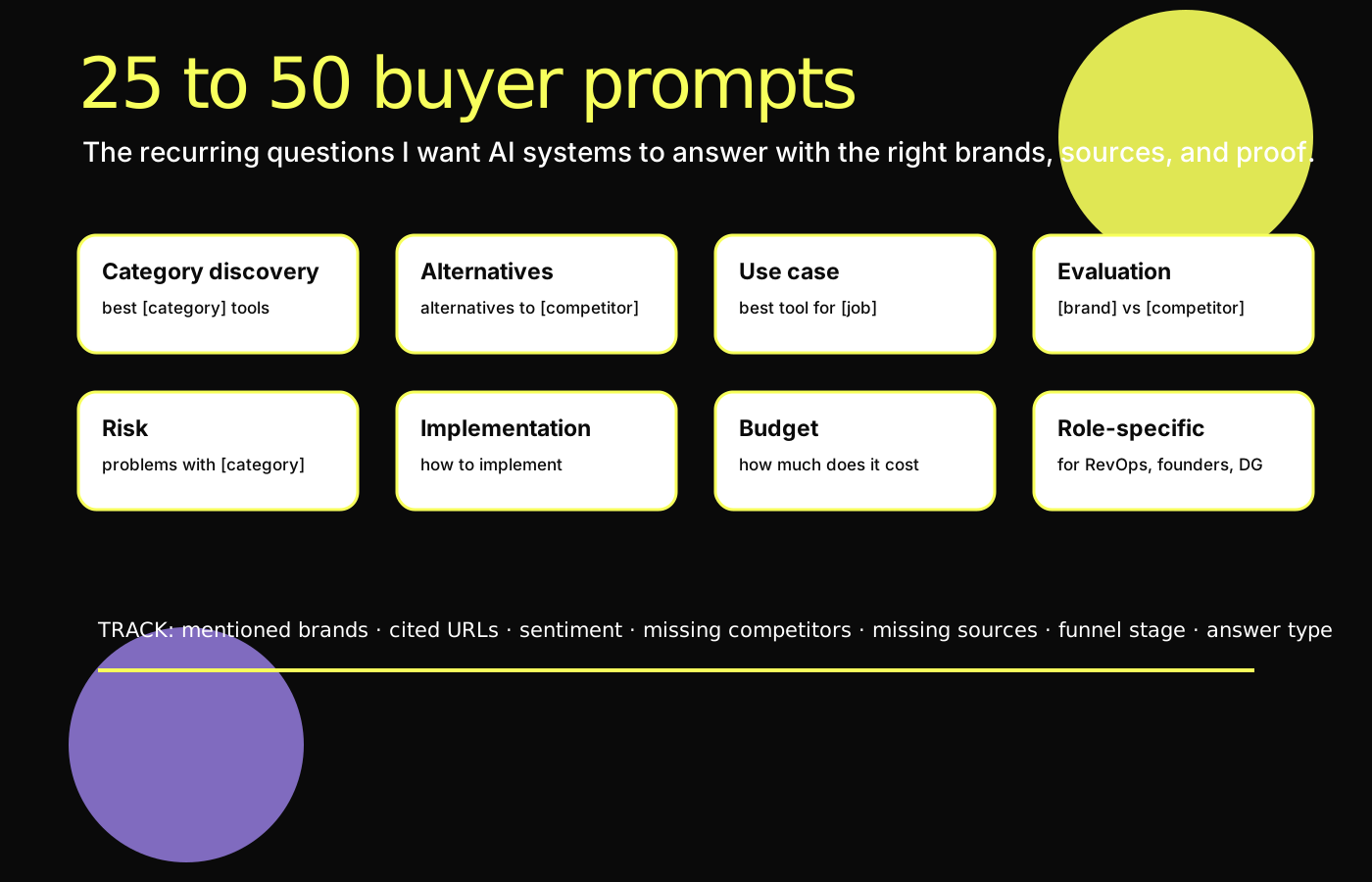
I like to build a recurring set of 25 to 50 buyer prompts across eight categories.
The point is not to create an enormous prompt database that nobody uses.
The point is to create a small, repeatable signal set that teaches me where to act.
| Prompt category | Example prompt | What it tells me |
|---|---|---|
| Category discovery | Best [category] tools for B2B SaaS. | Which vendors AI systems associate with the category. |
| Alternative search | Alternatives to [competitor]. | Whether the brand appears when buyers are replacing a known option. |
| Use-case search | Best tool for [job-to-be-done]. | Whether the brand owns specific workflow and outcome language. |
| Evaluation | [Brand] vs [competitor]. | How answer engines frame direct tradeoffs. |
| Risk | Problems with [category]. | Which objections, warnings, and failure modes shape buyer trust. |
| Implementation | How to implement [category] for a SaaS team. | Whether AI systems trust the brand to explain adoption and rollout. |
| Budget | How much does [category] cost? | Whether pricing and value are clear or being inferred elsewhere. |
| Role-specific | Best [category] for demand gen leaders, RevOps, or founder-led sales. | Whether the brand is associated with the real buying committee. |
What I track for every prompt
I do not stop at “brand mentioned: yes or no.”
That is a useful starting point, but it is not enough to guide content strategy.
For every prompt, I track the full answer environment.
The spreadsheet template I use
The tracker should be boring enough to maintain.
If the template is too complicated, the process dies after one month.
| Field | Example |
|---|---|
| Prompt | Best customer intelligence tools for B2B SaaS demand gen teams. |
| Prompt type | Role-specific plus category discovery. |
| Engine | ChatGPT, Perplexity, Gemini, Claude, Google AI Mode. |
| Date tested | 2026-09-28. |
| Brands mentioned | Brand A, Brand B, Brand C. |
| Cited URLs | Review pages, vendor pages, guides, comparison articles. |
| Cited domains | G2, Capterra, vendor blog, analyst site, community thread. |
| Sentiment | Positive, neutral, negative, mixed, or inaccurate. |
| Funnel stage | Awareness, consideration, decision, implementation. |
| Answer type | Recommends, compares, educates, warns, explains. |
| Brand presence | Mentioned, missing, cited, misrepresented, or recommended. |
| Gap | No comparison page, weak implementation guide, missing third-party mention. |
| Action | Create page, update page, pitch source, add proof, clarify positioning. |
Prompt
Prompt category
Engine
Market or country
Date tested
Brand mentioned?
Brand recommended?
Brand cited?
Competitors mentioned
Cited URLs
Cited domains
Sentiment
Query intent
Funnel stage
Answer type
Missing sources
Content gap
Citation opportunity
Recommended action
Owner
Status
The recurring prompt bank
Here is the starting bank I use before tailoring prompts to a category.
I do not treat these as final prompts.
I treat them as scaffolding that gets rewritten with real buyer language from sales calls, support tickets, search data, communities, competitor pages, and customer conversations.
Category discovery prompts
- Best [category] tools for B2B SaaS.
- Top [category] platforms for SaaS companies.
- What are the best [category] solutions for growing SaaS teams?
- Which [category] tools should a Seed stage SaaS company consider?
- Which [category] tools are best for Series A SaaS companies?
Alternative search prompts
- Best alternatives to [competitor].
- [Competitor] alternatives for B2B SaaS.
- Cheaper alternatives to [competitor].
- Easier-to-implement alternatives to [competitor].
- Alternatives to [competitor] for small marketing teams.
Use-case prompts
- Best tool for [job-to-be-done].
- Best software for improving [specific outcome].
- How can a SaaS team solve [pain point]?
- Tools to help with [workflow].
- Best platform for [specific team process].
Evaluation prompts
- [Brand] vs [competitor].
- Is [brand] better than [competitor]?
- [Brand] compared to [competitor] for B2B SaaS.
- Pros and cons of [brand].
- When should a company choose [brand] over [competitor]?
Risk, implementation, budget, and role-specific prompts
- Problems with [category].
- Common issues with [category] tools.
- Why do [category] implementations fail?
- How to implement [category] for a SaaS team.
- How long does it take to implement [category]?
- How much does [category] cost?
- What is a typical budget for [category] software?
- Best [category] tools for demand gen leaders.
- Best [category] tools for RevOps teams.
- Best [category] tools for founder-led sales.
How I turn gaps into actions
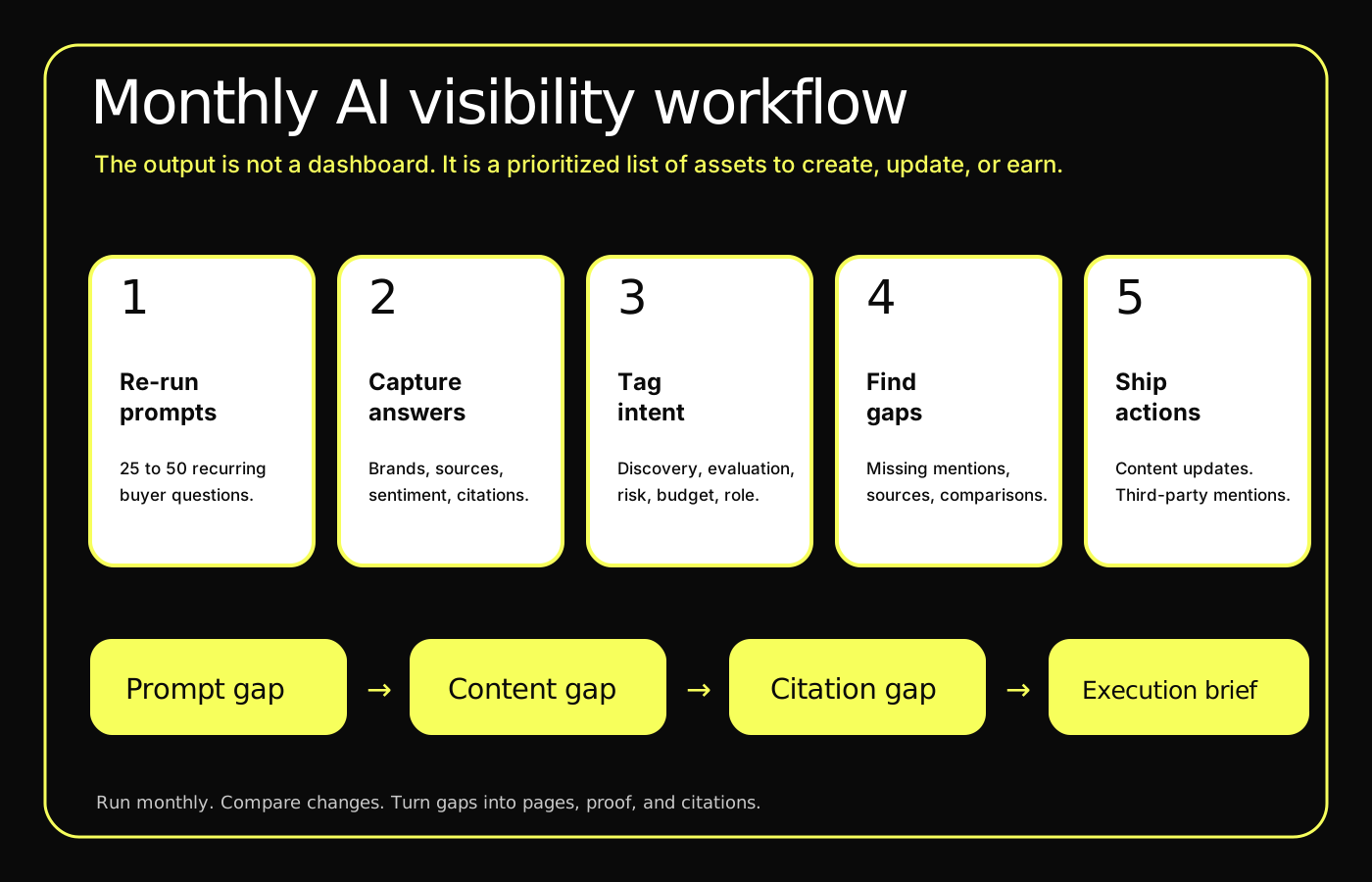
The useful output is not a screenshot of an AI answer.
The useful output is a decision about what to create, update, earn, or clarify next.
| Signal | What it usually means | Action I take |
|---|---|---|
| Competitors are mentioned and my brand is missing. | The answer engine does not associate the brand with that buying context. | Create or improve the relevant comparison, use-case, or category page. |
| Third-party listicles are repeatedly cited. | The category trust layer is outside my website. | Earn legitimate inclusion, update profiles, or create a better independent source. |
| Owned pages appear but sentiment is weak. | The page is crawlable but not persuasive or specific enough. | Add proof, fit boundaries, examples, and clearer differentiation. |
| Risk prompts surface outdated objections. | The market has stale or incomplete information. | Publish a risk, implementation, or objection-handling guide. |
| Implementation prompts cite generic sources. | The brand has not proven operational expertise. | Create implementation playbooks, rollout templates, and customer examples. |
| Pricing prompts rely on review sites. | The pricing page is too vague or missing key facts. | Clarify pricing logic, packaging, contract terms, and cost drivers. |
The content brief template
Every high-priority gap should become a brief.
This keeps AI visibility from turning into a vague research exercise.
Target prompt:
Prompt category:
Buyer intent:
Funnel stage:
Current AI answer summary:
Brands mentioned:
Sources cited:
Current brand presence:
Missing or inaccurate claims:
Content gap:
Citation gap:
Recommended asset:
Direct answer to include in the first 50 to 100 words:
Entities to include:
Proof points:
Internal links:
Third-party citation targets:
Owner:
Due date:
Success metric:
The page template I use for a prompt gap
If the gap calls for owned content, I want the page to answer the prompt directly and then cover the follow-up questions an AI answer engine would need to resolve.
H1: [Buyer question]
Opening answer: [50 to 100 words that directly answer the prompt]
Who this is for: [ICP, company stage, team, use case]
Short answer table: [Options, fit, tradeoffs, proof]
Selection criteria: [What the buyer should evaluate]
Recommended approach: [What I would do and why]
Common risks: [Failure modes and how to avoid them]
Implementation notes: [Timeline, team, systems, dependencies]
FAQs: [Fan-out questions from the prompt set]
Proof: [Customer examples, screenshots, data, quotes, third-party references]
The monthly checklist
This is the checklist I would run once a month.
Prompt coverage
- I have 25 to 50 recurring buyer prompts.
- The prompts cover category discovery, alternatives, use cases, comparisons, risk, implementation, budget, and role-specific searches.
- The prompts reflect actual buyer language, not only internal category language.
- The prompt set includes competitors, jobs-to-be-done, buyer roles, and objections.
Engine testing
- I tested priority prompts in ChatGPT.
- I tested priority prompts in Perplexity.
- I tested priority prompts in Gemini.
- I tested priority prompts in Claude.
- I checked Google AI Overviews or AI Mode where available.
Tracking
- I captured mentioned brands.
- I captured cited URLs and cited domains.
- I tagged sentiment, intent, funnel stage, and answer type.
- I identified prompts where competitors appear and the brand does not.
- I identified repeated third-party sources.
- I flagged answers that misrepresent positioning, pricing, fit, or proof.
Actions
- I identified pages to create.
- I identified pages to update.
- I identified third-party citation opportunities.
- I identified review site or marketplace profile updates.
- I assigned owners and due dates.
- I decided which gaps are not worth acting on yet.
A simple scoring model
I like a simple 10-point score because it is easy to understand over time.
| Factor | Score |
|---|---|
| Brand is mentioned. | 0 to 2 |
| Brand is recommended positively. | 0 to 2 |
| Brand-owned page is cited. | 0 to 2 |
| Trusted third-party page mentions the brand. | 0 to 2 |
| Answer accurately describes positioning. | 0 to 2 |
A score of 0 to 2 means the brand is invisible or misrepresented.
A score of 3 to 5 means the brand is present but weak.
A score of 6 to 8 means the brand is visible and reasonably positioned.
A score of 9 to 10 means the brand has strong visibility, credible citations, and a useful recommendation context.
What most marketers will misunderstand
They will treat AI visibility like another ranking report.
They will ask, “Do we show up?” and stop there.
The better question is, “What does the answer environment teach us about how buyers, competitors, sources, and AI systems understand the category?”
That is where the strategy is.
If AI systems cite the same third-party sources over and over, those sources matter.
If risk prompts surface the same objection repeatedly, that objection needs a better answer.
If implementation prompts cite generic sources, there is an authority gap.
If role-specific prompts ignore the brand, the positioning is not specific enough for that buyer.
What I would do first
I would not start with a 500-prompt audit.
I would start with 25 high-intent prompts that sales, marketing, and customer success all recognize.
I would run them across the major answer engines.
I would capture the citations, competitors, sentiment, and missing sources.
Then I would pick the five highest-value gaps and turn each one into a brief.
The best AI visibility work becomes boring operational discipline.
Monitor the prompts.
Study the answer environment.
Close the content and citation gaps.
Repeat monthly.
Frequently asked questions
What is AI visibility monitoring?
AI visibility monitoring is the recurring process of testing buyer prompts in AI search and answer engines, then tracking which brands are mentioned, which URLs are cited, what sentiment appears, and which content or citation gaps should become the next action.
How many prompts should a B2B SaaS company monitor?
A practical starting set is 25 to 50 recurring buyer prompts across category discovery, alternatives, use cases, direct comparisons, risk, implementation, budget, and role-specific buying situations.
What should I track for each AI prompt?
Track the prompt, engine, date, mentioned brands, cited URLs, cited domains, sentiment, missing competitors, missing sources, query intent, funnel stage, answer type, and recommended action.