A content strategy is the set of decisions that tells you what to publish, for whom, why they should trust it, and how you'll know it helped the business. It isn't a calendar. The calendar says when something ships. The strategy says why it deserves the slot.
This template puts those decisions on one page. Print it, fill it in for one offer, one buyer and one quarter, and you have a strategy you can actually review.
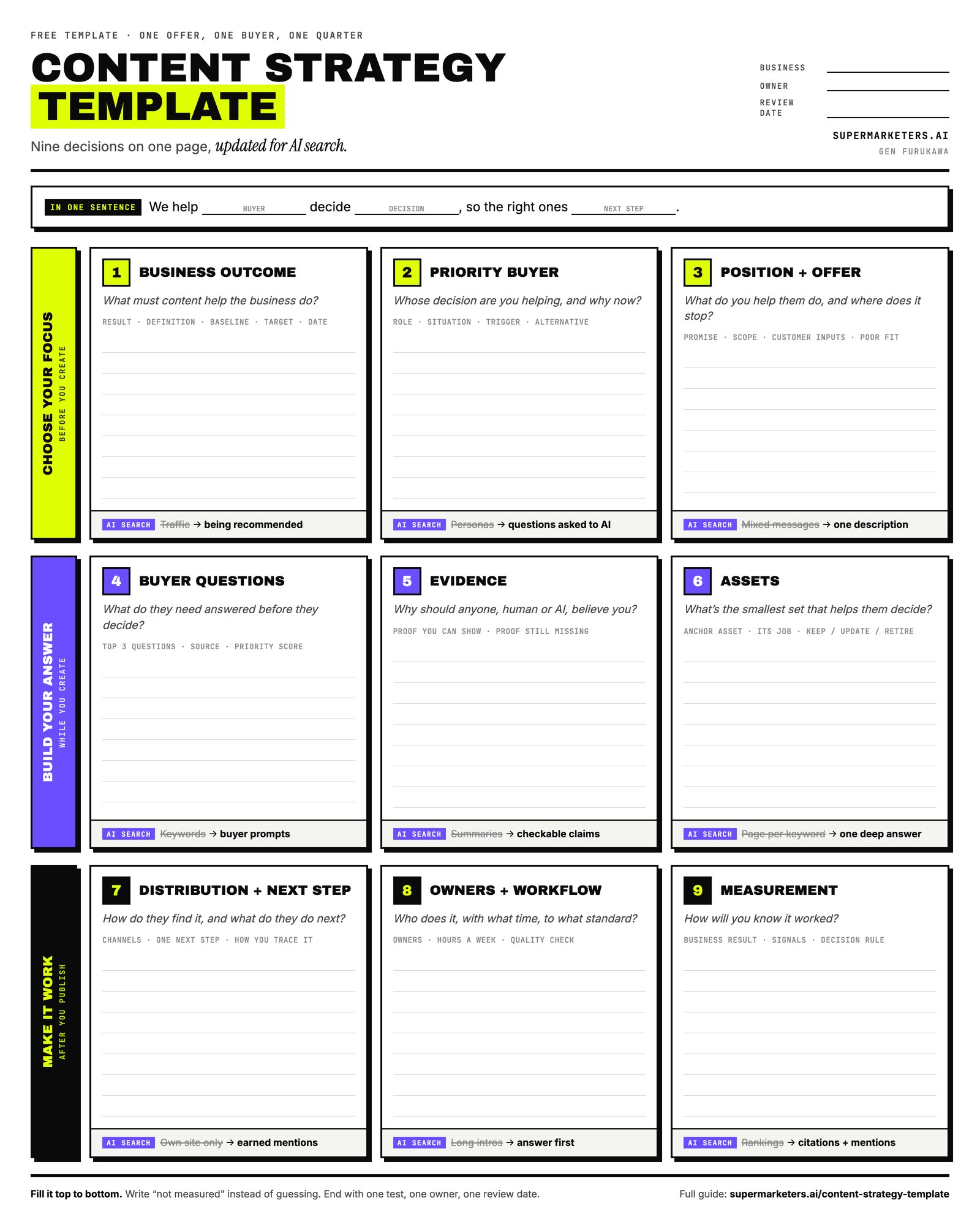
The template at a glance
| Row | Decision | Decision | Decision |
|---|---|---|---|
| Choose your focus before you create | 1 Business outcome What must content help the business do? | 2 Priority buyer Whose decision are you helping, and why now? | 3 Position + offer What do you help them do, and where does it stop? |
| Build your answer while you create | 4 Buyer questions What do they need answered before they decide? | 5 Evidence Why should anyone, human or AI, believe you? | 6 Assets What's the smallest set of content that helps them decide? |
| Make it work after you publish | 7 Distribution + next step How do they find it, and what do they do next? | 8 Owners + workflow Who does it, with what time, to what standard? | 9 Measurement How will you know it worked? |
Fill it top to bottom. Row 1 decides everything below it. Most teams start in row 3 ("we should post more on LinkedIn") and work backwards to a reason.
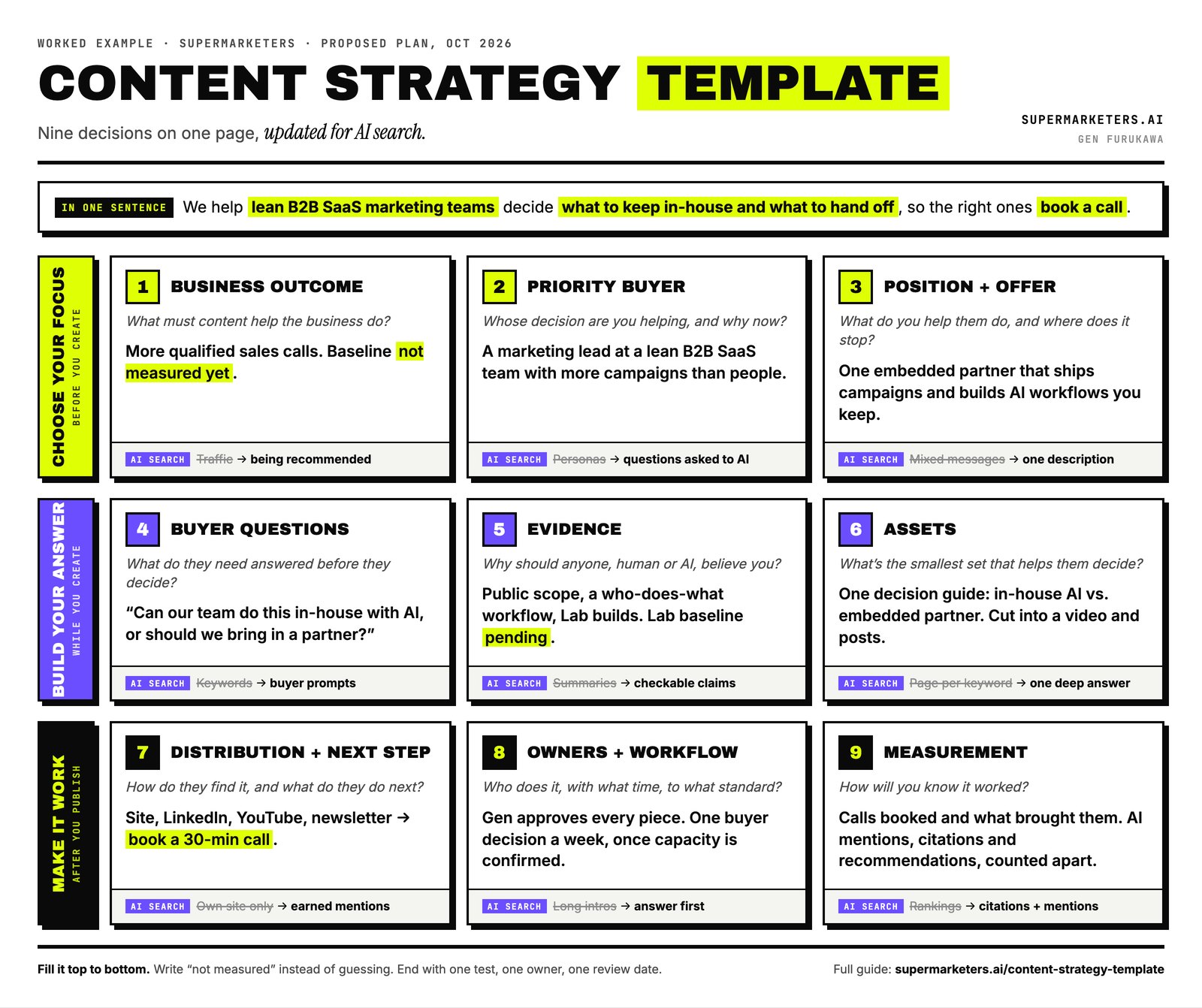
A filled-in example
Here's the template with my own proposed plan for SuperMarketers. It's a plan, not reported results: the baseline isn't measured yet, so there's no target on it.
How to fill it in (45 minutes)
- Pick the scope. One offer, one priority buyer, one quarter. A sheet that covers every audience decides nothing.
- Gather what you have. Recent sales calls, customer questions, existing pages, Search Console.
- Row 1 (about 10 minutes). Outcome, buyer, offer.
- Row 2 (about 15 minutes). Questions, evidence, assets.
- Row 3 (about 10 minutes). Distribution, owners, measurement.
- Mark the gaps. Write "not measured" instead of guessing, and underline every assumption.
- End with one test, one owner and one review date.
That's a planning estimate, not a benchmark. Research takes longer.
Fill it in by talking it out with Claude
Typing into nine boxes is slow. Talking is faster, and a good interviewer catches the vague answers. Paste this prompt into Claude, switch on voice mode, and answer out loud. It asks one question at a time, pushes back on "more leads," marks what you don't know instead of guessing, and writes up the page at the end.
Interview me to fill in a one-page content strategy. I'm answering out loud, so keep every turn short: one question at a time, under 40 words, no lists until the end.

The page has nine boxes in three rows.
Row 1, Choose your focus (before we create):
1. Business outcome: what must content help the business do?
2. Priority buyer: whose decision are we helping, and why now?
3. Position + offer: what do we help them do, and where does it stop?
Row 2, Build your answer (while we create):
4. Buyer questions: what do they need answered before they decide?
5. Evidence: why should anyone, human or AI, believe us?
6. Assets: what's the smallest set of content that helps them decide?
Row 3, Make it work (after we publish):
7. Distribution + next step: how do they find it, and what do they do next?
8. Owners + workflow: who does it, with what time, to what standard?
9. Measurement: how will we know it worked?

How to run it:
- Start by asking which business, which offer, which buyer and which quarter. Keep it to one of each.
- Go box by box, in order. Ask the box's question, then one follow-up if my answer is vague.
- Push back on generic answers like "more leads" or "B2B companies". Ask me to pick one.
- For each box, ask one AI search question too. Examples: "Which of these would a buyer type into ChatGPT?" (box 4), "Where else on the web would an AI read about us?" (box 7).
- If I don't know, write "not measured" or "assumption" and move on. Never invent a number, a customer or a result.
- After each row, read back the three answers in one sentence each and ask if they're right.

When we finish, write it up:
1. The nine boxes, each answered in 20 words or fewer.
2. The strategy in one sentence: "We help [buyer] decide [the decision], so the right ones [next step]."
3. The assumptions I should check, as a list.
4. One test to run first, with an owner and a review date.

Start now with your first question.
If you already use the 1-Page Marketing Plan
This template borrows its shape from Allan Dib's 1-Page Marketing Plan: nine boxes, three rows, filled in order. His rows follow the customer (before they're a prospect, while they're a lead, after they buy). These rows follow the content (before you create it, while you create it, after you publish it).
The two fit together. Your marketing plan says who you sell to and how the sale happens. The content strategy fills in what content does at each step:
| 1-Page Marketing Plan square | Where it lives in the content strategy |
|---|---|
| 1 My target market | 2 Priority buyer |
| 2 My message to my target market | 3 Position + offer, backed by 5 Evidence |
| 3 The media I will use | 7 Distribution |
| 4 My lead capture system | 7 Next step |
| 5 My lead nurturing system | 6 Assets (the ones that teach and prove) |
| 6 My sales conversion strategy | 4 Buyer questions + 6 Assets (the decision guide sales sends) |
| 7, 8, 9 Customer experience, lifetime value, referrals | Out of scope here; customer stories from them feed 5 Evidence |
If you've filled in the marketing plan, you've already answered boxes 2, 3 and part of 7. Start there.
The rest of this guide goes box by box: what to write, my answer, and what AI search changed.
How to create a content strategy, box by box
Row 1: Choose your focus
1. Business outcome
Pick the one business result content should help produce this quarter. Write a definition, a baseline, a target and a date.
"More leads" leaves room for a very cheerful dashboard. "Qualified conversations" is better, but it still needs a definition: the right kind of company, a real need, someone who can move the decision forward.
If you don't have a baseline, measuring it is your first task. Give it an owner and a date instead of decorating the page with a target you can't defend.
Add one leading signal you can move this week. Revenue is the score. You can't move the score directly, so you track what comes before it.
My plan: qualified conversations with B2B SaaS marketing teams about content and AI search. The baseline isn't measured yet, so the 90-day target waits until it is.
What AI search changed: "more traffic" is a weaker goal than it was. When Google showed an AI summary, people clicked a regular result on 8% of visits, against 15% when it didn't (Pew Research Center, July 2025). Ahrefs' re-run puts the click loss for a top-ranking page at 58% when an AI Overview appears (Ahrefs, Feb 2026). The goal becomes being the answer AI recommends, tied to pipeline you can count.
2. Priority buyer
A job title is thin. Write the situation: the trigger that makes the problem urgent now, the constraint, the alternative they're considering, and who signs off.
A marketing lead who needs a launch out the door has different questions from a founder still checking whether anyone wants the product. Use their words from sales and customer calls. Search data can confirm demand. It can't tell you the buying situation.
Write down who the plan is not for. It's the fastest way to stop the strategy from drifting.
My plan: a marketing lead at a lean B2B SaaS team with more campaigns than people to ship them. They have paying customers, an expert to learn from, and someone who can approve the work. Their alternative is keeping it in-house and using Claude or ChatGPT to go faster. Not for: teams still looking for a product people want.
What AI search changed: the useful version of a persona is now the full question your buyer types into ChatGPT, constraints included. "Best content agency" became "we're a 12-person SaaS team with one marketer, should we hire an agency or use AI?" That's box 4.
3. Position + offer
Write what you help this buyer do, the alternative they'd choose instead, and why your approach might fit. Then write the scope, what the customer has to bring, and when you're a poor fit.
Positioning gets useful when it helps someone rule you out. A comparison that gives your own service full marks in every row is a brochure wearing a spreadsheet.
End the box with one sentence you want AI to repeat about you. Then use those same words everywhere: your site, LinkedIn, profiles, directories.
My plan: "One embedded partner that ships your campaigns and builds the AI workflows your team keeps." A Foundation month, then any of four kinds of work (Content, AI Search, Social & Video, Demand Gen), from $5,000 a month. The client brings expertise and approval. Poor fit: a team that already has the time, the skills and an owner. They should do it in-house.
What AI search changed: AI engines describe you from everything they read about you. If your homepage, LinkedIn and directory listings all say something different, the model averages them. I wrote about why consistent descriptions matter in AI search.
Row 2: Build your answer
4. Buyer questions
This is the box most strategies skip, and the one AI search made essential.
List the questions that change the buyer's decision. Start with the ones closest to your offer and backed by evidence:
- sales and support calls
- Search Console, especially long queries (six or more words read like questions people asked an AI)
- the follow-up questions AI engines suggest
- Reddit, communities, review sites
Then score them. A simple first pass: buyer fit, business relevance and available proof, 0 to 2 each, plus effort as low, medium or high. The score organizes your judgment. It doesn't prove demand.
My plan: the lead question is "Can our team do this in-house with AI, or would an embedded partner help?" Search Console gave me 389 distinct questions in four weeks to check it against. Score: fit 2, relevance 2, proof 1, so 5 of 6 at medium effort. The offer fits; the proof still needs building. I wrote up how I choose which buyer prompts to track separately.
What AI search changed: a keyword list becomes a prompt bank. Keywords told you what people typed into a search box. Prompts tell you what they asked a model that answers back. You re-run the same set in ChatGPT, Gemini, Perplexity and Google's AI answers on a schedule, and that becomes part of your scoreboard (box 9).
5. Evidence
For each important answer, write down the proof you can actually show: a documented process, a demo, a worked example, a customer result you have permission to use, original research with a method.
Keep a claim ledger: claim, source, owner, date checked, limitation. If a claim is a hypothesis, label it. If the evidence is missing, narrow the claim or assign the research.
My plan: the public service scope, a who-does-what breakdown of an AI-assisted workflow, and builds done in the open in the Lab. What's missing: the Lab's 10 buyer questions are chosen and frozen, but the baseline is still pending. It can't support an improvement claim yet, so I don't make one.
What AI search changed: rewriting the top ten results used to be a strategy. An AI engine can now write that summary itself, so it has no reason to cite yours. What earns a citation is information it can't get elsewhere: first-party data, named examples, tests with dates, a named expert explaining the reasoning and its limits.
6. Assets
Choose the smallest set of content that helps the buyer understand, compare and act.
Audit what you already have first. For each relevant page: its purpose, whether it's still accurate, its next step, and a decision to keep, update, combine or retire it. Improving an existing page often beats writing a new one.
Give every piece one job. Most B2B content does one of four:
- Validate the fear. Name what's actually causing the problem.
- Show the gap. Make the problem visible and specific to the reader.
- Teach the fix. Give the method away. It builds trust faster than promising it.
- Prove it works. Before and after, with receipts.
If a piece has no job, don't make it.
My plan: one anchor asset, a decision guide comparing an in-house AI workflow with an embedded partner, including a responsibility checklist and a worked scope. It links to the existing AI-search posts and the service page. A video walkthrough and a few LinkedIn posts cut from it, each adding something for its channel instead of repeating the intro four times.
What AI search changed: one page per keyword is out. Google says AI Overviews and AI Mode may use "query fan-out": they run multiple related searches across subtopics, then build one answer (Google Search Central). You get cited by covering the decision deeply enough to answer the follow-up questions too. Give a question its own page only when that page is useful on its own.
Row 3: Make it work
7. Distribution + next step
Decide how the buyer will find each asset before you make it. Pick a few realistic routes: owned (site, newsletter, YouTube), social (for B2B, usually LinkedIn), earned (other people's sites, podcasts, lists, reviews), and sales conversations already underway.
Give each asset one next step that fits its job, and write the full path: content, then what, then what, then the sale. Someone still evaluating should be able to keep learning. Someone ready should find the next step without hunting through the footer.
Ask every new inquiry what brought them. Attribution will stay incomplete. Writing that down beats pretending every sale has one clean cause.
My plan: the guide lives on the site, with cuts on LinkedIn, YouTube and the newsletter, and it gets used in sales calls where the question already came up. Path: guide, then proof or the service page, then a 30-minute call.
What AI search changed: the earned line used to be "nice to have PR." Now it's half the job. Muck Rack's analysis of more than 25 million links cited by ChatGPT, Claude and Gemini found 84% came from earned media (Muck Rack, May 2026; a PR-software vendor, so read it with that in mind). In Ahrefs' study of 75,000 brands, mentions on YouTube and across the web correlated far more strongly with AI visibility than backlinks did: about 0.74 for YouTube mentions against 0.18 to 0.29 for backlinks (Ahrefs, Dec 2025). That's correlation, not proof. Earn mentions where your buyers actually read. Don't manufacture them.
Two more things changed here. Some buyers now arrive already sold by an AI answer: on Ahrefs' own site, AI search sent 0.5% of visitors and 12.1% of signups over 30 days (Ahrefs, June 2025; one site, one month). The page they land on has to close, not re-explain the category. And check access. OpenAI runs a separate crawler for ChatGPT search. In its own words: "OAI-SearchBot is used to surface websites in search results in ChatGPT's search features," while GPTBot crawls content for training, and "each setting is independent of the others" (OpenAI, Overview of OpenAI Crawlers). So you can allow search and block training in robots.txt. Letting a crawler in creates the chance to be cited. It doesn't buy one.
8. Owners + workflow
Put names and hours behind the plan: strategy owner, subject expert, production, reviewer, publisher. One person can hold several roles. Each role still needs an owner, and someone has final approval.
Estimate capacity before promising a cadence. Count research, expert time, writing, editing, design, distribution and maintenance. The first draft has a habit of borrowing time from every other step. When the plan exceeds capacity, cut the number of assets before you cut the quality of the evidence.
Give each piece a short brief (buyer decision, outcome, evidence, asset, next step, owner, due date) and a publish check (accuracy, sources, links, voice, the answer up front).
My plan: I own strategy and final approval. Production and expert fact-check owners still need assigning. AI agents assist with research and drafting, and a person checks every piece before it ships. The proposed pilot is one buyer decision a week, and capacity gets confirmed before that becomes a promise.
What AI search changed: AI engines pull passages, not pages, so long intros cost you. Put the answer in the first two sentences, use headings that match the question, and keep important information in text, not only in an image or video. Schema helps machines read a page; it won't save a page with nothing worth citing (why schema won't save you). Google settles the markup question for its own AI features: "Structured data isn't required for generative AI search, and there's no special schema.org markup you need to add." The same page says you don't need llms.txt or other "AI text files," because "Google Search itself doesn't use them" (Google Search Central, Optimizing your website for generative AI features, updated July 10, 2026). Keep using schema for rich results; just don't expect it to earn a citation.
Refresh on a rule, not a whim. Across 17 million citations, AI assistants cited pages that were on average 25.7% newer than Google's organic results (Ahrefs, July 2025). That means real updates when the facts change. A new date on an unchanged page doesn't count.
9. Measurement
Start with the business outcome. Then add diagnostics: whether the right people find the work, use it and take the next step. Page views, watch time and impressions help explain what happened. They aren't reasons to make more of something on their own.
Write decision rules before you see the numbers:
- The right people arrive but don't continue: fix the answer or the next step.
- Sales finds it useful but nobody sees it: fix distribution before rewriting.
- It attracts the wrong people: go back to boxes 2 and 4.
Review production weekly and commercial results monthly, over a window that matches your buying cycle. One quiet week proves nothing.
My plan: qualified conversations and what people say brought them, first. Then the path from guide to service page to booking, and each post's Search Console numbers 28 days after it ships. Here's a full example of that 28-day read: a page Google showed 6,303 times that got 1 click.
What AI search changed: rankings and sessions don't tell you whether AI recommends you. Count three things separately:
- A mention: the answer names you.
- A citation: the answer links to your page.
- A recommendation: the answer actively suggests you.
An answer can contain one without the others. Record the prompt, engine, date, settings and the full saved answer. Then run it more than once: SparkToro found less than a 1 in 100 chance that ChatGPT or Google's AI gives the same list of brands in any two responses (SparkToro, Jan 2026). Track how often you appear across many runs, not your rank in one.
The platforms now report some of this too. Search Console's generative AI performance report shows impressions in AI Overviews and AI Mode, rolled out to all sites on August 31, 2026; values it can't show export as zeros, so don't read those as real zeros (Search Console Help). Bing Webmaster Tools reports how often Copilot and Bing's AI summaries cite your pages, from a sample (Bing, Feb 2026). Impressions and citations still aren't conversions. My prompt tracking guide covers the method.
And keep it in proportion: citations aren't customers. AI visibility sits next to qualified conversations on the scoreboard, never in place of them.
The strategy in one sentence
When the nine boxes are filled, compress them into one line at the top of the page:
We help [buyer] decide [the decision], so the right ones [next step].
Mine: we help lean B2B SaaS marketing teams decide what to keep in-house and what to hand off, so the right ones book a call.
If you can't write the sentence, one of the boxes is still vague. Go find it.
Where most companies need to update for AI search
You don't need a new strategy. AEO updates nine defaults; it doesn't replace SEO. Each row has a check you can run today, most in under ten minutes.
| Box | Stop | Start | Check it today |
|---|---|---|---|
| 1 Outcome | Chasing traffic | Getting recommended, tied to booked calls | Ask ChatGPT your top buyer question. Are you named? |
| 2 Buyer | Persona docs | The full question they type into AI | Write your buyer's question in 20 words, constraints included. |
| 3 Offer | Different words on every page | One description, everywhere | Put your homepage, LinkedIn and G2 one-liners side by side. Do they match? |
| 4 Questions | A keyword list | A prompt bank of buying decisions | Write 10 prompts and run each in ChatGPT and Perplexity. |
| 5 Evidence | Summaries of what already ranks | Claims with a source, a date and a name | Open your best page. Does every number have a source? |
| 6 Assets | One page per keyword | One deep answer, follow-ups included | Note the follow-ups AI suggests. Does your page answer them? |
| 7 Distribution | Your own site only | Mentions on the sites AI cites | List the sites an AI answer cites. Are you on any? Is OAI-SearchBot allowed in robots.txt? |
| 8 Workflow | Long intros | The answer in the first two sentences | Read your top page's opening. Does it answer the question? |
| 9 Measurement | Rankings and sessions | Mentions, citations and recommendations, counted apart | Run one prompt five times. How often are you named? |
If you only do three, do 4, 7 and 9. They tell you where you stand, and the other six are guesses until you know.
Your next step
The page is done when it tells you what deserves the next hour of work. Download the template, fill in row 1 this week, and write one test with an owner and a review date.
If you'd rather work through it with someone, bring your next campaign to a 30-minute call. We'll go through the nine boxes for your team and what to keep in-house.