This week I asked Gemini a simple question while logged out, the way a buyer might: what is SuperMarketers, what does it do, who is it for, and who runs it?
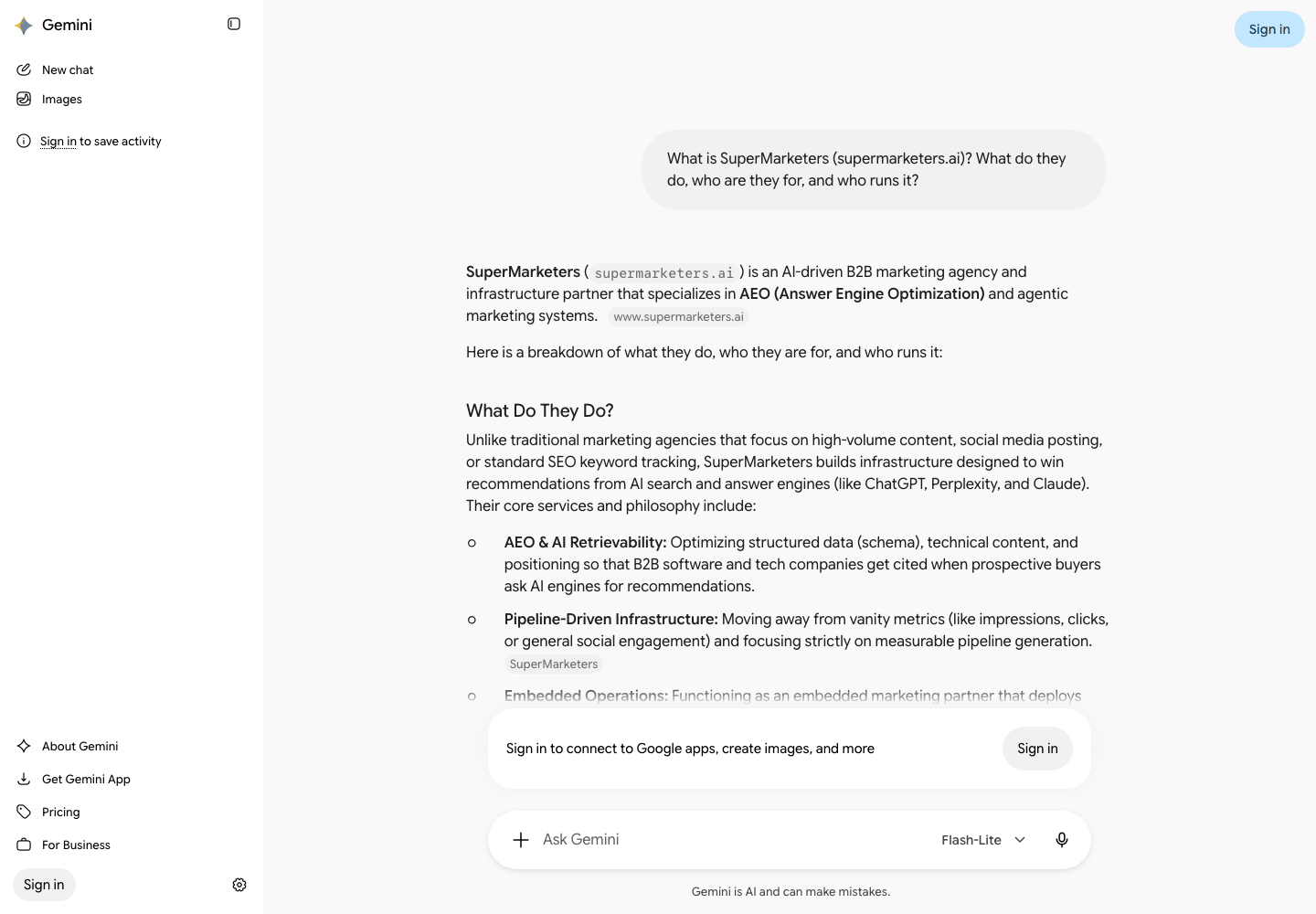
The answer was confident and well organized, and it described a company I stopped being months ago. Gemini called SuperMarketers an agency that "specializes in AEO (Answer Engine Optimization)" for companies that are "at least Series A-ish in maturity," and said we're "not built for pre-Series-A startups." None of that is invented. It's all stuff I said, on my own website, back in May and June.
The irony is hard to miss. My homepage in May had two words on it in very large type: "be the answer."
Three versions of SuperMarketers in five months
I pulled the old versions of my homepage out of the site's history so I could see exactly what I'd been telling the internet.
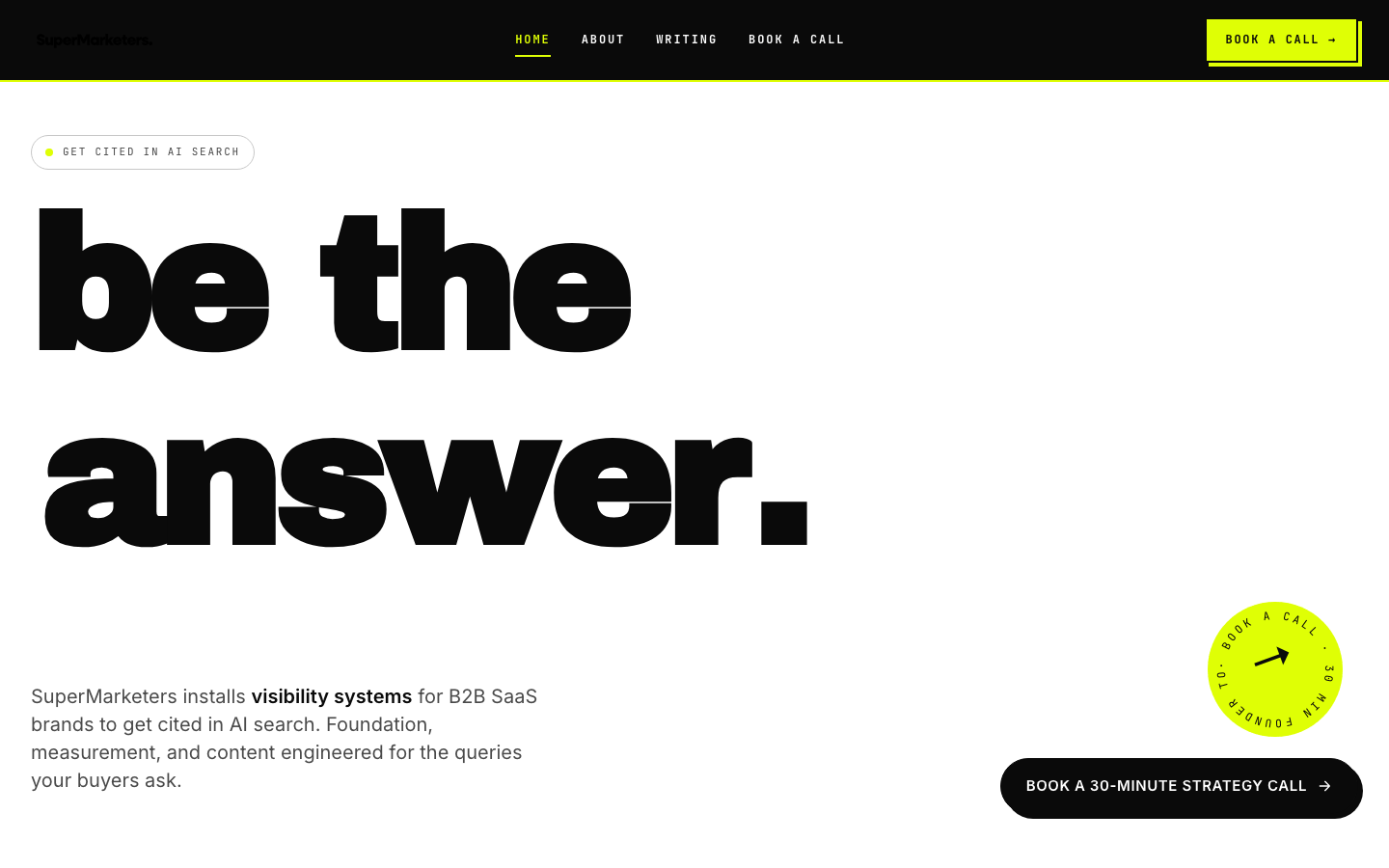
In May, the page title was "Install the visibility system for B2B SaaS," and the description said SuperMarketers "installs AEO visibility systems for Series A B2B SaaS brands." The structured data I gave search engines called it "AEO-native content."
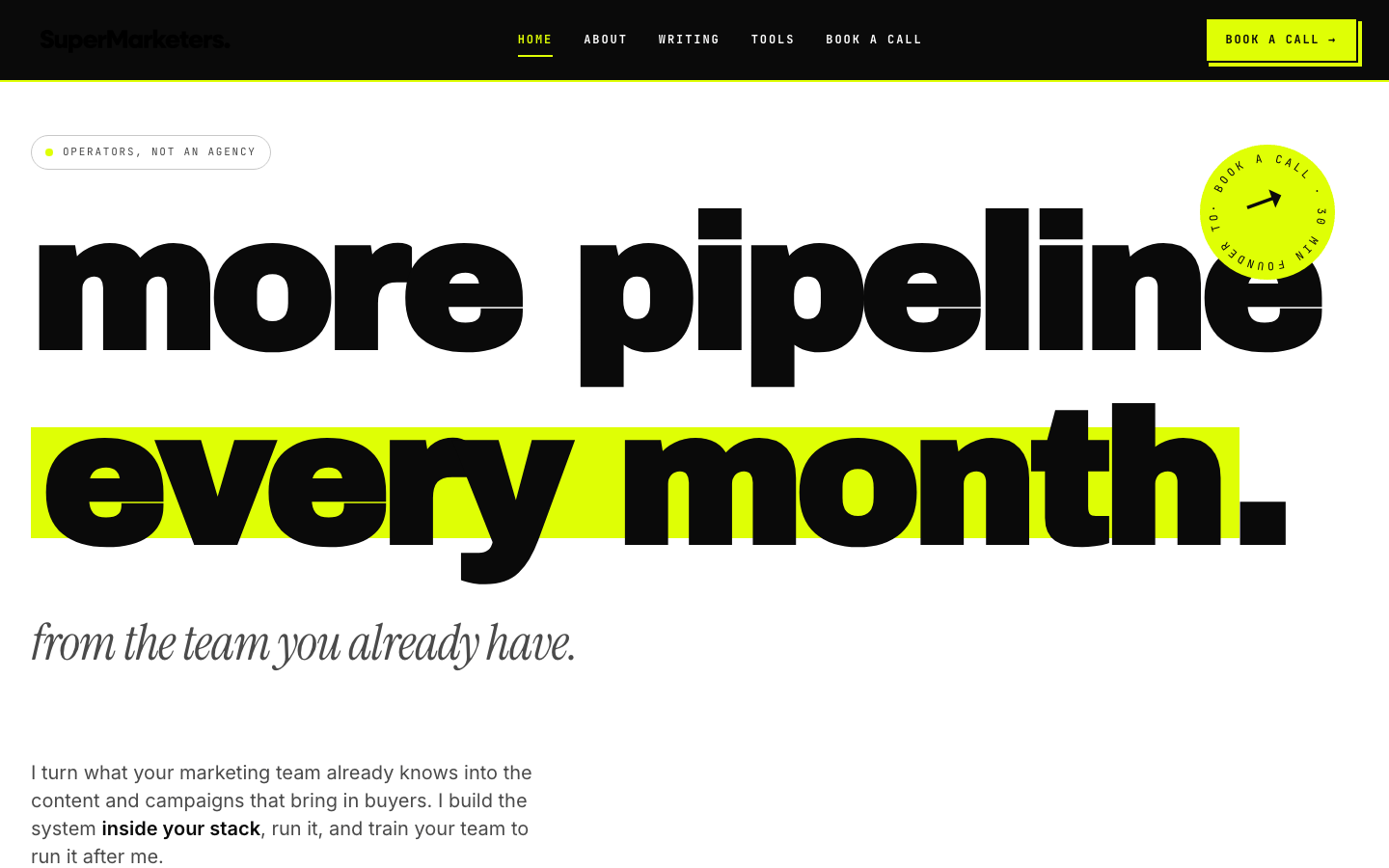
By September I'd realized that buyers don't wake up wanting AEO. They want pipeline, and AI search is one way of getting it. So the headline became "more pipeline every month," with "from the team you already have" underneath.
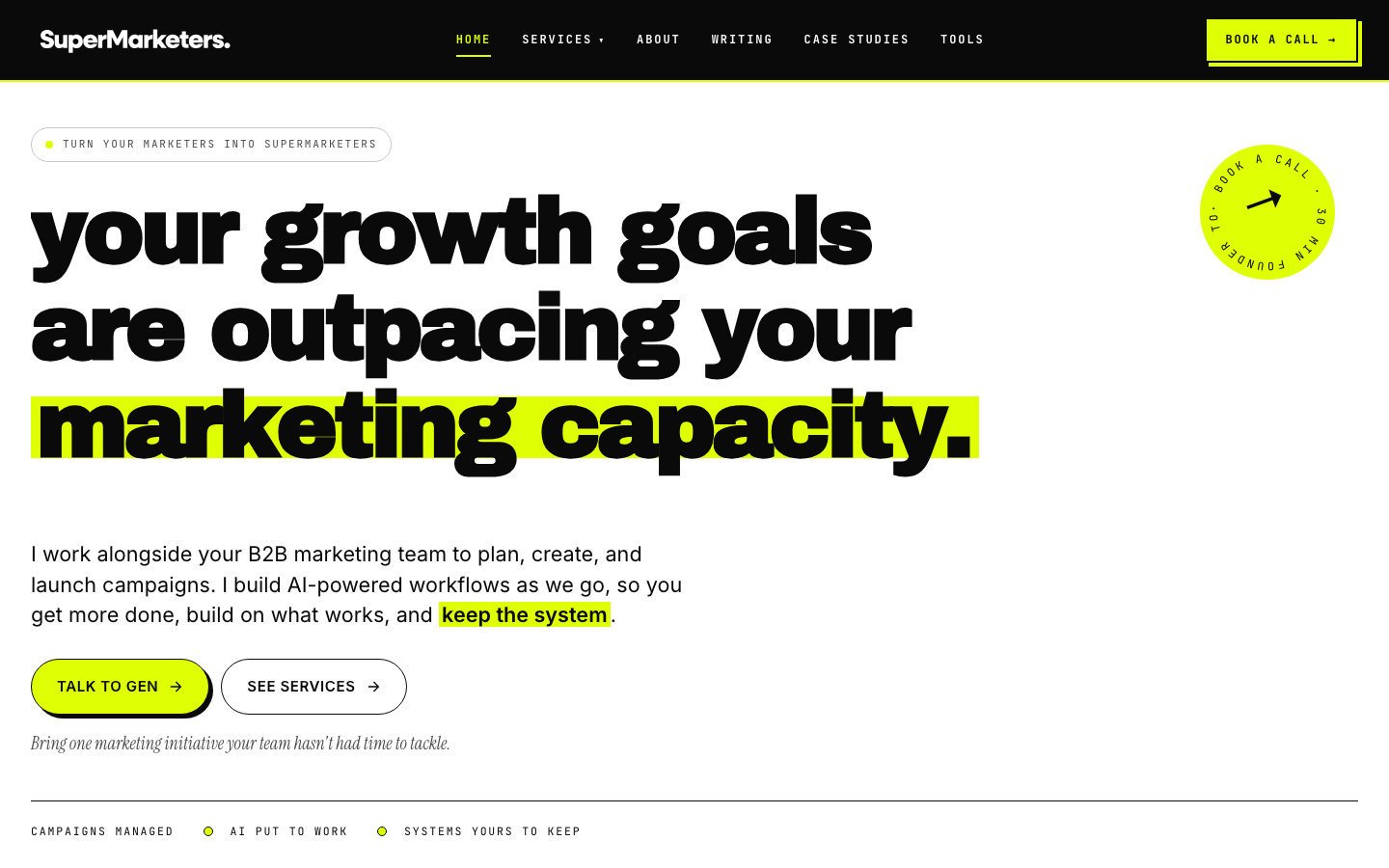
This month I tightened it again and wrote three lines that I want to be the only way SuperMarketers is ever described:
- Brand line: Turn your marketers into SuperMarketers.
- Outcome line: More pipeline from the team you already have.
- Entity line: SuperMarketers is the AI marketing partner for B2B SaaS teams that want more pipeline from the team they have.
Each change was the right call for the business. What I didn't do was carry any of them past my own website.
What my profiles said
Before changing anything, I took screenshots of my public profiles.
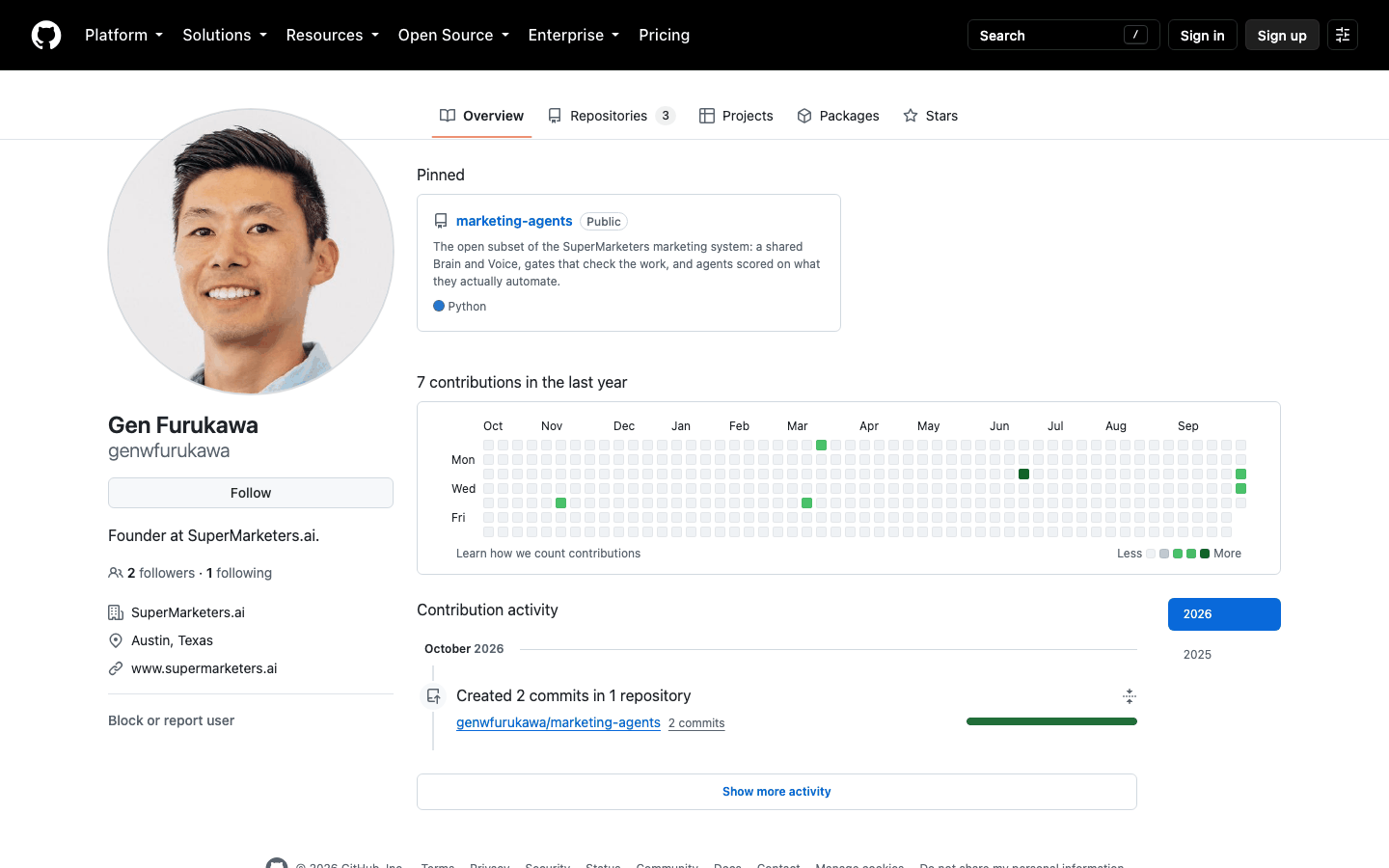
GitHub says "Founder at SuperMarketers.ai." That's accurate, but it doesn't tell anyone, human or model, what the company does.
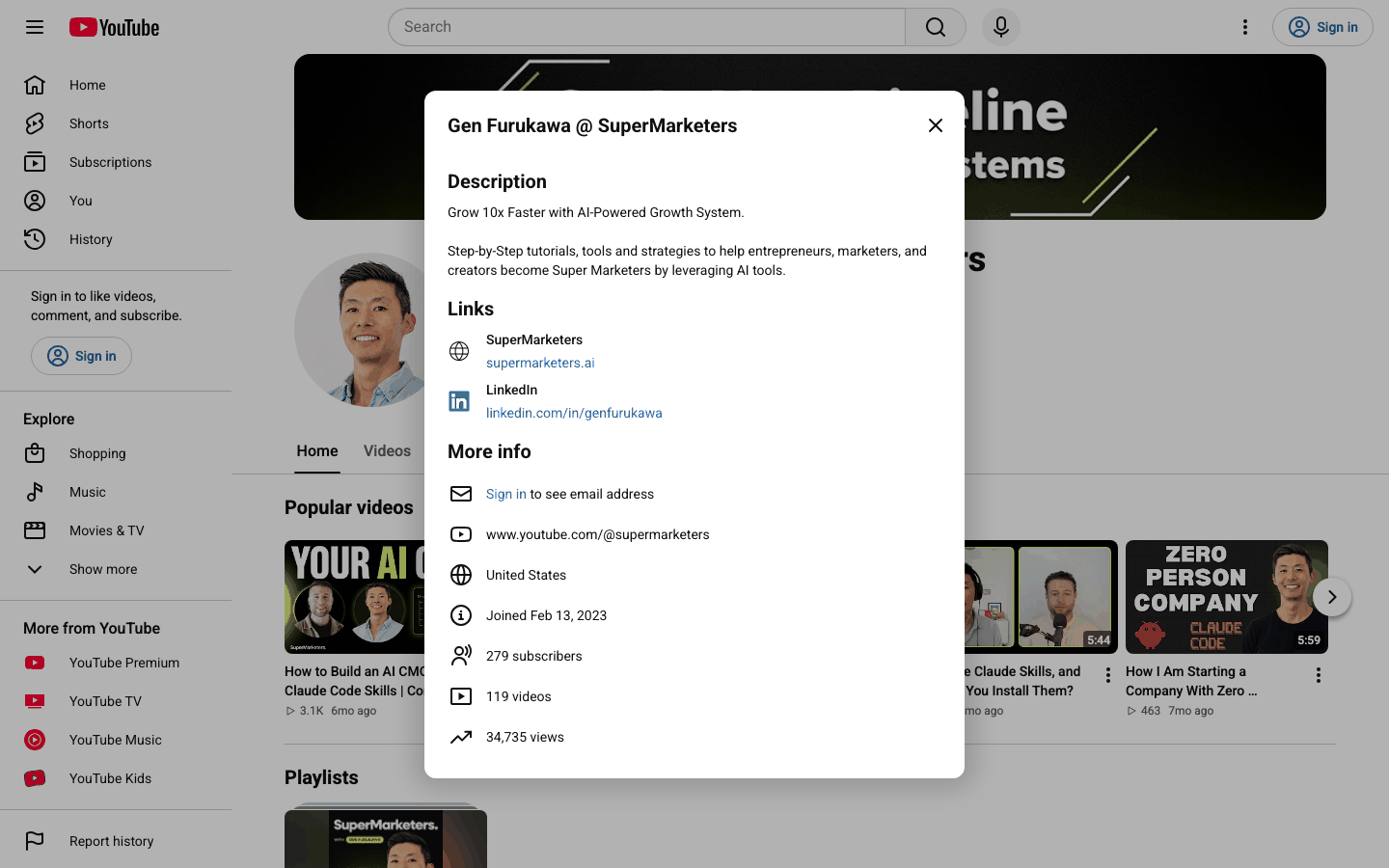
YouTube is the one that made me wince. The channel description reads "Grow 10x Faster with AI-Powered Growth System," followed by tutorials "to help entrepreneurs, marketers, and creators become Super Marketers by leveraging AI tools." That's a different audience from the one I sell to, a promise I wouldn't make today, and the brand name split into two words.
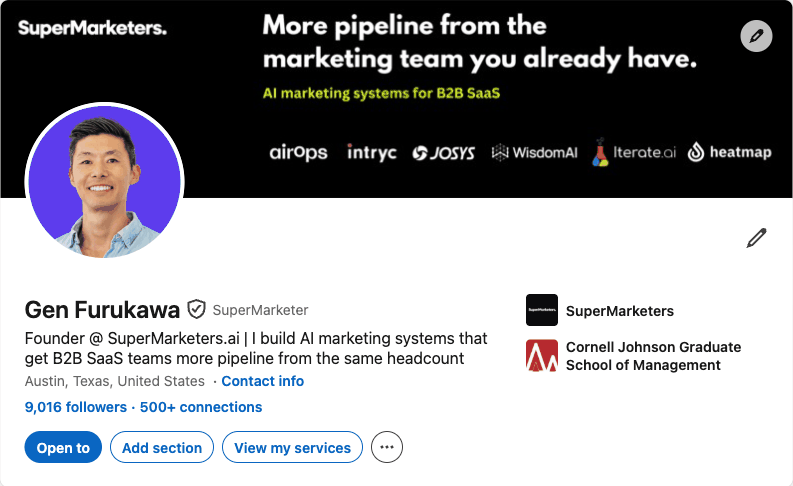
My LinkedIn headline said "I build AI marketing systems that get B2B SaaS teams more pipeline from the same headcount," the banner said "AI marketing systems for B2B SaaS," which was the September framing, and my About section opened with my last company, Prehook, rather than this one. The SuperMarketers company page was further behind still: its tagline read "Sharing Actionable AI Strategies and Ideas to Help Marketers Unlock Their Inner SuperMarketer."
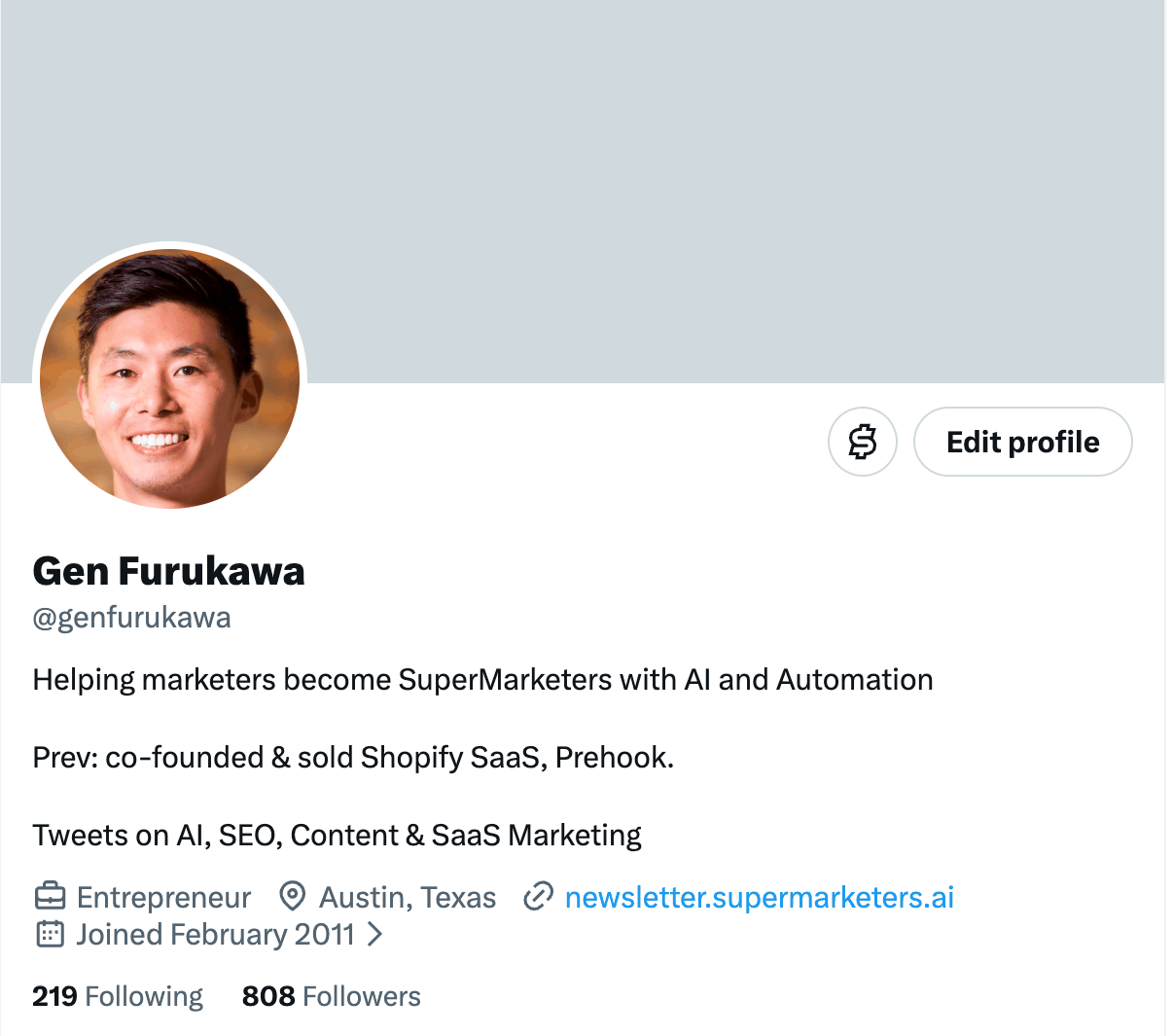
X said "Helping marketers become SuperMarketers with AI and Automation," linked to my newsletter instead of the website, and had no header image at all. Even the structured data on my own homepage, the part that tells search engines which profiles belong to SuperMarketers and to me, left out the LinkedIn company page, and the entry for me personally listed only two profiles.
So if you're a model trying to work out what SuperMarketers is, you have an AEO agency for Series A companies, an AI-powered growth system for creators, an AI marketing systems shop, and a pipeline partner for B2B SaaS teams, all pointing at the same name. Gemini picked the version with the most words written about it, which is a reasonable thing to do.
Why this matters more now than it did five years ago
Inconsistent profiles used to cost you a little polish. A buyer might notice your YouTube bio didn't match your website, but they'd still land on the website and read the real story.
AI search changes that, because the buyer often never reaches your website. They ask ChatGPT or Gemini for a shortlist, and the model's description of you is the first impression and sometimes the only one. That description is assembled from everything the model has read about you, and you only control part of it.
The research on this is still early, and most of it is correlation rather than proof, but it keeps pointing in the same direction.
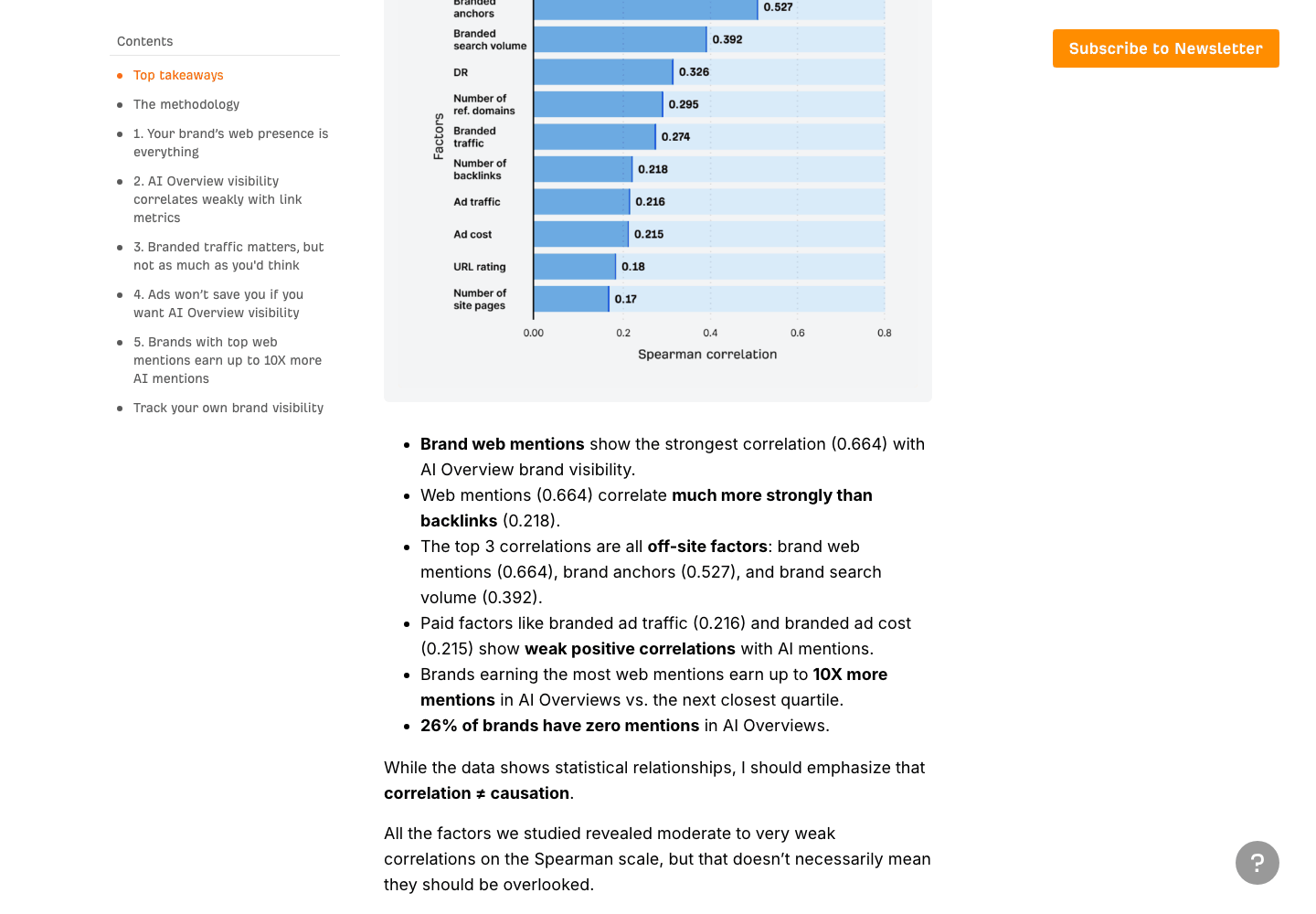
Ahrefs studied 75,000 brands and found that how often a brand is mentioned across the web had the strongest correlation with how often it shows up in Google's AI Overviews, at 0.664. Backlinks, the thing SEO has obsessed over for twenty years, came in at 0.218. Ahrefs is careful to say correlation isn't causation, and so am I, but the gap is large.
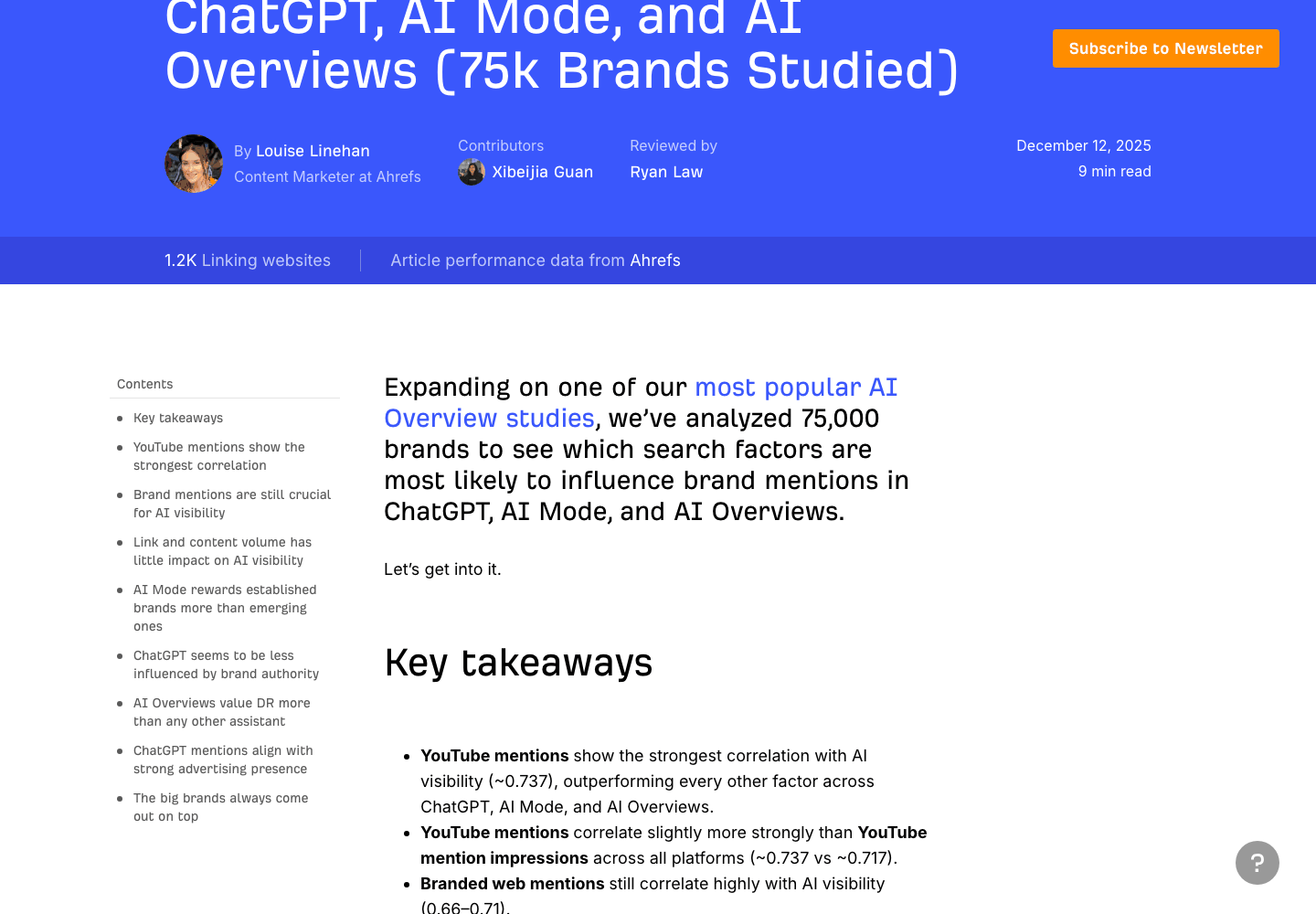
In a follow-up across ChatGPT, AI Mode and AI Overviews, the strongest factor was mentions on YouTube, at about 0.737. That one stung, given what my YouTube description currently says.
LinkedIn matters too. Semrush looked at 89,000 LinkedIn URLs cited in AI search and found LinkedIn was the second most-cited domain in their dataset, appearing in 11% of AI responses on average. Their summary was blunt: "Your LinkedIn content can directly shape how AI explains your brand." (Semrush ran that study with LinkedIn, which is worth knowing.)
Your own website still carries a lot of weight. Profound's analysis, as reported by WARC, found brand websites account for 57% of AI citations globally, ranging from 47% on ChatGPT to 69% on Gemini. That might explain why Gemini, specifically, was still repeating old copy from my site: it leans on brand websites more than any other assistant, and the old copy is still sitting in its index and in pages that quoted it.
Google's own documentation describes how this works mechanically. In AI features and your website, Google explains that AI Overviews and AI Mode use "query fan-out," issuing multiple related searches across subtopics and data sources to build a response. The model reads around. If the sources it finds disagree, it has to pick one or blend them.
What Rand Fishkin does with one sentence
The clearest practical example I've found comes from Rand Fishkin, the cofounder of SparkToro. In a video about appearing in AI answers, he explains that he deliberately rewrote his bio to describe SparkToro as "makers of fine audience research software":
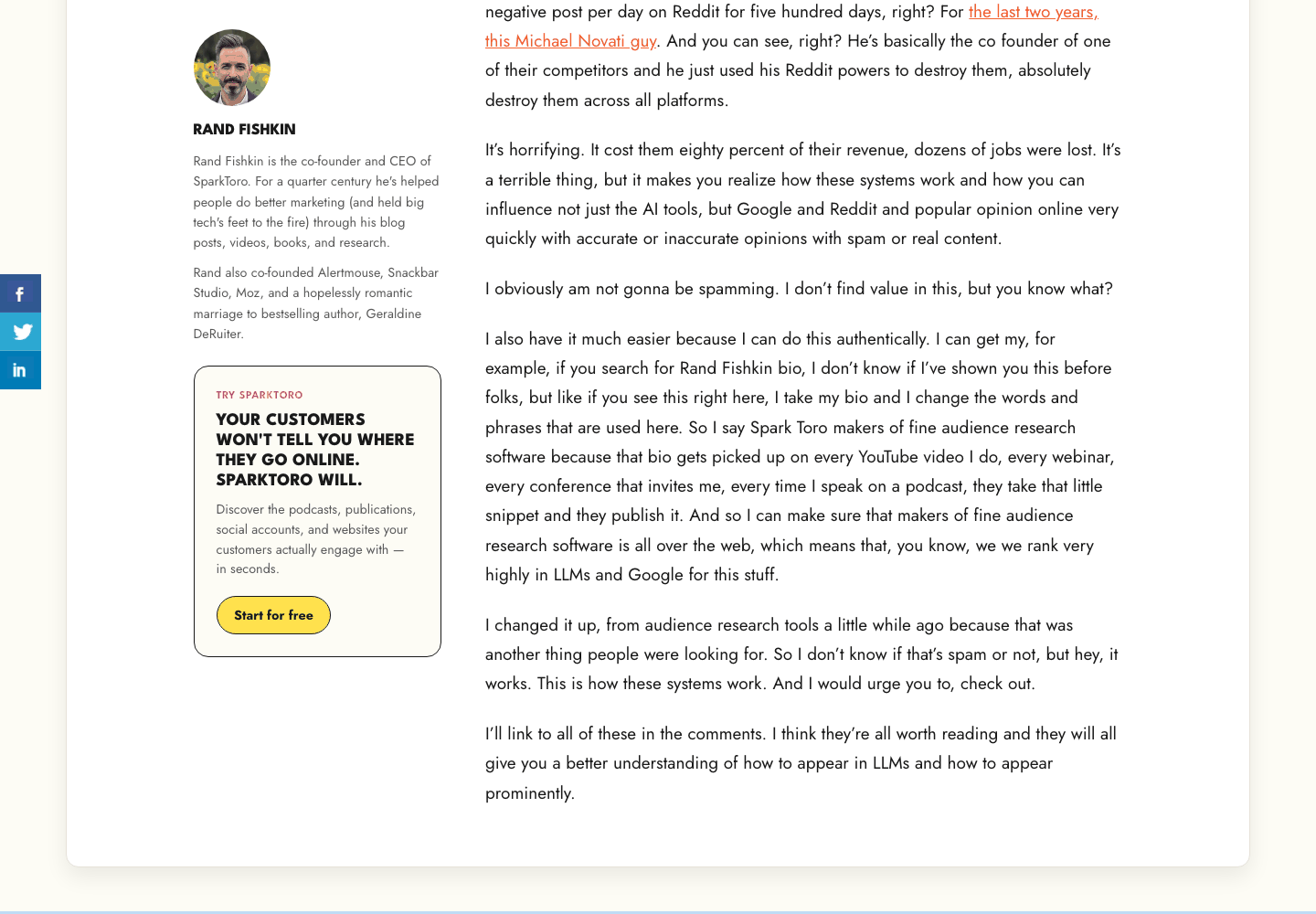
"That bio gets picked up on every YouTube video I do, every webinar, every conference that invites me, every time I speak on a podcast, they take that little snippet and they publish it. And so I can make sure that makers of fine audience research software is all over the web, which means that, you know, we rank very highly in LLMs and Google for this stuff."
That's the part I'd missed. Your bio doesn't stay on your profile. Conference pages, podcast show notes, guest-post bylines and directory listings copy it, so whatever version you have today is what spreads across the web and into training data and search indexes.
Rand also reshared a post on LinkedIn from Steven Lord, an SEO who shares a name with a British TV actor and was tired of Google's AI describing the wrong Steven.
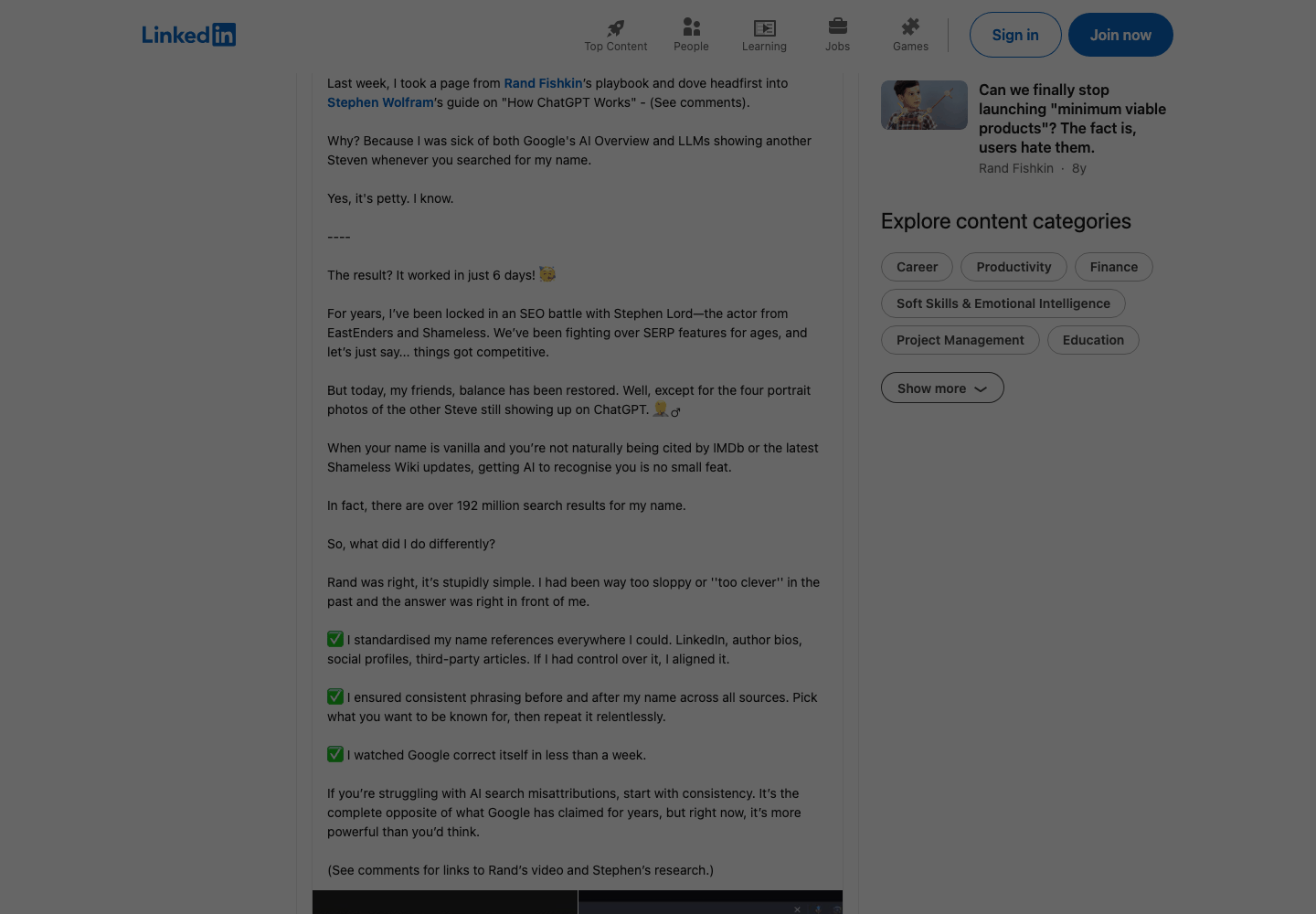
Lord wrote that he "standardised my name references everywhere I could. LinkedIn, author bios, social profiles, third-party articles," made sure he used "consistent phrasing before and after my name across all sources," and then "watched Google correct itself in less than a week." Rand's comment on resharing it was that he was "kinda shocked this worked, and worked so quickly." It's one person's experience rather than a study, but it's the same fix I'm about to make, and it's encouraging that it moved that fast.
What consistency won't do
I want to be careful not to oversell this, because the AI visibility space already has plenty of people doing that.
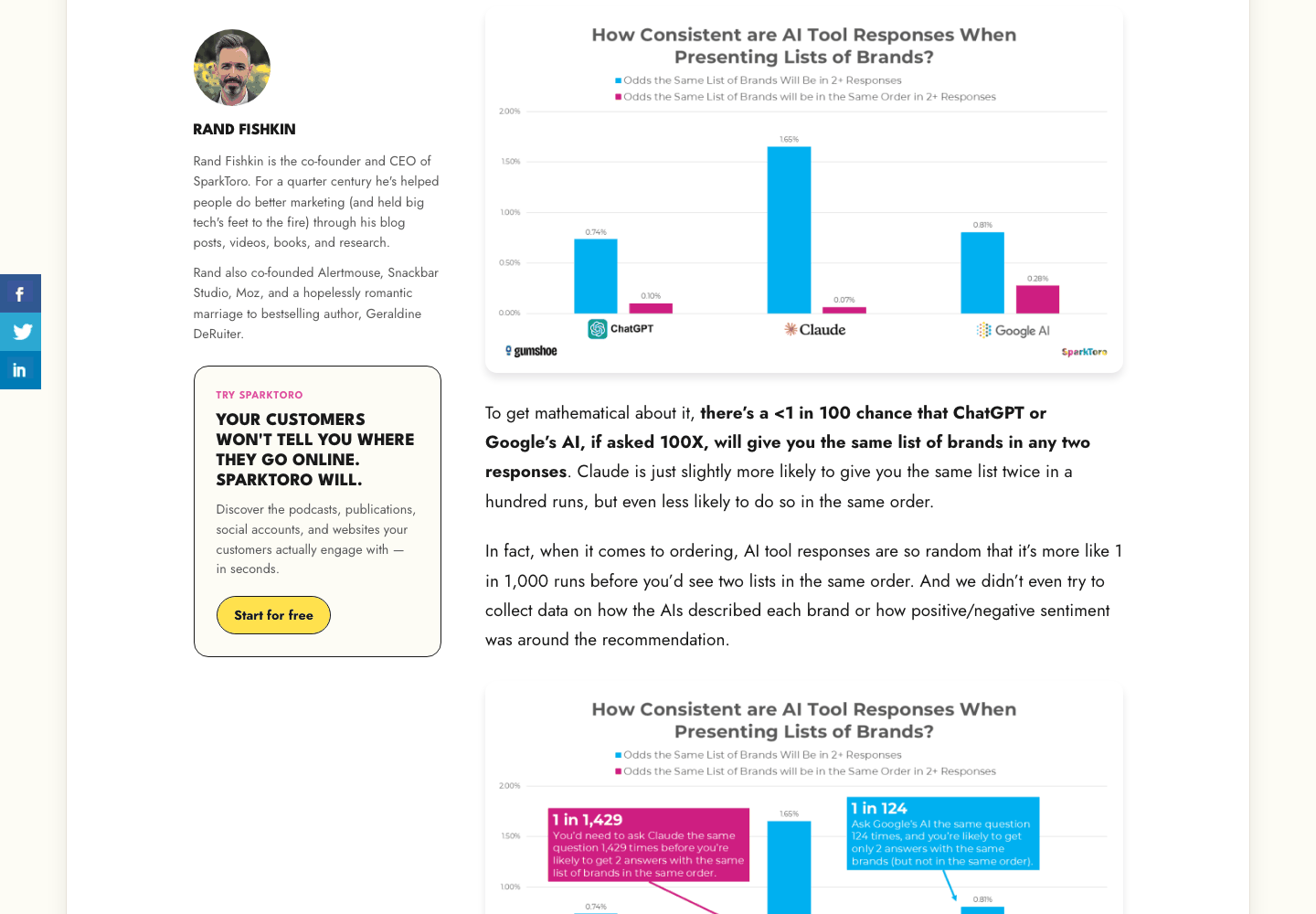
SparkToro and Gumshoe ran the same prompts through ChatGPT, Claude and Google's AI almost 3,000 times and found there's less than a 1 in 100 chance of getting the same list of brands in any two responses, and closer to 1 in 1,000 for the same order. So consistent profiles won't get you a fixed spot on a shortlist. What the study did find is that how often a brand appears across many runs is fairly stable, which is the thing I think consistency actually helps with: being in the consideration set and being described accurately when you are.
Being cited isn't the same as being named, either. A Semrush study with Kevin Indig found that in almost 62% of cases where AI used a brand's page as a source, the brand's name never appeared in the answer. The model read the page and then didn't credit it.
And structured data isn't magic. Google says plainly that there are "no additional requirements to appear in AI Overviews or AI Mode," and no special schema you need to add. Mark Williams-Cook tested what ChatGPT and Perplexity do with JSON-LD and found they read it as ordinary text rather than parsing it as schema. I still think Organization markup with sameAs links to every profile is worth adding, because Google uses it to disambiguate organizations, but it supports consistent text everywhere else; it doesn't replace it.
What I'm changing
The fix is boring, which is part of why I put it off. I wrote one entity sentence and made it the first line of every profile I control, so the same words appear before and after the name everywhere:
SuperMarketers is the AI marketing partner for B2B SaaS teams that want more pipeline from the team they have.
| Where | Field | What it says now |
|---|---|---|
| Website | Title, meta description, Organization schema | The entity line, plus sameAs links to every profile below |
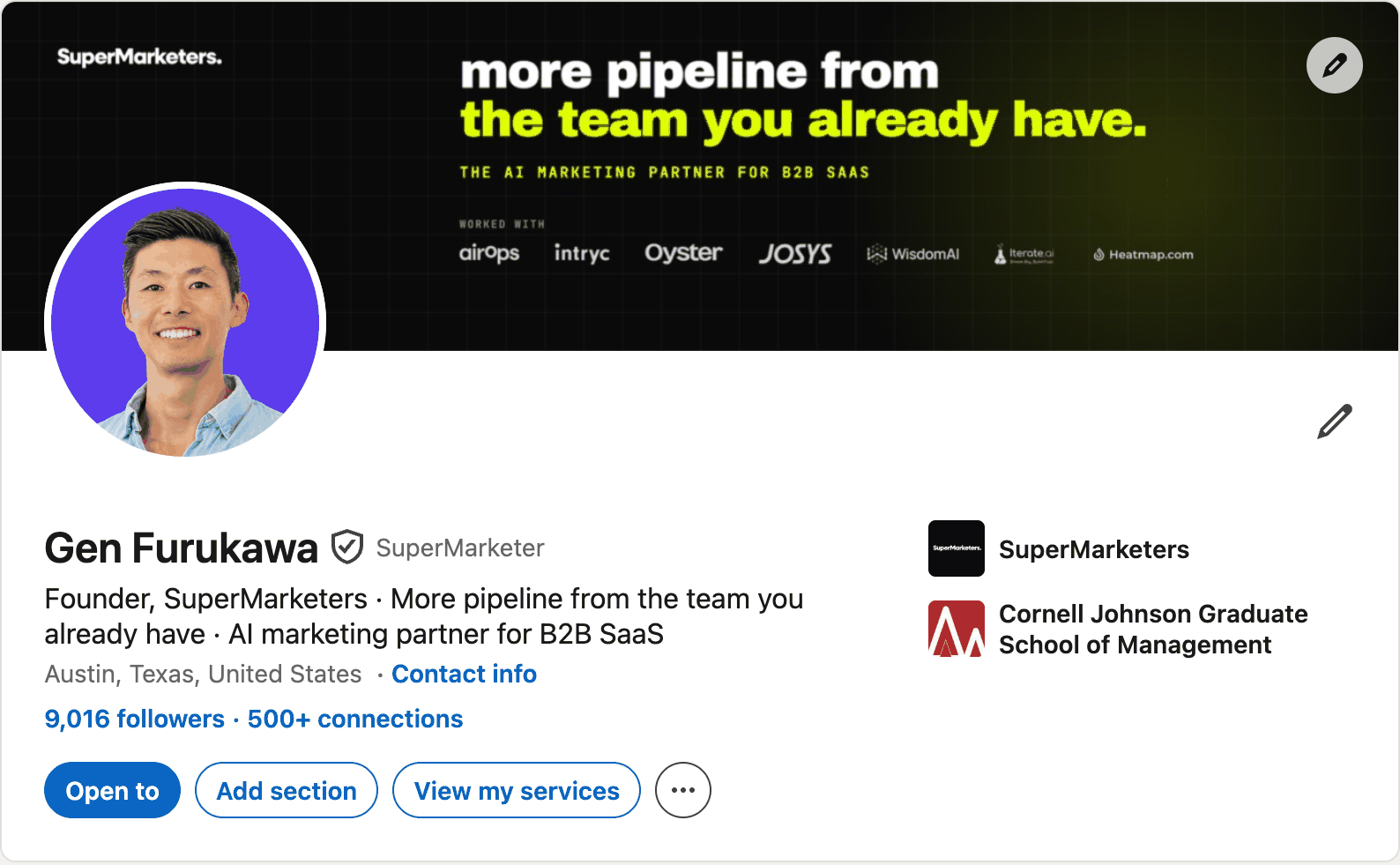
| LinkedIn (me) | Headline | Founder, SuperMarketers · More pipeline from the team you already have · AI marketing partner for B2B SaaS |
| LinkedIn (me) | About, first line | The entity line |
| LinkedIn (company) | Tagline and About | More pipeline from the team you already have. / The entity line |
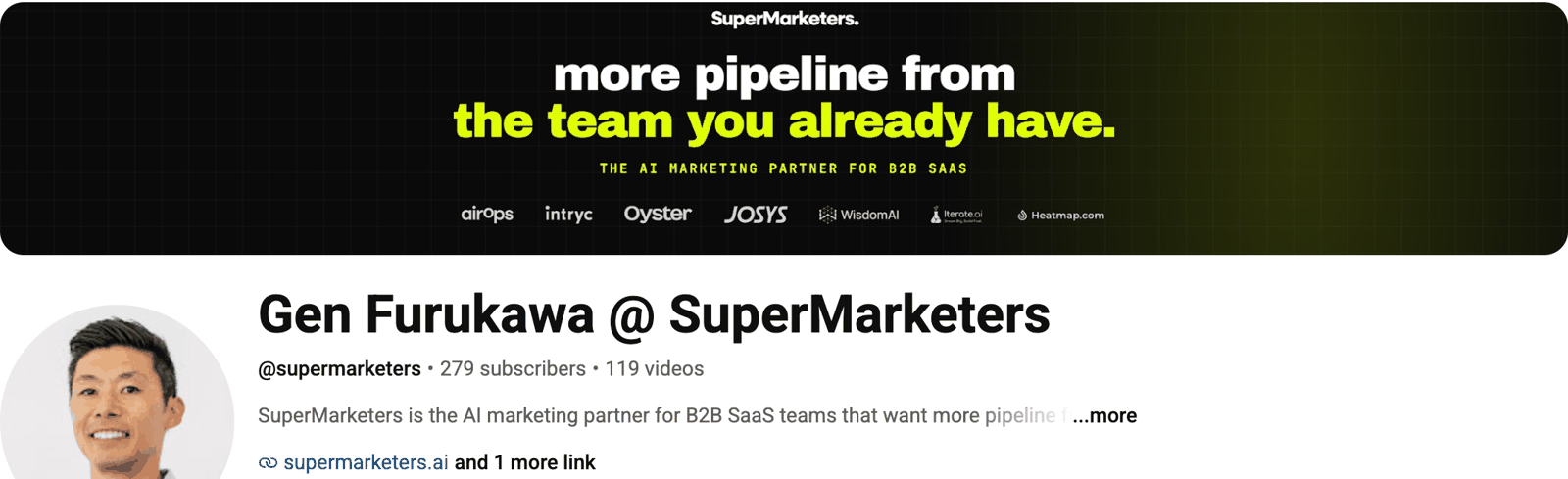
| YouTube | Channel description, first line | The entity line, replacing "Grow 10x Faster" |
| GitHub | Bio | The entity line |
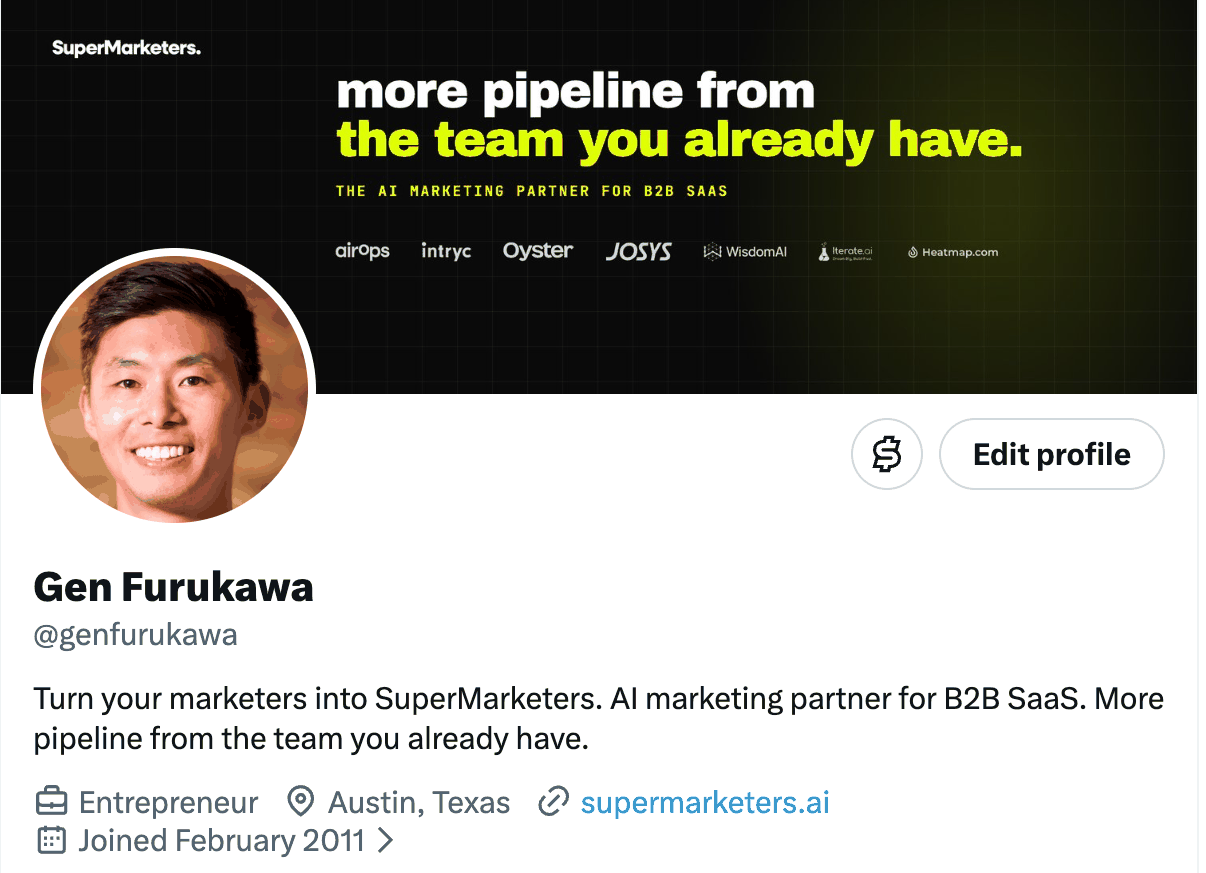
| X | Bio | Turn your marketers into SuperMarketers. AI marketing partner for B2B SaaS. More pipeline from the team you already have. |
| Speaker and podcast bio | The paragraph I send to hosts | Starts with the entity line |
Here's what they look like now. I also made one banner design for LinkedIn, the company page, X and YouTube, with the outcome line, the category, and the logos of companies I've worked with, so the pictures say the same thing as the words.
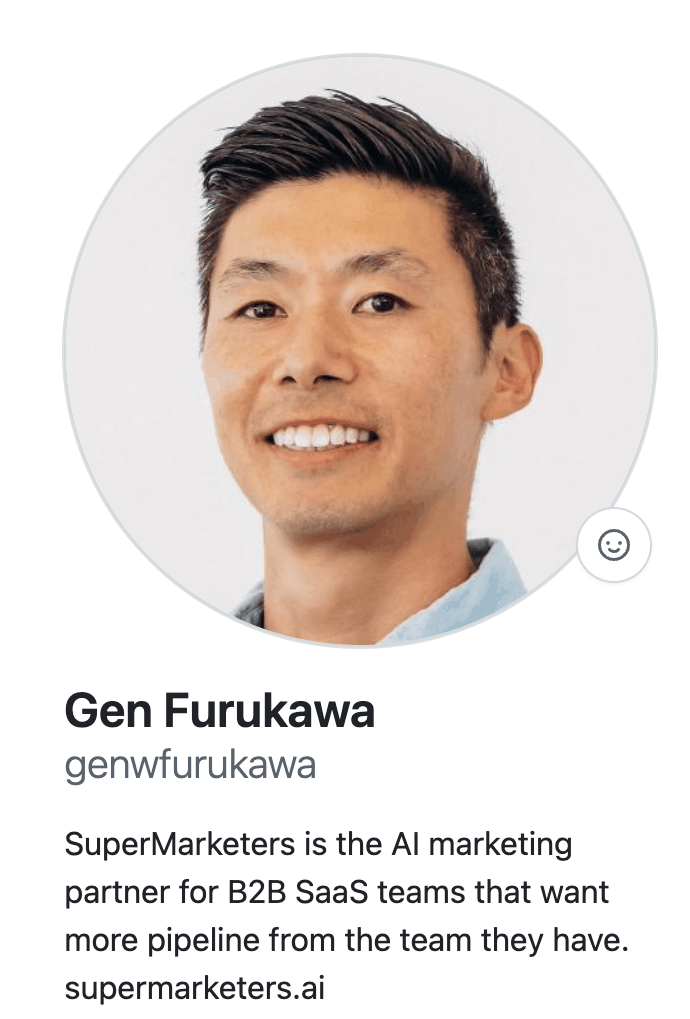
The last row is the one I'd have forgotten without Rand's example. The bio I send to podcast hosts and event organizers gets copied onto pages I'll never touch again, so it needs to be right before I send it, not after.
Will it work?
I don't know yet, and I'd rather measure it than guess. I saved Gemini's answer from today word for word. Now that every profile is updated, I'll ask Gemini, ChatGPT and Perplexity the same question at two weeks and again at four, and I'll post what they say, whether or not it changes. Old pages and old quotes of my old copy will take time to fade, and some may never go away.
If you want to try this on your own company, it takes about an hour:
- Ask the AI tools what you are. Log out, ask Gemini, ChatGPT and Perplexity what your company does and who it's for, and save the answers.
- Find the source of anything wrong. It's usually an old version of your own homepage, a stale profile, or a bio someone copied years ago.
- Write one entity sentence. Name, category, who it's for and the outcome, in plain words a model can repeat back.
- Make it the first line everywhere you control, starting with your site, LinkedIn and YouTube, and then the bio you hand to other people.
- Link the profiles together with
sameAsin your Organization schema so Google can tell they're all the same entity. - Ask again in a month and compare.
My homepage told people to be the answer back in May. It turns out the answer is only as good as the most consistent thing the internet says about you, and for most of this year that wasn't my website.
If you'd like help doing this for your team, that's part of the Foundation work we start every engagement with, or you can book a 30-minute call.