Most AEO advice starts in the wrong place.
It tells marketers to “optimize for questions,” “add FAQ schema,” or “write conversational content,” which is directionally true and operationally useless.
The practical question is sharper: which AI-assisted buyer conversations should your brand be present in, and what content or proof would make an answer engine include you?
That is the job of AEO keyword research.
It is not SEO keyword research with question marks added.
It is the process of reverse-engineering the conversations your buyers are having with ChatGPT, Perplexity, Gemini, Claude, Google AI Overviews, and Google AI Mode, then building the content, proof, and third-party authority that makes your brand part of the answer.
AEO keyword research maps buyer prompts, answer patterns, citations, competitor mentions, and trusted sources so you can decide what to create, update, or earn externally.
Why AEO keyword research is different
SEO keyword research is built around queries, SERP intent, rankings, volume, difficulty, and traffic potential.
AEO keyword research is built around prompts, buyer context, answer inclusion, brand mentions, citations, sentiment, competitive share of voice, and the pages or third-party sources AI systems use to form an answer.
A normal keyword might be “best CRM software.”
An AEO prompt sounds more like this:
What CRM would work best for a 10-person B2B SaaS sales team that uses HubSpot for marketing but needs better pipeline forecasting?
That prompt includes the buyer, use case, constraints, incumbent tools, evaluation criteria, and desired outcome.
That context changes the answer.
Step 1: Start with topics, not prompts
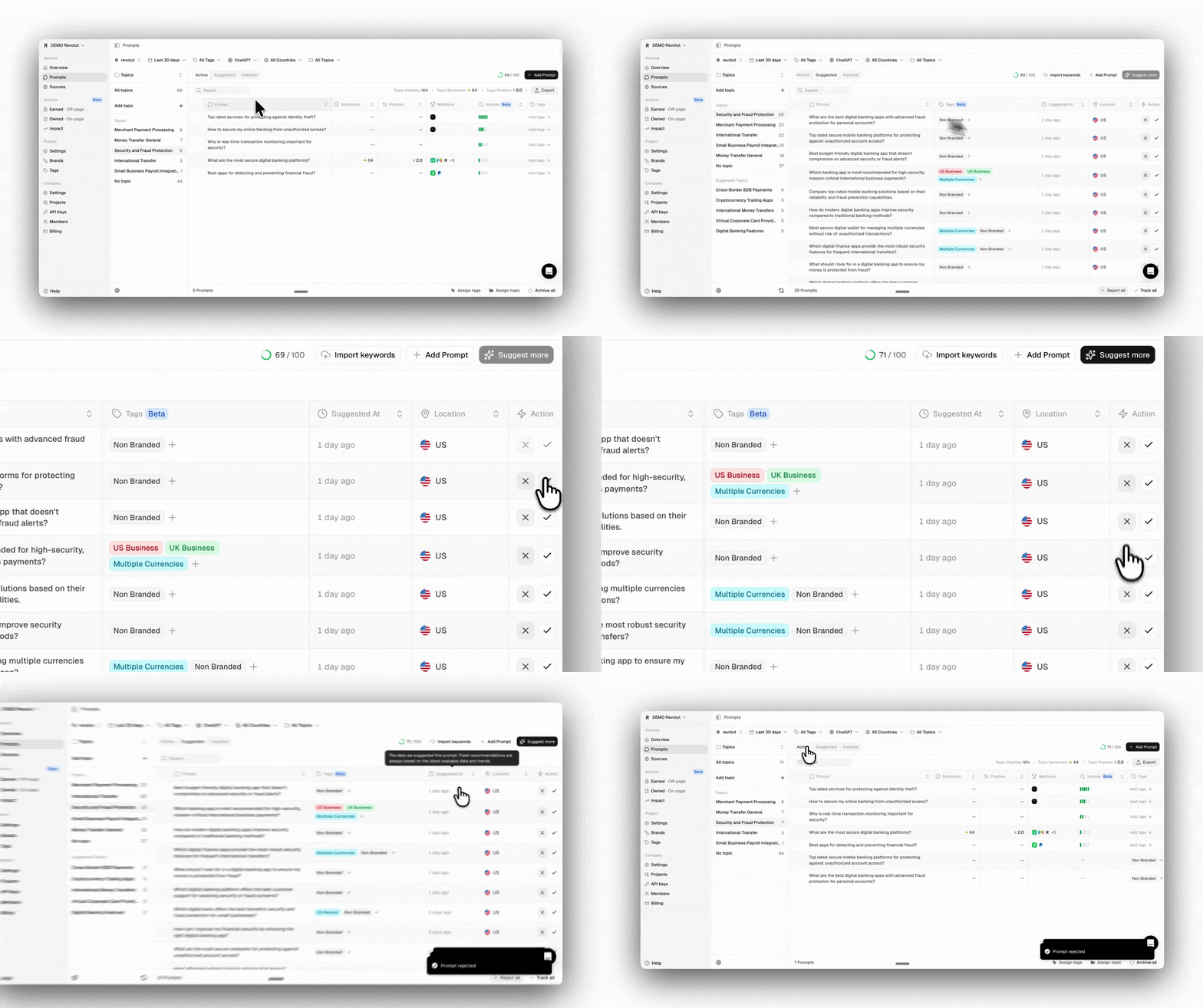
Before you write prompts, define the 5 to 10 topic areas where your brand needs to be visible.
For a B2B SaaS company, these usually come from product categories, primary use cases, pain points, jobs-to-be-done, alternatives, buying triggers, integrations, compliance concerns, personas, and high-value segments.
For SuperMarketers, a starting topic map might include AI visibility and AEO, B2B SaaS demand generation, founder-led content, SEO and content strategy for AI search, pipeline generation for Seed to Series B SaaS, agency alternatives, and citation intelligence.
This topic structure matters because tools like Peec.ai, Profound, AthenaHQ, and Scrunch all organize prompt tracking around topics, tags, personas, regions, or similar reporting layers.
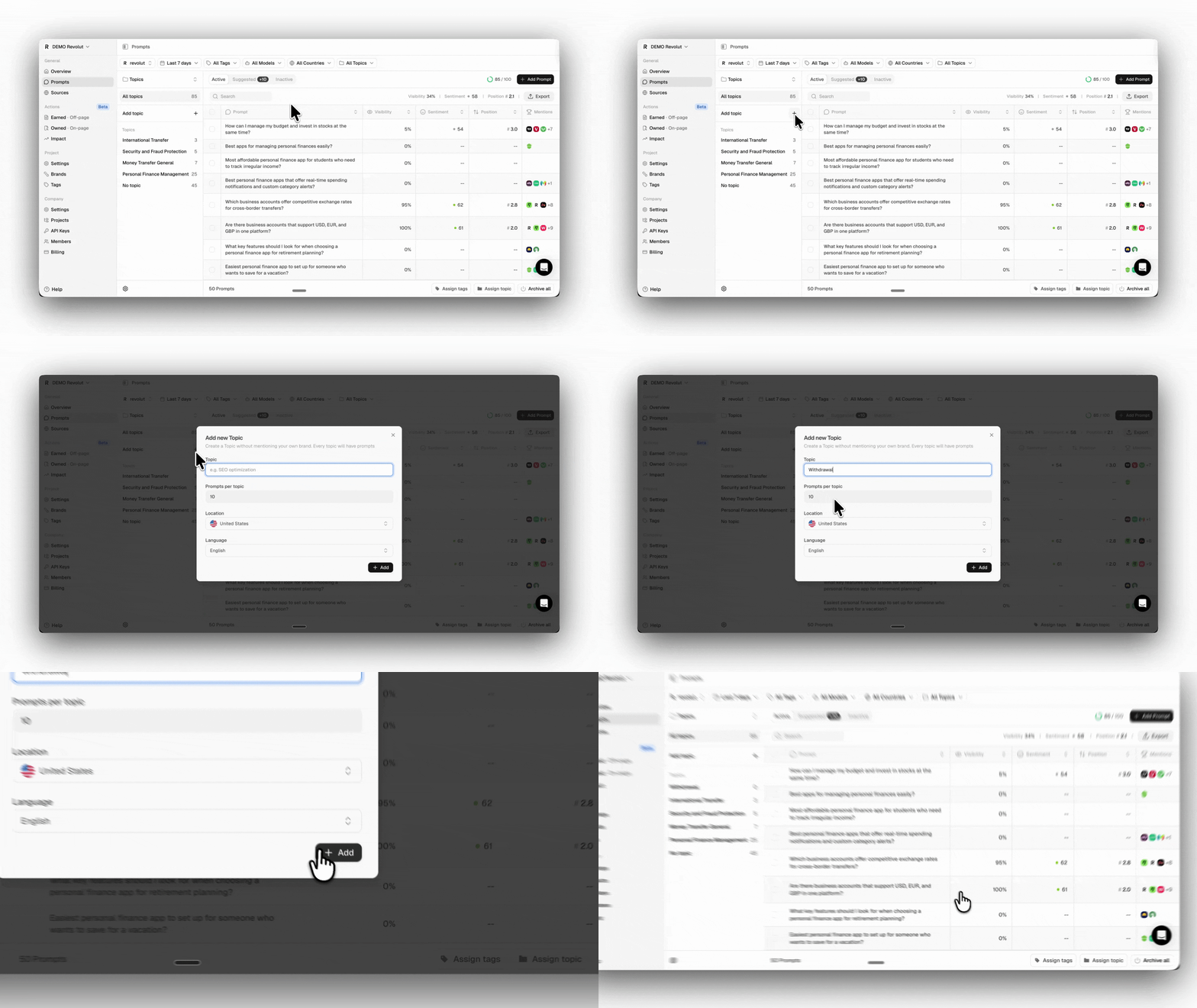
Step 2: Pull a seed universe from traditional SEO data
Traditional SEO research is still useful, but it is the input, not the finished output.
Pull seeds from Google Search Console, existing rankings, paid search terms, Google Autocomplete, People Also Ask, Ahrefs or Semrush, Reddit and communities, sales calls, demo forms, customer onboarding notes, competitor pages, G2, TrustRadius, Capterra, and analyst-style roundups.
The goal is not to preserve exact keywords.
The goal is to identify the questions, decision criteria, and language patterns behind them.
A keyword like “AEO strategy” can become several prompts: how should a B2B SaaS company build an AEO strategy, what are the best tactics to get cited in ChatGPT and Perplexity, which agencies improve AI visibility, how do I track brand visibility in AI answers, and what is the difference between SEO, GEO, AEO, and LLMO.
Step 3: Convert keywords into buyer prompts
Use this transformation rule:
Keyword + buyer + context + constraint + decision intent = prompt.
| SEO keyword | Weak AEO prompt | Strong AEO prompt |
|---|---|---|
| AEO agency | What is an AEO agency? | Which AEO agencies are best for Seed to Series B B2B SaaS companies that need pipeline, not just visibility? |
| AI visibility tools | What are AI visibility tools? | What tools can track whether my B2B SaaS brand is mentioned and cited in ChatGPT, Perplexity, Gemini, and Google AI Overviews? |
| Demand generation agency | What is the best demand generation agency? | Which demand generation agencies are strongest for a technical B2B SaaS startup with a small marketing team and a 6-month pipeline target? |
| Founder-led content | How do I do founder-led content? | How should a B2B SaaS founder use LinkedIn, newsletters, and webinars to build trust with buyers before sales outreach? |
The strong prompt includes the business context that a real buyer would give an AI assistant.
Step 4: Build prompt coverage across the funnel
Most teams over-index on bottom-funnel prompts because those look closest to revenue.
That is a mistake.
AI assistants influence category understanding long before the buyer asks for a vendor list.
A good prompt set should cover five layers: problem education, category definition, solution approach, vendor and tool discovery, and comparison or decision prompts.
| Prompt family | Template | Example |
|---|---|---|
| Problem education | How can a [persona] solve [problem] without [constraint]? | How can a B2B SaaS company build pipeline when paid acquisition is getting more expensive? |
| Category definition | What is [category], and how does it help [persona]? | What is answer engine optimization, and how does it help B2B SaaS companies get discovered in AI search? |
| Solution approach | What is the best way for [persona] to [achieve outcome]? | What is the best way for a Seed stage SaaS company to build an AEO strategy? |
| Vendor discovery | What are the best [tools/agencies] for [persona]? | What are the best AEO agencies for B2B SaaS companies? |
| Comparison and decision | Compare [A] vs [B] for [persona] trying to [outcome]. | Should a SaaS company hire an AEO agency or build AI visibility in-house? |
Step 5: Add persona, segment, and constraint modifiers
AEO prompts become more useful when they simulate the actual buyer.
Create variations by adding persona, company stage, industry, business model, constraint, current tech stack, and geography.
A useful starting set is 50 to 100 prompts, which AthenaHQ recommends as enough to see patterns while staying focused enough to act on.
A second useful sizing heuristic from Scrunch is: topic clusters × 12 to 15 questions per topic cluster = approximate starting prompt set size.
That gives you enough coverage to see patterns without creating a prompt list so large that every result becomes noise.
| Prompt family | Starter share | Purpose |
|---|---|---|
| Problem and category education | 25% | Learn how AI explains the market and pain. |
| How-to and strategy | 20% | Find content gaps and answer blocks to build. |
| Vendor discovery | 20% | See whether you appear in category recommendations. |
| Comparison, alternatives, and pricing | 20% | Track decision-stage visibility. |
| Branded and reputation prompts | 15% | Audit entity clarity, sentiment, and positioning accuracy. |
Step 6: Separate branded and non-branded prompts
You need both.
Non-branded prompts show whether you are part of the category conversation.
Branded prompts show how AI systems describe, compare, and evaluate you when the buyer already knows your name.
Non-branded prompts look like “what are the best AEO agencies for B2B SaaS companies” or “how should a SaaS company track brand visibility in ChatGPT and Perplexity.”
Branded prompts look like “what does SuperMarketers do,” “is SuperMarketers a good fit for a Seed stage B2B SaaS company,” or “compare SuperMarketers to a traditional SEO agency.”
If AI systems describe you incorrectly, vaguely, or incompletely, you have an entity clarity problem, not just a content gap.
Step 7: Track prompts across engines
AI visibility is engine-specific.
ChatGPT, Perplexity, Gemini, Claude, Google AI Overviews, and Google AI Mode do not cite the same sources or produce the same brand set.
Profound notes that ChatGPT’s sources have only a 39% overlap with Google’s sources, which is a useful reminder that Google rankings are not a complete proxy for AI visibility.
For each prompt, capture brand mentions, brand citations, cited pages, competitor mentions, competitor citations, sentiment, brand position, third-party sources, implied sub-queries, and whether the answer recommends action, comparison, or vendor selection.
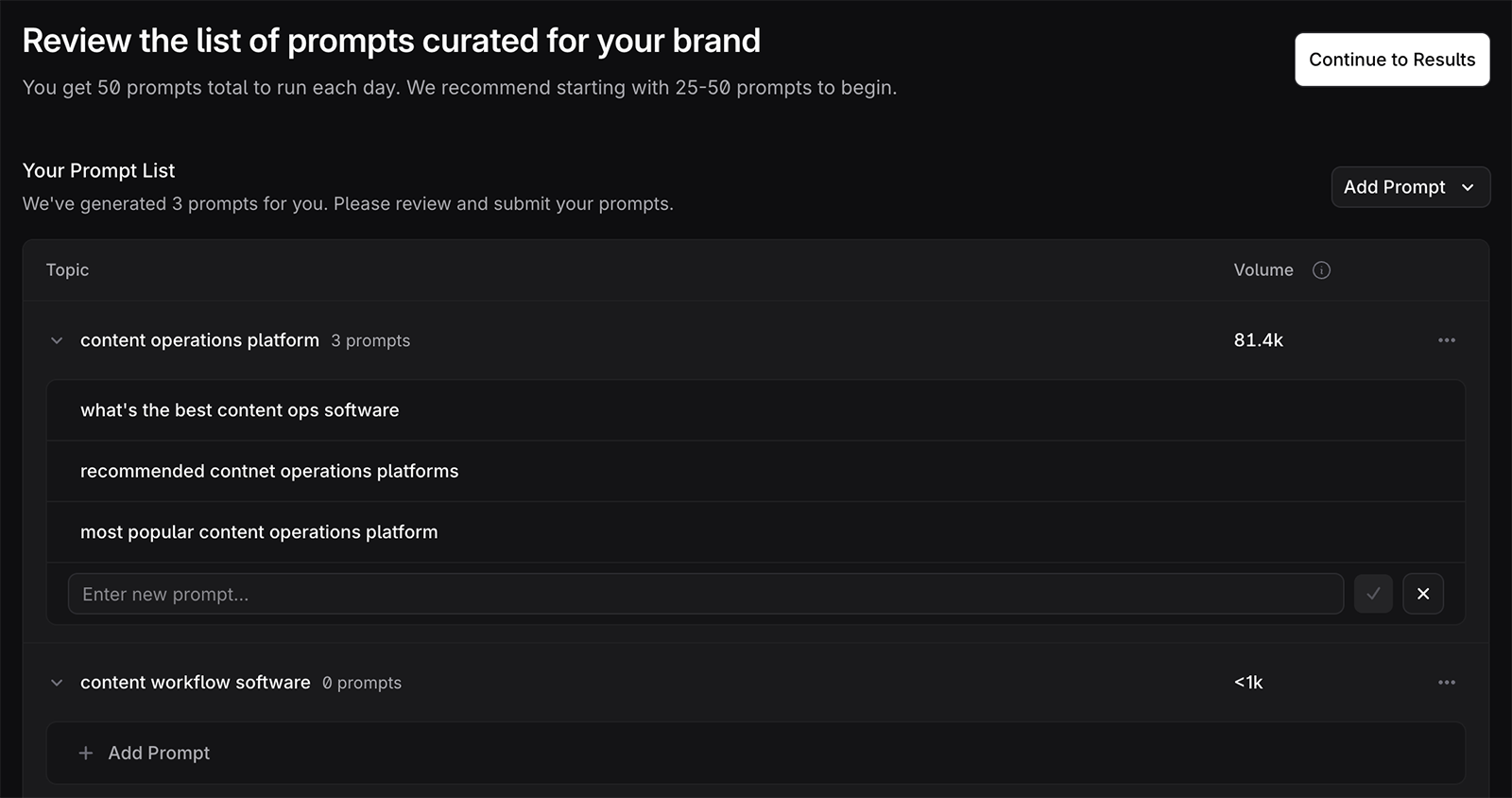
Separate mention, citation, and answer absorption.
A brand can be mentioned without being cited.
A page can be cited without meaningfully shaping the answer.
A page can also be absorbed into the final answer when its definitions, criteria, examples, or data points become part of the generated response.
The goal is not only citation share.
The goal is to influence the answer in the direction of useful truth, accurate positioning, and buyer confidence.
Step 8: Read cited sources as content briefs
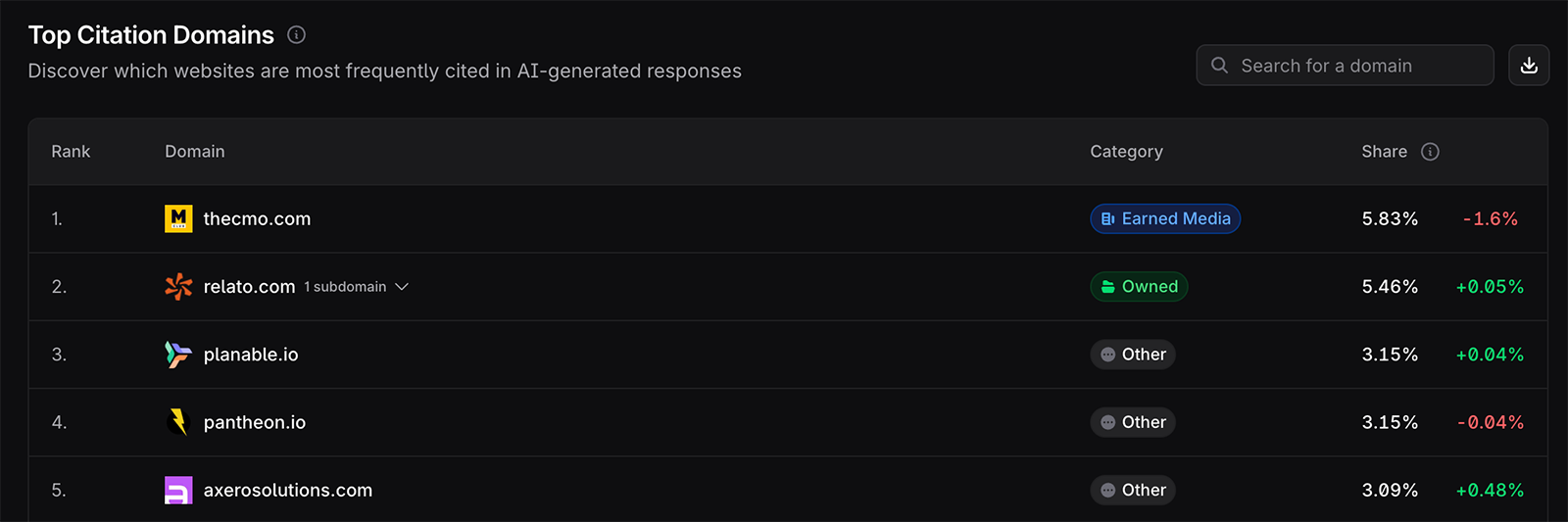
The fastest way to understand what AI systems trust is to inspect the pages they cite.
For each important prompt, document top cited domains, top cited pages, page type, claims pulled into the answer, missing angles, whether your owned content can realistically win the citation, and whether a third-party placement is needed.
This is where AEO becomes broader than content marketing.
If the top cited sources are G2 pages, Reddit threads, analyst lists, integration marketplaces, or “best tools” roundup pages, the answer may not be another owned blog post.
The answer may be review generation, partner pages, third-party list inclusion, PR, Reddit participation, or comparison content on trusted domains.
Step 9: Use query fan-out to expand the roadmap
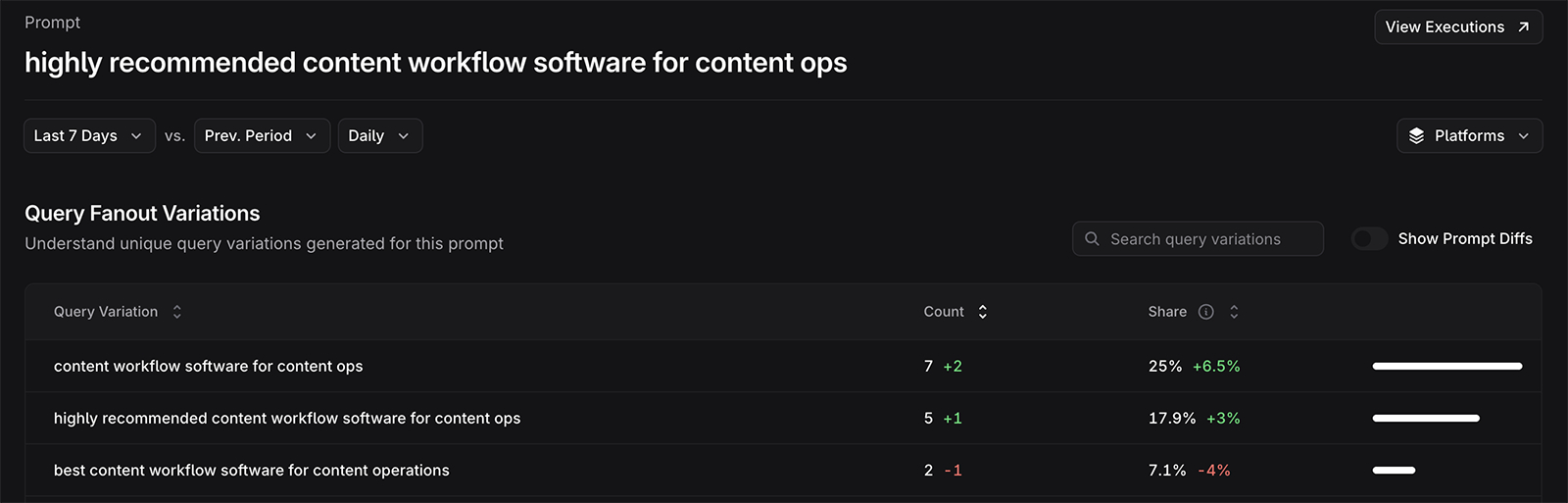
Google describes query fan-out as a set of concurrent, related queries generated by the model to fetch additional relevant results for a user’s query.
That means one buyer prompt often implies multiple sub-queries.
A prompt like “what are the best AEO agencies for a Series A SaaS company” may fan out into what is AEO, what is GEO, which agencies specialize in AI search visibility, which agencies work with B2B SaaS, how much AEO agencies cost, what case studies prove performance, what tools track AI visibility, and what is the difference between SEO and AEO.
Those fan-out queries should become supporting content, FAQ sections, comparison pages, glossary pages, proof points, or third-party authority targets.
Step 10: Turn prompt tracking into a content roadmap
Do not treat prompt tracking as a dashboard exercise.
Each prompt should lead to an action.
| Prompt result | Likely issue | Action |
|---|---|---|
| Competitors mentioned, you absent | Category visibility gap | Create or update category, use case, and comparison content. |
| You mentioned but not cited | Citation gap | Strengthen source pages, add structured facts, improve crawlability, and build corroborating mentions. |
| You cited but described poorly | Positioning/entity gap | Update About, homepage, product pages, schema, third-party profiles, and reviews. |
| Third-party pages dominate citations | Authority source gap | Prioritize PR, partner pages, list inclusion, review platforms, and community visibility. |
| Brand appears in low position | Competitive salience gap | Add comparison assets, proof points, case studies, and stronger category associations. |
The prompt tracking template
Use this as the working spreadsheet.
Topic · Funnel stage · Persona · Segment · Prompt · Prompt type · Engine · Location · Brand mentioned? · Brand cited? · Cited URL · Competitors mentioned · Competitors cited · Brand position · Sentiment · Top cited domains · Content gap · Recommended action · Priority · Owner · Review cadence
Prompt prioritization score
Once you have a starter set, score each prompt before deciding what to track every week.
Use a 1 to 5 score for commercial relevance, brand absence, competitor presence, citation opportunity, content gap, authority gap, prompt uniqueness, and sales usefulness.
Prioritize prompts with high commercial relevance, visible competitor presence, clear brand absence, and an actionable content or authority gap.
Prune prompts that repeatedly surface the same citations, same competitors, and same answer structure unless they represent an important persona, funnel stage, or geography.
Starter prompt bank
- How can a Seed stage B2B SaaS company build pipeline without relying only on paid ads?
- What is answer engine optimization, and how does it help B2B SaaS companies get discovered in AI search?
- How should a B2B SaaS company do keyword research for AEO?
- How do you build a list of prompts to track for AI visibility?
- What content should a SaaS company create to get cited by ChatGPT and Perplexity?
- What are the best AEO agencies for B2B SaaS companies?
- What tools should a SaaS marketing team use to track AI search visibility?
- Should a B2B SaaS company hire an AEO agency or manage AI visibility in-house?
- What does SuperMarketers do?
- Compare SuperMarketers to a traditional SEO agency for B2B SaaS growth.
Recommended cadence
Weekly, review high-priority prompts for new mentions, lost mentions, new citations, lost citations, competitor movement, sentiment changes, and new cited domains.
Monthly, turn findings into actions: refresh key pages, create comparison or use case pages, add FAQs, improve internal linking, add proof points, pursue third-party citations, and update review profiles or partner listings.
Quarterly, rebuild the prompt set: archive low-signal prompts, add new buyer language, add new competitors, expand into new personas or verticals, and compare engine-specific behavior.
The best resources I used
- Google Search Central: Optimizing for generative AI features on Google Search.
- Google Search Central: Top ways to ensure your content performs well in Google’s AI experiences.
- GEO: Generative Engine Optimization, KDD 2024.
- Optimizing Visibility in Generative Engines: A Critical Survey of GEO, 2023–2026.
- HubSpot: AEO keyword research guide.
- Peec.ai: Setting up your prompts.
- AthenaHQ: Setting Up Your Prompts.
- Profound: Prompt Tracking Tool for AI Search Performance.
- Profound: How to Track Your Brand Visibility in AI Search.
- Semrush: What is query fan-out?.
- Aleyda Solis: Google AI Mode’s Query Fan-Out Technique.
- Search Engine Journal: AI search engines often cite third-party content.
The real deliverable is the loop.
Identify buyer conversations. Track the prompts that represent those conversations. See which brands and sources AI systems trust. Diagnose gaps in visibility, citation, sentiment, and authority. Update owned content and pursue third-party validation. Re-run the prompts and measure whether the answer changed.
That loop is how AEO keyword research turns into pipeline leverage instead of another spreadsheet.