A brand voice guide AI follows has three things most guides skip: real examples of your writing, a reason for every rule, and a check that runs on every draft. Adjectives like "confident" and "friendly" don't make the cut. A model can't copy an adjective. It copies sentences.
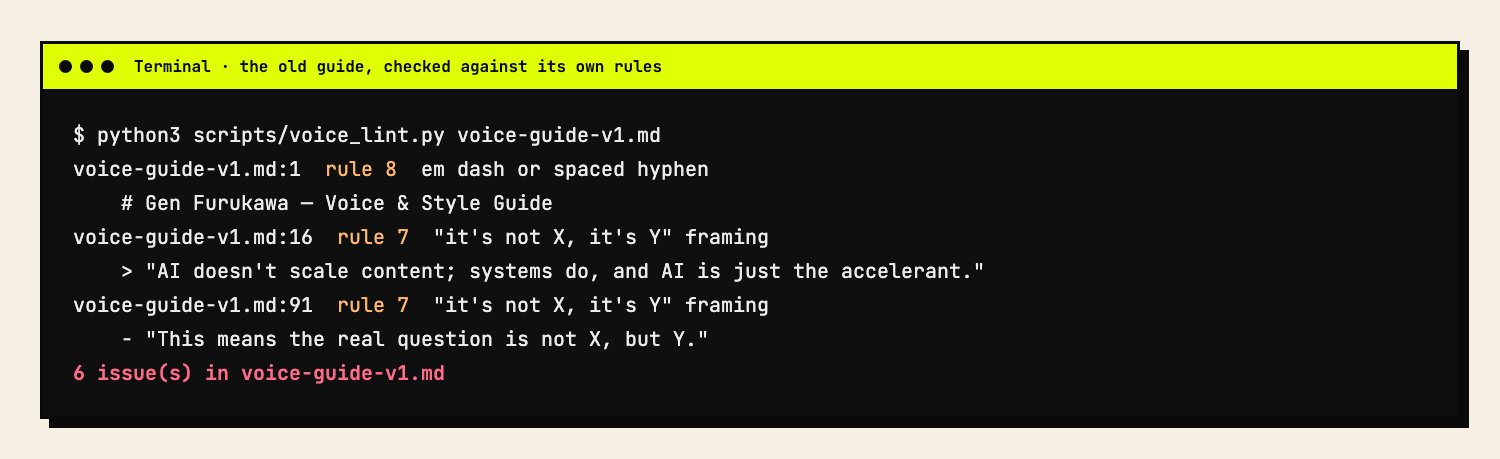
I learned that by checking my own guide. My AI drafts kept drifting from how I write, so I ran my voice guide against its own rules. It failed 6 times.
Here's how I rebuilt it, what I learned doing it, and a free template with the same structure.
The last straw was one LinkedIn post that took four drafts to stop sounding like generic advice and start sounding like me.
Why does AI ignore your brand voice guide?
Three reasons, and my old guide had all three.
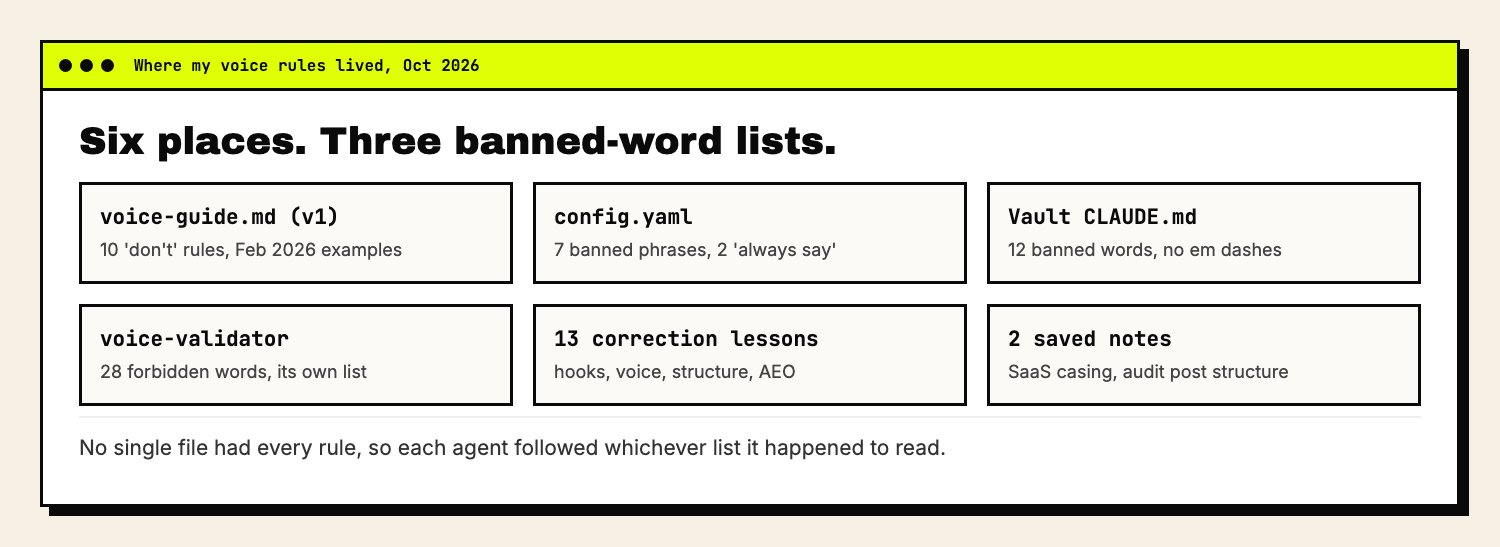
The rules were spread across files. My voice rules lived in six places: the guide, a config file, my notes vault, the checker, 13 correction lessons and two saved notes. There were three different banned-word lists, with 7, 12 and 28 entries. No single file had every rule, so each AI tool followed whichever one it read.
The examples taught the wrong habit. My guide banned the "it's not X, it's Y" framing. Its own thesis example was "AI doesn't scale content; systems do." AI copies examples more faithfully than rules, so the example won.
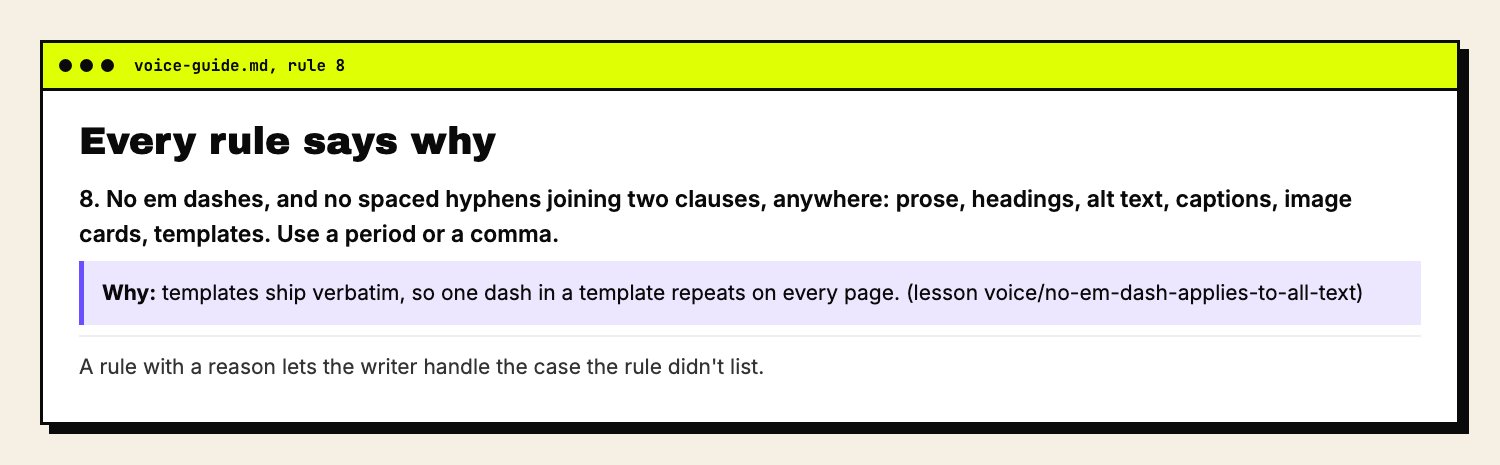
The rules had no reasons. "No em dashes" kept failing in image captions and alt text, after the body text was clean. The rule only held once it said why: templates ship word for word, so one dash in a template repeats on every page.
How do you build a brand voice guide AI will follow?
Five steps. I did each one this week on my own guide.
1. Write who you're writing for
One paragraph: their role, their stage, what they already tried, how they read.
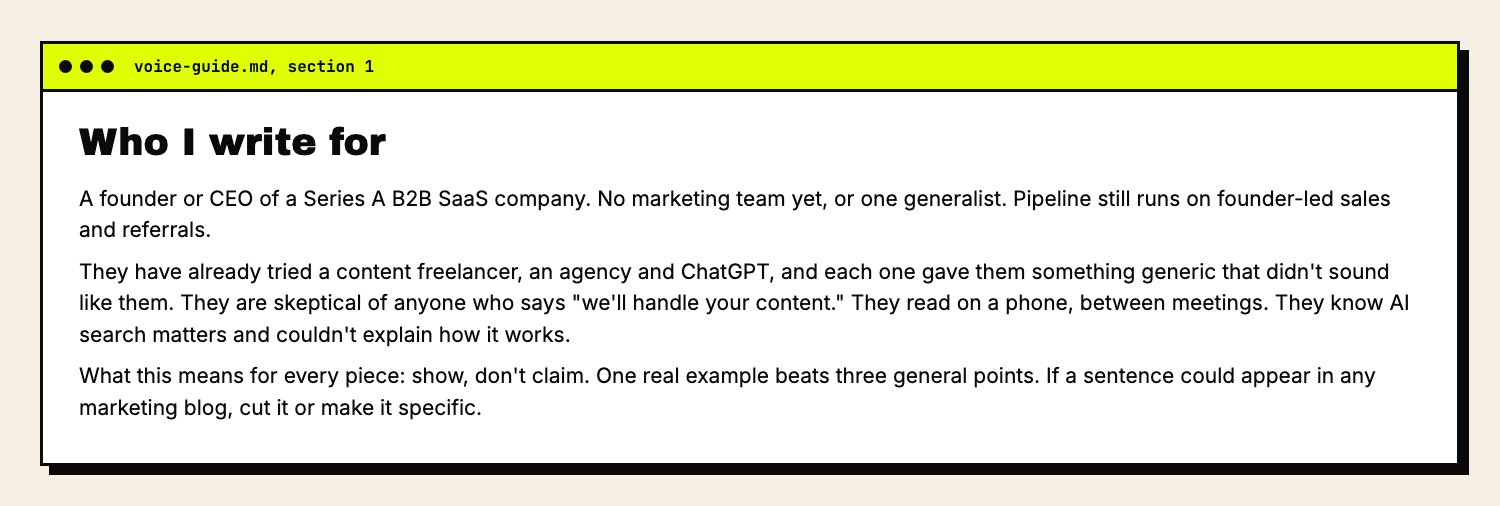
Mine is a Series A SaaS founder with no marketing team who has already tried a freelancer, an agency and ChatGPT. That one paragraph changes every draft. It turns "explain the concept" into "show the real example".
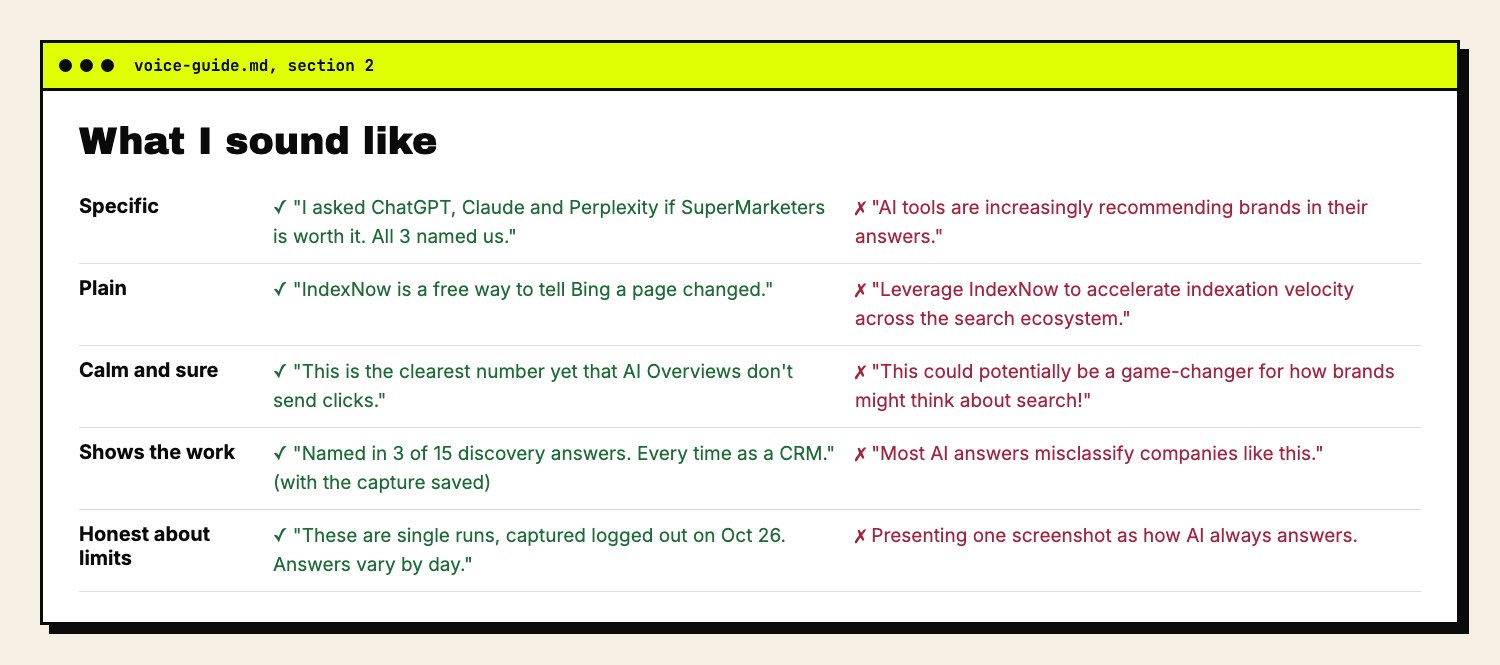
2. Name 4 or 5 traits, each with a real "sounds like" and "doesn't"
Pick traits you can show. For each one, paste a sentence you actually wrote and the generic version AI gives you.
3. Give every rule a reason
A rule with a reason covers the cases you didn't list. Write the rule, then "Why:", then an example.
4. Turn your edits into before and after examples
This is the part most guides skip, and it matters most. Every time you rewrite an AI draft, keep the old line and the new line. They show the model exactly what you want.
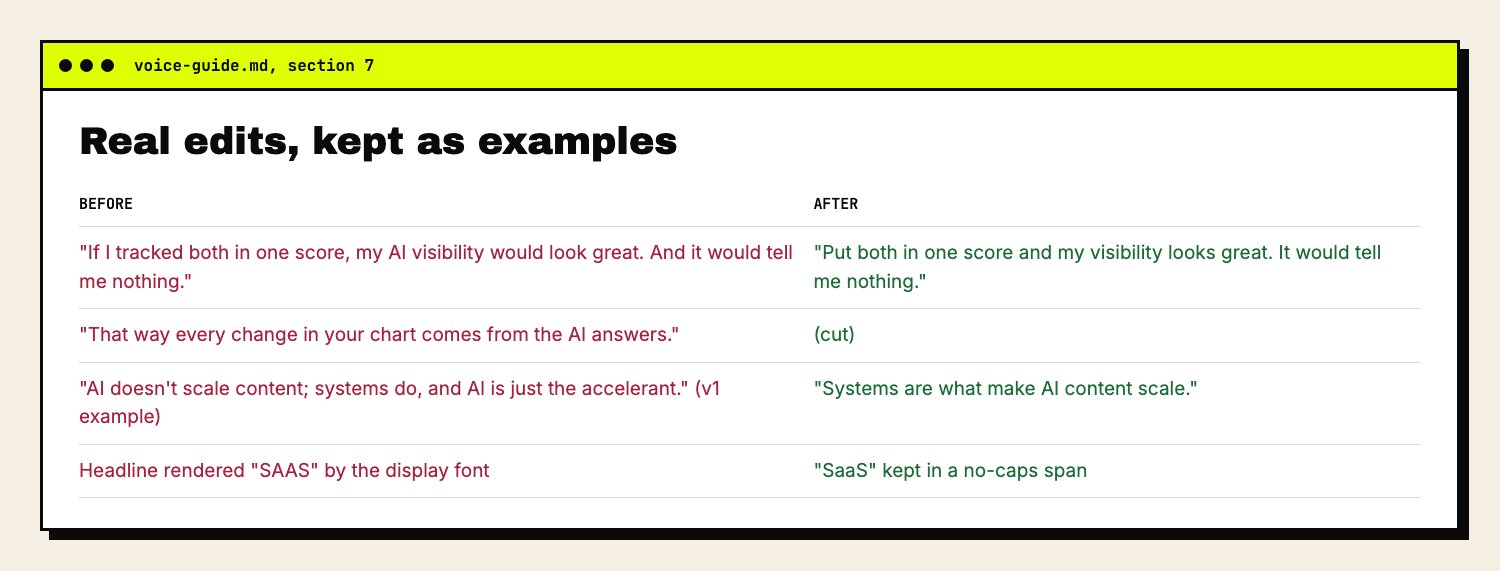
The edit I make all the time: deleting the last sentence of a paragraph. AI loves to explain the point it just made.
5. Put banned words in one list and check it with code
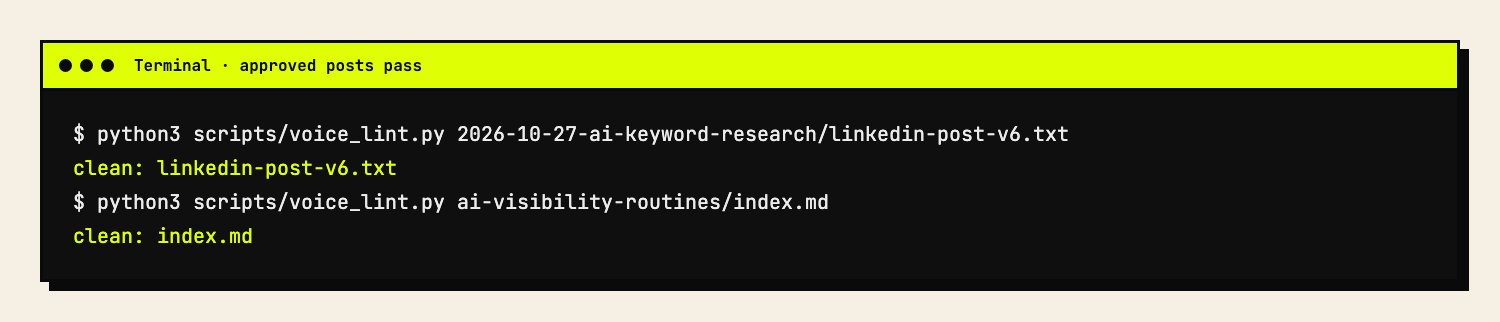
AI checkers miss words. In my own system, an AI checker once marked a draft "pass" while it contained "content engine", a phrase on its own banned list. A script doesn't skip anything.
I wrote a small one, voice_lint.py. It reads the banned list straight from the guide, so there's one list to update. It also catches em dashes, "it's not X, it's Y" framing, hedges like "might" and "perhaps", question hooks, and "SAAS" in all caps.
What should a brand voice guide include?
The standard best practice, from style guides like Mailchimp's, comes down to one idea: your voice stays the same everywhere, and your tone changes with the context. A good guide has personality traits with "sounds like" and "doesn't sound like" examples, words to use and avoid, a tone guide by channel, style decisions like contractions and commas, and real examples from your own writing.
The AI content platforms add the parts a model needs. AirOps' Brand Kit is built from Foundations (company description, mission, values, brand voice and tone, author persona, global writing rules), plus audiences, content types, product lines, regions and competitors. Its writing rules are scoped: global rules apply everywhere, and audience or region rules override them. Profound's Brand Kit splits into brand information (about the brand, ideal customer profile, competitors, brand point of view) and writing style (author persona, tone of voice, writing rules), generated from your website.
Here's how they compare, based on their public docs as of Nov 2026, and what I added to mine:
| Section | Standard style guide | AirOps Brand Kit | Profound Brand Kit | My voice guide |
|---|---|---|---|---|
| Who you write for | Sometimes | Audiences | Ideal customer profile | Primary reader and the champion who forwards it |
| Company foundations and point of view | Rarely | Description, mission, values | About the brand, brand point of view | The line word for word, what we believe |
| Author persona | No | Author persona | Author persona | First person, background used only when relevant |
| Traits with examples | Yes | Brand voice and tone | Tone of voice | 5 traits, each with a real "sounds like" and "doesn't" |
| Rules | Do's and don'ts | Writing rules, scoped | Writing rules | 21 rules, each with the reason and an example |
| Banned words | Words to avoid | Inside writing rules | Inside writing rules | One list, checked by a script |
| Tone by channel | Yes | Content types | Not in their docs | Tone table for 7 contexts, plus structures per format |
| Style sheet | Yes | Inside writing rules | Inside writing rules | Commas, numbers, casing, product names |
| Competitors | No | Competitors | Competitors | How to name them fairly, with sources |
| Real edits, before and after | No | Content samples | Writing sample | Every correction, dated |
| A check on every draft | No | Not in their docs | Not in their docs | voice_lint.py plus a review checklist |
| Proof it's used everywhere | No | Applies inside the platform | Applies inside the platform | voice_coverage.py across every tool |
The platforms are good at storing a brand kit and applying it inside their own tools. A markdown file in your repo goes further: every tool you use can read it, and you can check that each one does.
What I learned rebuilding my voice guide
- One file wins. Three banned lists meant three voices. Everything else should point to one guide.
- Check the guide against itself. Mine broke its own rules 6 times before any AI touched it.
- Examples outrank rules. A bad example teaches the habit faster than a rule forbids it.
- Reasons make rules stick. The em dash rule only held once it explained why.
- Your edits are your voice. The before and after pairs taught more than any trait description.
- Code checks words, AI checks judgment. Banned words go to a script. "Is the hook specific?" goes to a person or a reviewer.
- Rules go stale. An older rule said never open a LinkedIn post with "I". A newer structure said open with what I did. The fix: date every rule, and the newer one wins.
- Write for one reader. The "who I write for" paragraph improved drafts more than any single rule.
Where does your brand voice show up?
Everywhere a buyer, a client or an AI engine reads your words. That's more places than most guides plan for:
| Output | What the guide controls |
|---|---|
| LinkedIn posts | The first line, the structure, the ending |
| Blog posts and tutorials | The opening answer, the headings, the proof |
| Video scripts | One takeaway per section, numbers said out loud |
| Newsletter | One topic, one link, the sign-off |
| Outbound and client messages | The first line about them, the tone, how you name competitors |
| Page titles, meta descriptions, alt text, image cards | Punctuation, casing, banned words |
| Profiles and llms.txt | The company line, word for word |
The last two rows are where voice leaks. Templates and image cards ship word for word, and AI answer engines quote your profiles and page descriptions when they describe you.
How do you get AI to use it every time?
Put one line where every tool reads first. In a code repo that's CLAUDE.md (Claude Code) and AGENTS.md (Codex):
Read config/voice-guide.md first before writing anything in our voice. It wins over every other style note.In ChatGPT or Claude, make a Project, upload the guide, and put the same line in the project instructions. Then call it by section, so the model knows which part to use:
- "Read my voice guide, then write a LinkedIn lesson post from these notes."
- "Check this draft against my voice guide. Quote each line that breaks a rule, name the rule, give the fix."
- "Here's your draft and my version. Add the rule my edit shows to the guide, with the reason and the before and after."
How do you know it's included everywhere?
Check it like code. I wrote a second script, voice_coverage.py. It confirms that every instruction file and every writing tool points to the guide, and that every other banned list in my system is contained in the guide's list.
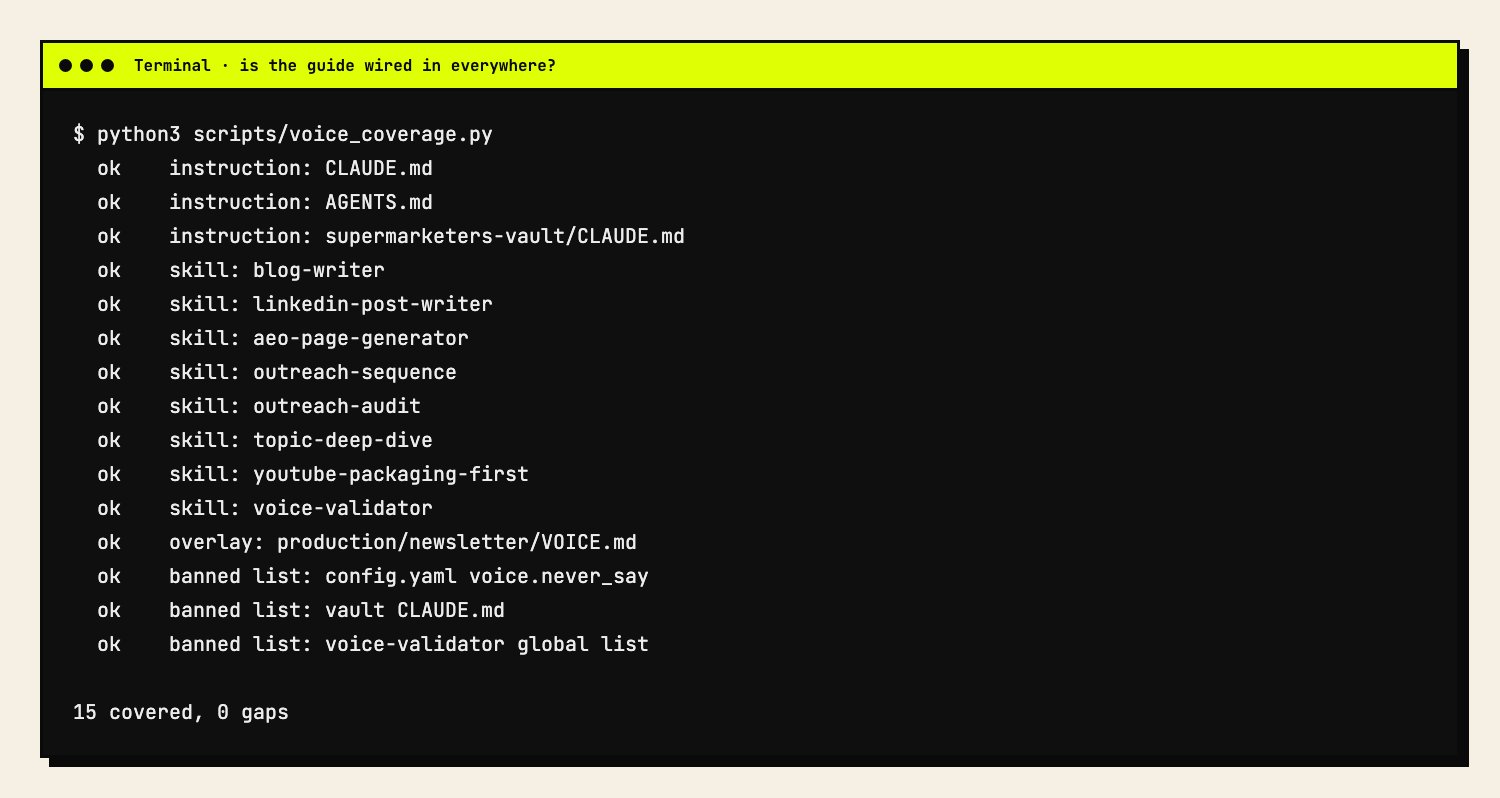
Run it after you add any new tool, skill or project. A voice guide that one tool skips is a voice guide that tool ignores.
Get the template
Download the voice guide template. It's the same structure as my real guide, with brackets to fill in, plus a map of which sections go into AirOps and Profound fields. Save it as voice-guide.md wherever your AI tools read first.
Download the prompts: one to build your guide from your writing and your edits, one to write in your voice, one to check a draft, and one to turn an edit into a new rule. Here's the first one:
You are helping me write a brand voice guide that AI tools will follow. Use the template I'm attaching.
I'm giving you: A) 10 pieces of my writing I'm proud of, B) 5 drafts next to the version I published,
C) who I write for. In order, asking me before each step:
1. From A, find 4 or 5 traits. Quote one real sentence of mine for each, plus the generic AI version.
2. From B, turn every change I made into a rule: the rule, why, and the before and after.
3. Put the words I removed or never use in one banned list.
4. Draft the full guide from the template. Mark anything you guessed with [CHECK].
Quote me exactly and don't add hype.
How SuperMarketers builds this for clients
In month one, I interview your founder and experts, collect your best existing work, and build the voice guide from it, along with the checks every draft passes before you see it. It's the base every other piece of work runs on, and it stays in your tools.
FAQ
How long should a brand voice guide be?
Long enough to hold real examples. Mine is about 390 lines. Length matters less than whether every rule has a reason and an example.
Can I just paste my old posts into ChatGPT or Claude?
It helps, but samples alone don't tell the model what to avoid or why. The edits and the reasons do that.
How often should I update it?
Every time you correct a draft. Add the rule the same day, with the date.
What's the difference between brand voice and tone?
Voice stays the same everywhere. Tone shifts by format: a LinkedIn post is shorter and punchier than a tutorial. The guide holds both: traits for voice, structures by format for tone.
Start with your last five edits. They already know your voice. If you'd rather have it built from your team's best work, book a call.