In July I built an approval system where silence meant yes. If I didn't object to a task by its due date, an agent ran it. On October 23 I switched it off, and three days later I deleted 52 agents, skills and commands I'd built around it.

What's left is the setup I run SuperMarketers on today: 21 Claude Code skills, 22 scheduled jobs, one voice file and one rule. The AI never approves its own work. A person approves and publishes, and that person is me.
This post is that setup, part by part, with the files and the numbers as of November 23, 2026. If you want a build guide in order, read agentic marketing, step by step. This is the tour of mine, including the part that still isn't working.
Why Claude Code and not a chat window
A chat window starts from zero every time. Claude Code opens inside a folder that already holds my voice guide, my offer, my buyer questions and my checks. Every agent reads the same files before it does anything.
I started the first of my four repos on February 20. Since then they've collected 711 commits: 294 in growth, 228 in the website, 172 in delivery and 17 in the open-source repo. The setup below is what survived those commits.
The whole setup on one page
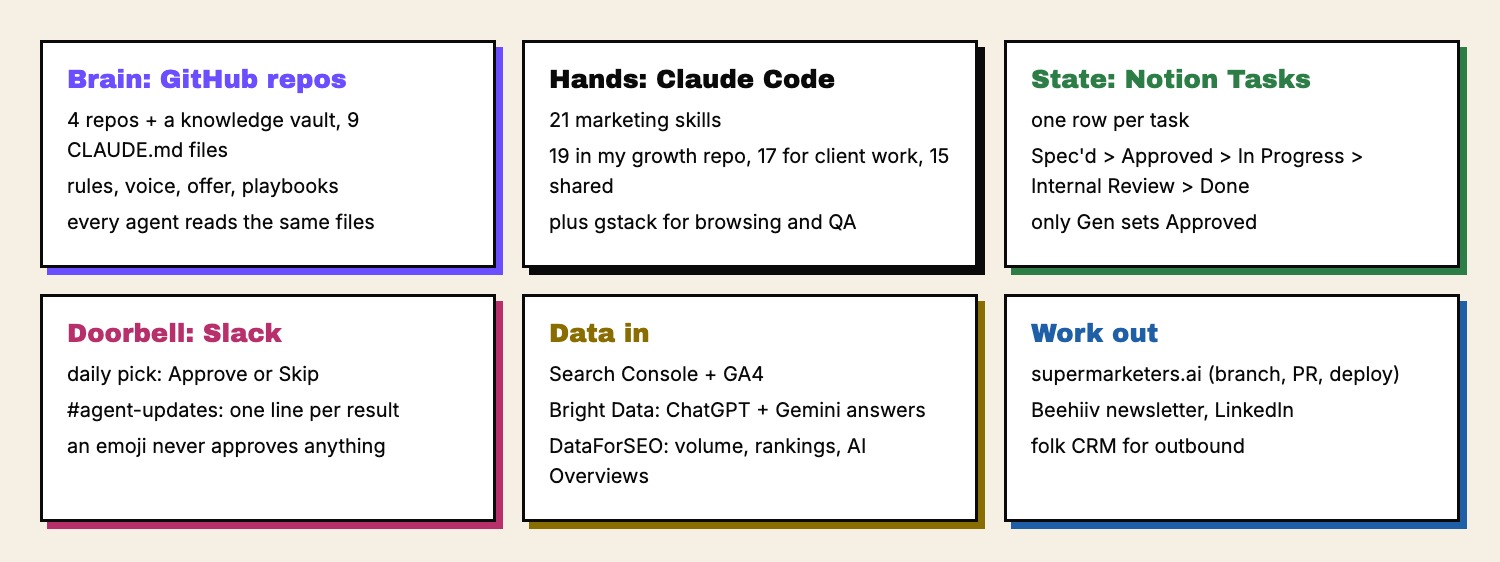
| Part | Tool | Its one job |
|---|---|---|
| Brain | 4 GitHub repos | Voice, offer, facts and rules, as plain files every agent reads |
| Hands | Claude Code, sometimes Codex | 21 skills that do the work |
| State | Notion Tasks | One row per task. Only I set Approved. |
| Doorbell | Slack | Reports and Approve/Skip cards reach me here |
| Data in | Search Console, GA4, Bright Data, DataForSEO | Rankings, AI Overviews, and what ChatGPT and Gemini answer |
| Work out | supermarketers.ai, Beehiiv, LinkedIn, folk | Where approved work lands |
Swap any tool and the system still works. The files and the gates are the part I'd rebuild first.
The brain is a folder
Everything an agent needs to know about SuperMarketers is Markdown in Git: offer, pricing, ICP, voice, playbooks. Methods that would work for any company live in one repo. SuperMarketers' own decisions and content live in another. The website is a third. The fourth is the open-source version anyone can copy.
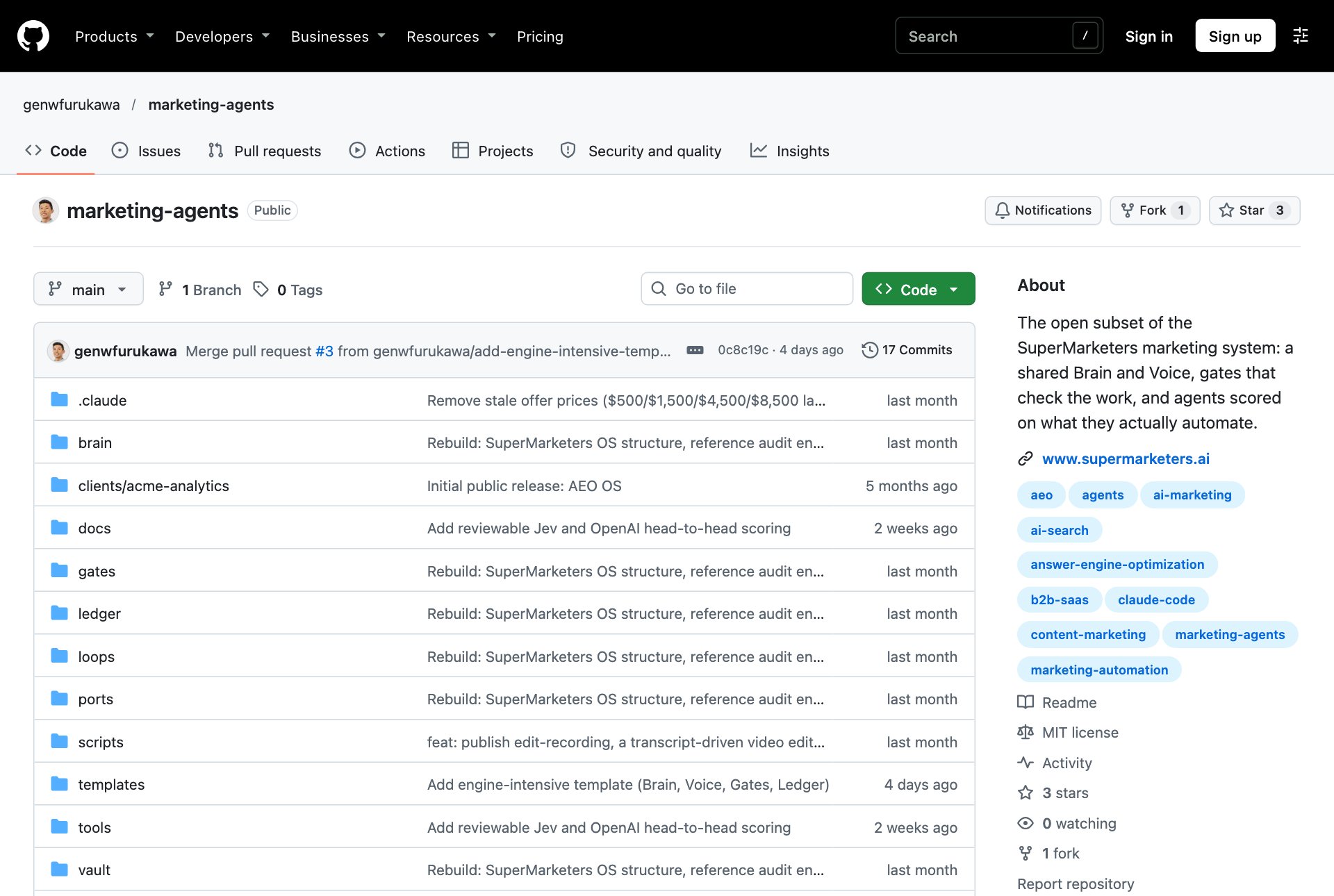
Nine CLAUDE.md files tell agents what belongs where. The one in my growth repo is a three-row table: methods go to delivery, decisions stay in growth, evolving research goes to the vault. Before that table existed, agents filed things wherever the conversation happened and I stopped trusting my own folders. The full structure is in three folders any AI can use.
Every agent reads one voice file
config/voice-guide.md is the file every writing skill loads before it drafts. It has 21 numbered rules, each with the reason it exists, and one banned list of 43 words and phrases. A script reads that list and checks every draft before I see it.
Here's the check running on a generic AI draft about AI agents, and then on my rewrite:
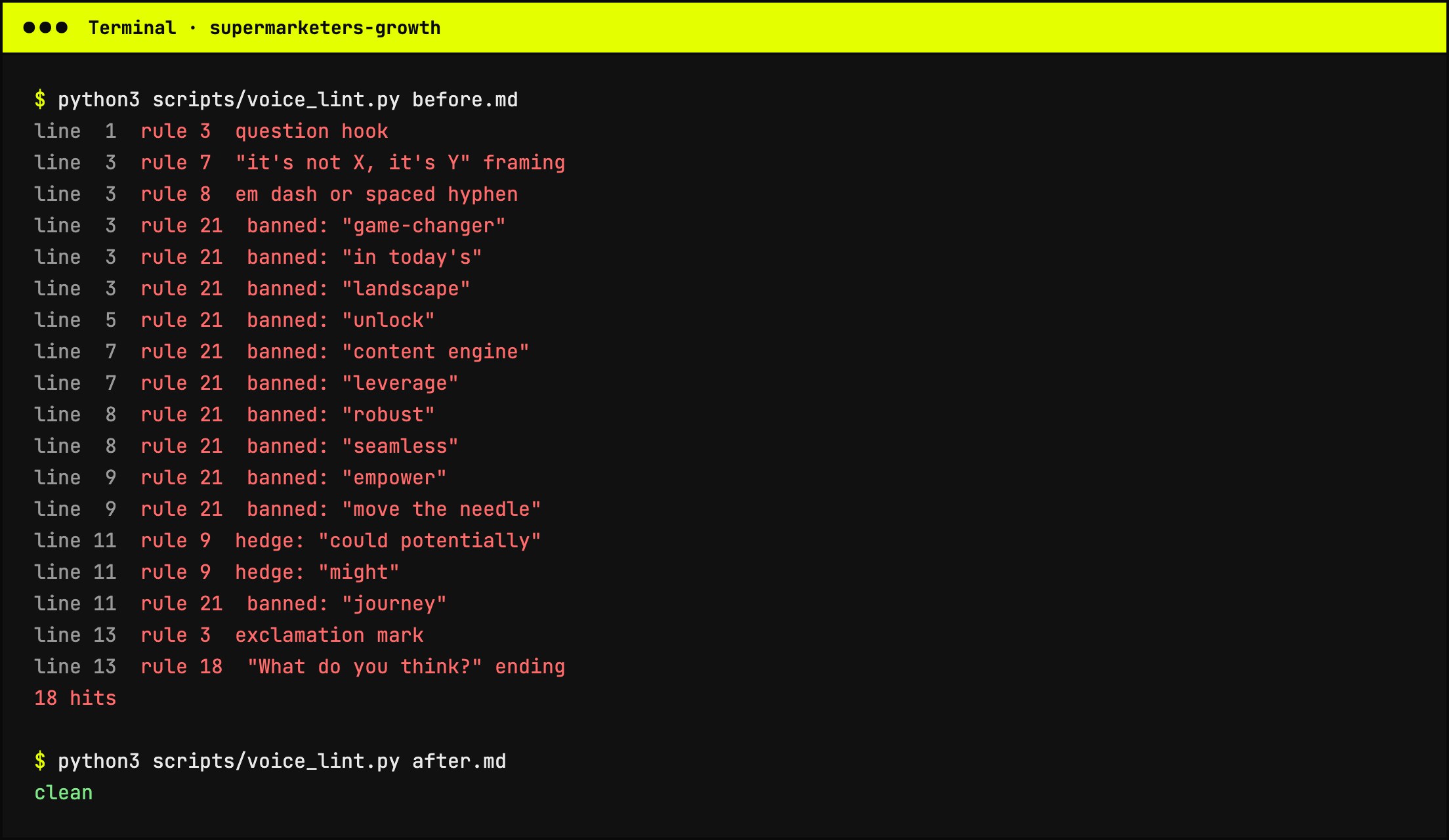
Most of those rules came from my own edits. Rule 7, no "it's not X, it's Y" in any form, is marked as mine, from October 2026. When I fix the same thing twice, it becomes a numbered rule with a date and a reason. The story of rebuilding the guide is in the brand voice guide AI follows.
A skill is a job description
A skill says when to use it, the steps, and the check at the end. Write the check first. A skill without one hands you more to review.
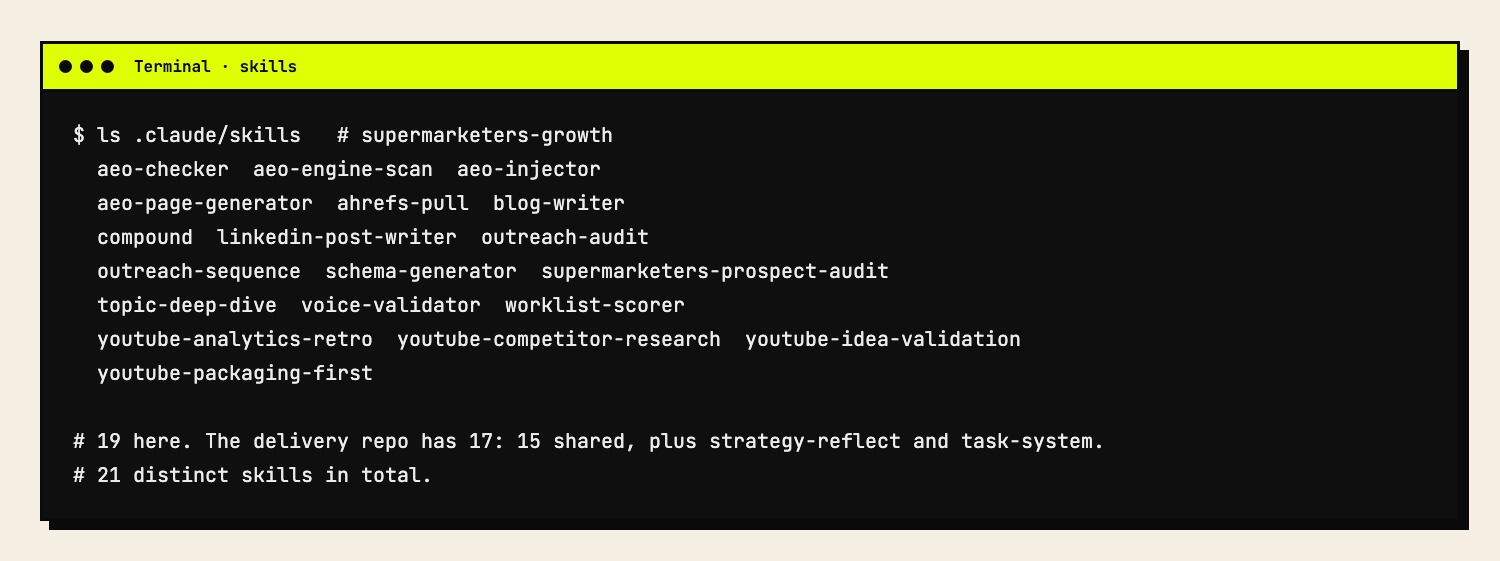
My blog-writer skill won't write from a one-line prompt. Its first rule is "you must interview before you write." Then it drafts in my voice and runs the voice validator before I see anything.
Four agents, doing real work
| Agent | What it does | What stays mine |
|---|---|---|
| Voice | Loads the guide, checks every draft | Adding rules from my edits |
| Content | Research first, draft second, check third, then log the number the change should move | Approving the task and reading the draft |
| AI search tracking | Asks ChatGPT and Gemini my buyers' questions every Monday and saves every answer | Reviewing the read before any number goes public |
| Outbound | Drafts a sequence that opens with one finding about the prospect's company, and loads it into folk | Sending every message, by hand |
The content agent's output is public. My site shipped 41 changes in October and 18 so far in November. Each one is dated in the Lab's shipped log, with the reason and the number it should move.
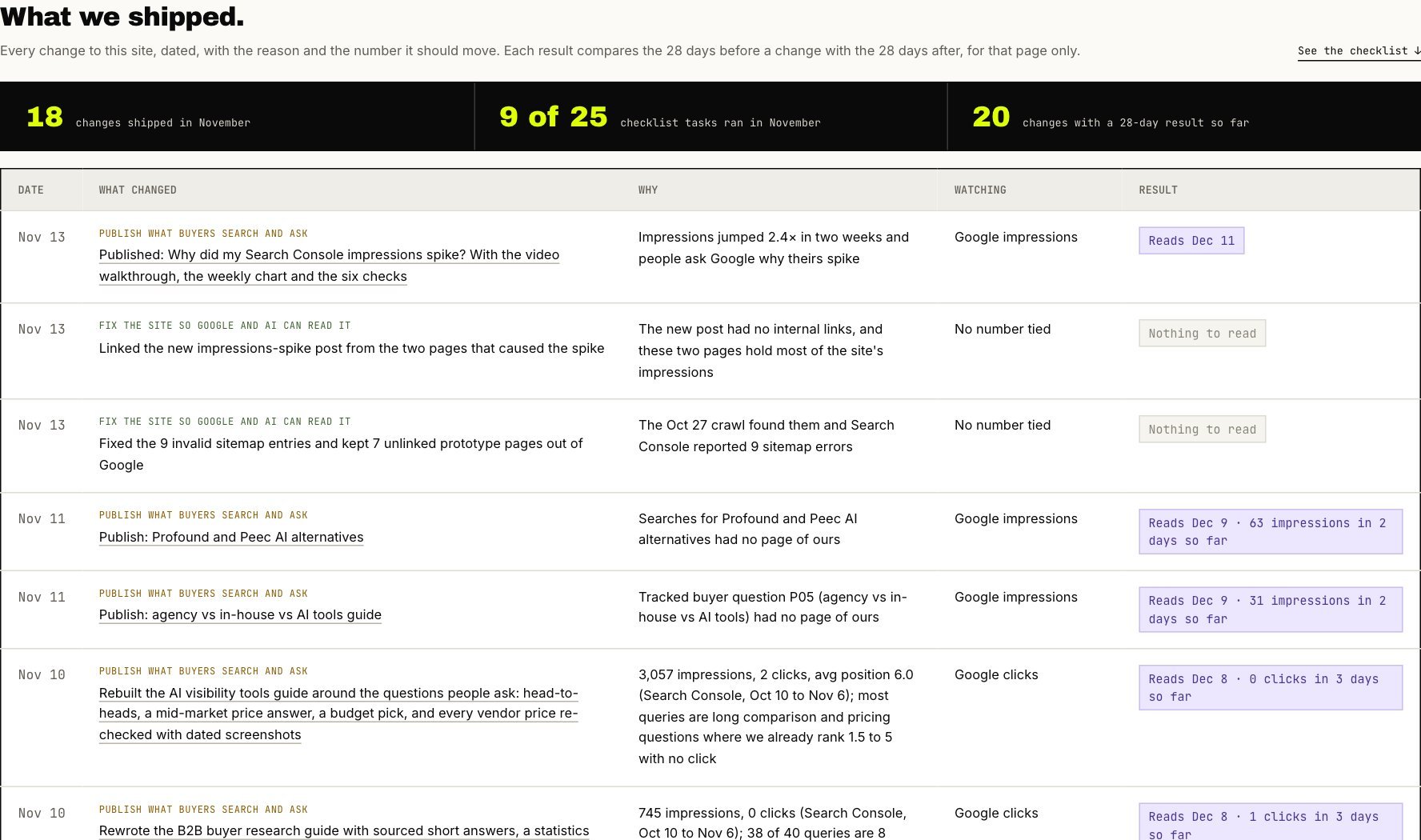
31 of October's 41 changes name the metric they should move. The other 10 don't, which means I can't tell you whether they worked.
What runs without me
22 jobs run on a schedule through launchd on my Mac. A weekday looks like this:
| Time | Job | What lands |
|---|---|---|
| 6:00 Mon | Lab weekly | AI answers, rankings and Search Console pages to refresh |
| 6:30 | Daily pick | One proposed task per client, with Approve and Skip buttons in Slack |
| 7:15 | News brief | What changed in AI search and B2B SaaS buying in the last 48 hours |
| 7:45 | Demand | Buyer questions to act on, and what competitors changed |
| 8:00 | Outreach card | Today's follow-ups to send |
| 10:00 | Lab refresh | Rebuilds the numbers on my Lab page |
| 15:30 | Outreach nudge | Who hasn't heard back |
Two of the 22 publish anything. Lab refresh updates the generated numbers on my Lab page, and the Hiring Index rebuilds every week. I approved both in advance, and both are data pages. No job publishes an article, a post or a message.
The daily pick is the doorbell. It proposes a task in Slack, and pressing Approve there is the only way that task reaches Approved. An emoji reaction approves nothing.
The two gates
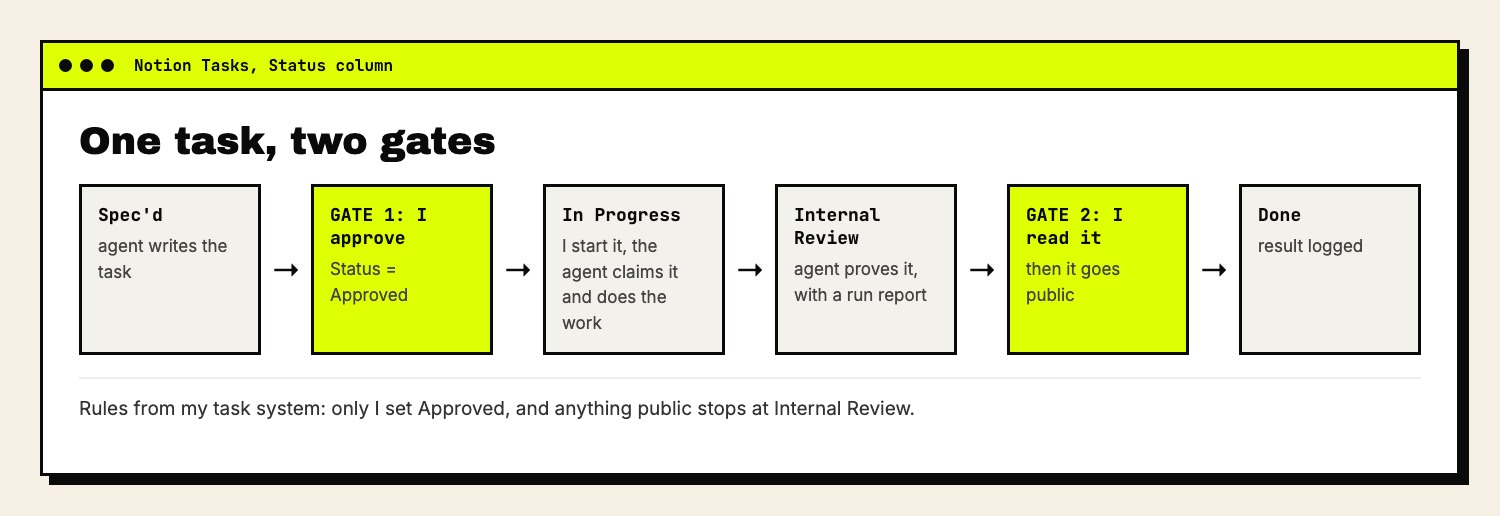
Gate 1: a task only runs once I set it to Approved in Notion. Every task answers three questions first: why we're doing it, how, and what done looks like.
Gate 2: anything public or client-facing stops at Internal Review until I read it. Every message to a client waits in my Slack DMs until I press Send.
Between the gates, the agents do the work and write a run report on the Notion row: what they did, what they checked, what they couldn't do. No task starts on its own. I start each approved one from the terminal.
The task rules I rewrote on October 23 say it in one line: "Focus, Due date, silence, and an agent-created task do not grant approval." Approval is a decision, and the decisions are mine.
What breaks
I took this screenshot on the morning I published this post:
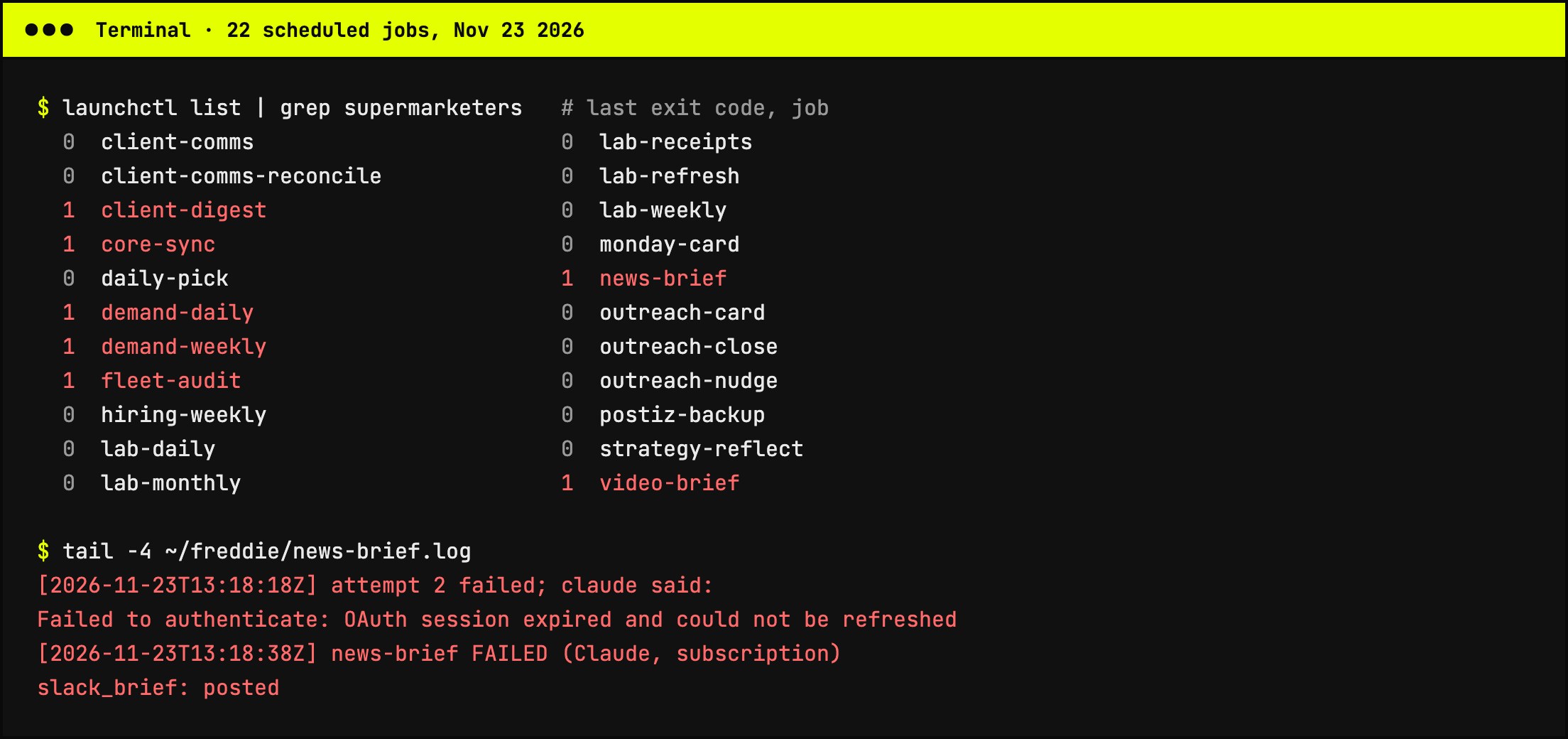
The folder is still called ~/freddie, after the named agent I retired in October. The jobs posted their failures to Slack, which is how I found out. A setup like this needs someone who reads the failures every morning.
The bigger miss is the number the whole setup exists to move. Every Monday my tracker asks ChatGPT and Gemini 9 buying questions, three times each, logged out.
| Round | Buying answers | SuperMarketers named | Named when asked about by name |
|---|---|---|---|
| Oct 27 | 54 | 0 | 6 of 6 |
| Nov 2 | 54 | 0 | 6 of 6 |
| Nov 9 (partial, 10 failed) | 18 | 0 | 2 of 2 |
| Nov 16 | 54 | 0 | 6 of 6 |
| Nov 23 | 54 | 0 | 6 of 6 |
0 of 54, five weeks running. The engines know who I am when asked directly. They don't recommend me yet when a buyer asks who to hire. These are automatic reads I haven't reviewed by hand, and one round was partial, so read them as a trend. On November 23, Google also showed an AI Overview on all 57 keywords I track.
Agents made the work cheap. They haven't made the market pick me. That takes pages buyers and AI engines trust, built week after week, and I'm running that experiment in the open on the Lab.
Build yours this week
Start with three things and ignore the rest until they work:
- One voice file. Your rules, each with its reason, and the words you never use.
- One skill. The task you repeat every week, with its steps and the check at the end.
- One weekly report. The number you care about, read by an agent every Monday.
The open-source repo has working versions of all three. For the AI search number, the free AI Recommendation Tracker gives you the prompt that writes your 10 buyer questions, a log and a dashboard.
Pick the one task you repeat every week and write its rules down today. That file is your first agent.