Startup marketing roles that list pay sit at about $150K to $188K in the middle of the range for US roles. The exception is AI search: none of the 6 open SEO and AEO roles list a salary, while every other kind of marketing work lists pay more than half the time.
I found that because, on a whim, I built a job board. After the news of layoffs at Canva and other companies this week, I wanted a resource that points marketers to open roles. And once the jobs were in one place, I was curious what the data would say.
The board lives at supermarketers.ai/hiring and updates every Monday. Below is what the first week of data shows, 20 remote roles you can apply to now, and how it's built, so you can point the same approach at any market.
What's in the data?
134 open marketing roles at 101 software startups, checked on Nov 4, 2026.
- Where they come from: each company's own job board on Ashby, Greenhouse or Lever, plus Y Combinator's directory. About 1,200 startups are checked every week.
- What counts: roles SuperMarketers also does. That's founding and head-of-marketing hires, AI search, content and product marketing, social and video, and growth and demand gen. Events, field marketing, PR, paid ads, partnerships and ops roles are left out.
- Pay: only the range the company published in its own post. 77 of the 134 roles list one. Nothing is estimated.
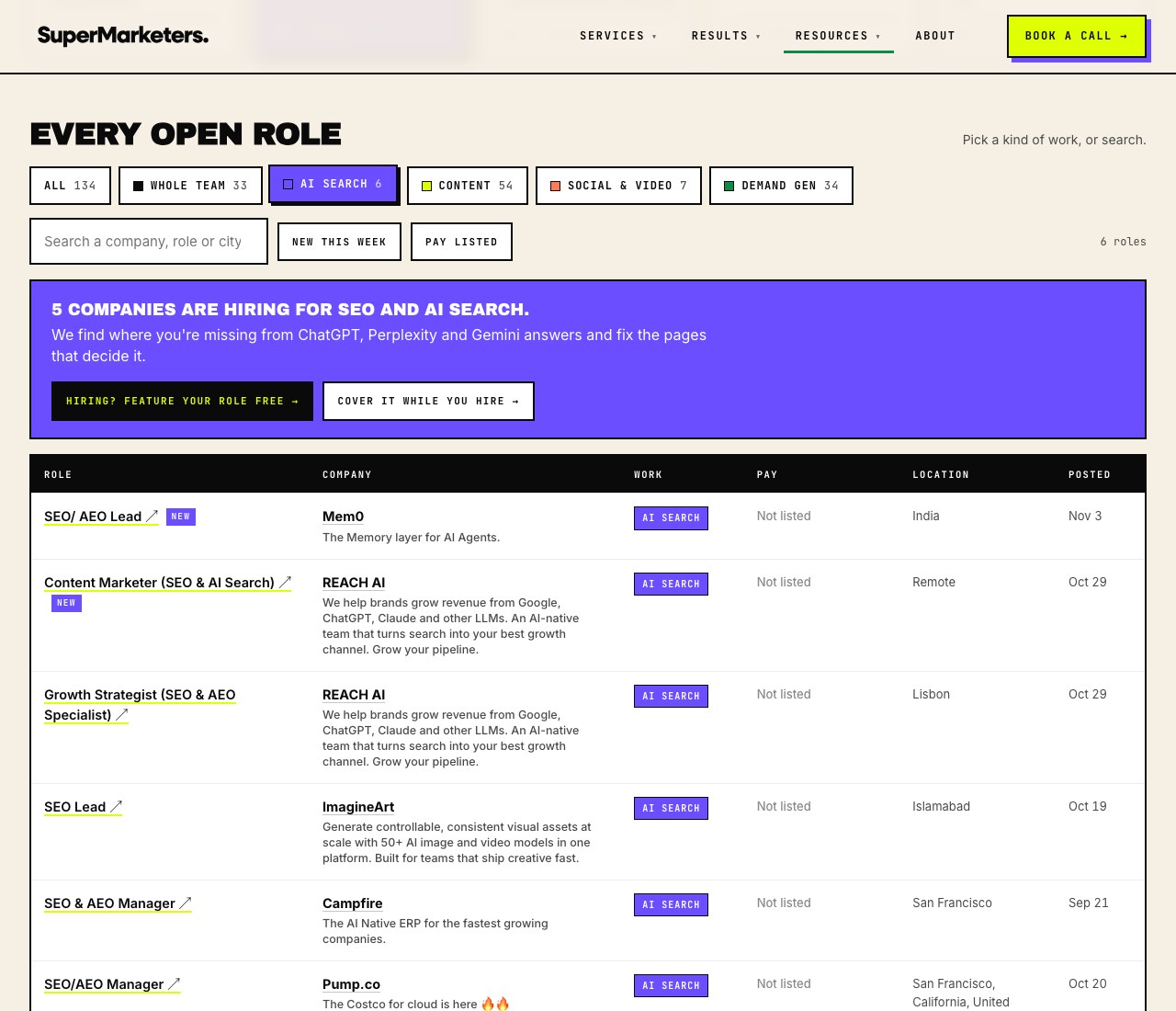
Why don't AI search roles list pay?
Here's how often each kind of work lists a salary:
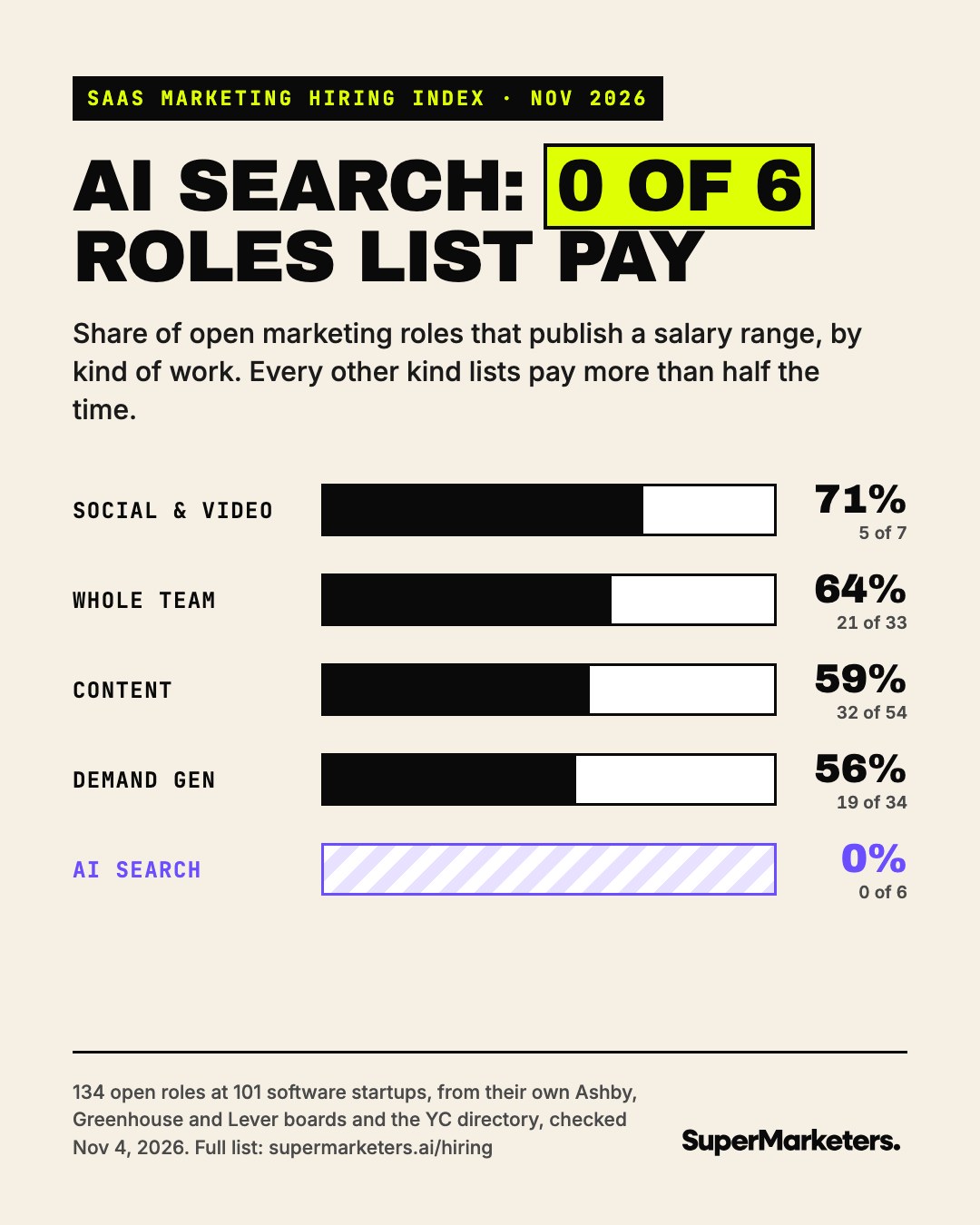
Campfire is the clearest example. It lists $180K to $250K on its product, content, customer and partner marketing roles. Its SEO & AEO Manager role has no number.
I'm not sure what to make of it yet. My read is that companies know they need AI search, but they haven't decided what it's worth. 5 of the 6 roles put AEO or AI search next to SEO in the title, so the work is being added to the SEO job rather than hired on its own.
Part of the problem is that "AI search" in a job post can mean 4 different jobs. When I scope this work for clients, it breaks down like this:
- An audit of where you show up in ChatGPT, Perplexity and Gemini, and who shows up instead.
- Rebuilding key pages so AI tools can find and quote them.
- Cleaning up how your company is described across your site and profiles.
- Re-running your buyers' prompts every week and reporting the trend.
Most of these posts fold all 4 into one SEO role.
If you're applying for one of these roles: look at what the same company pays for its other marketing roles. At Campfire, that's $180K to $250K. It's a fair anchor when they ask for your number.
Do founding marketers earn less than heads of marketing?
Yes, at least among the roles that list pay.
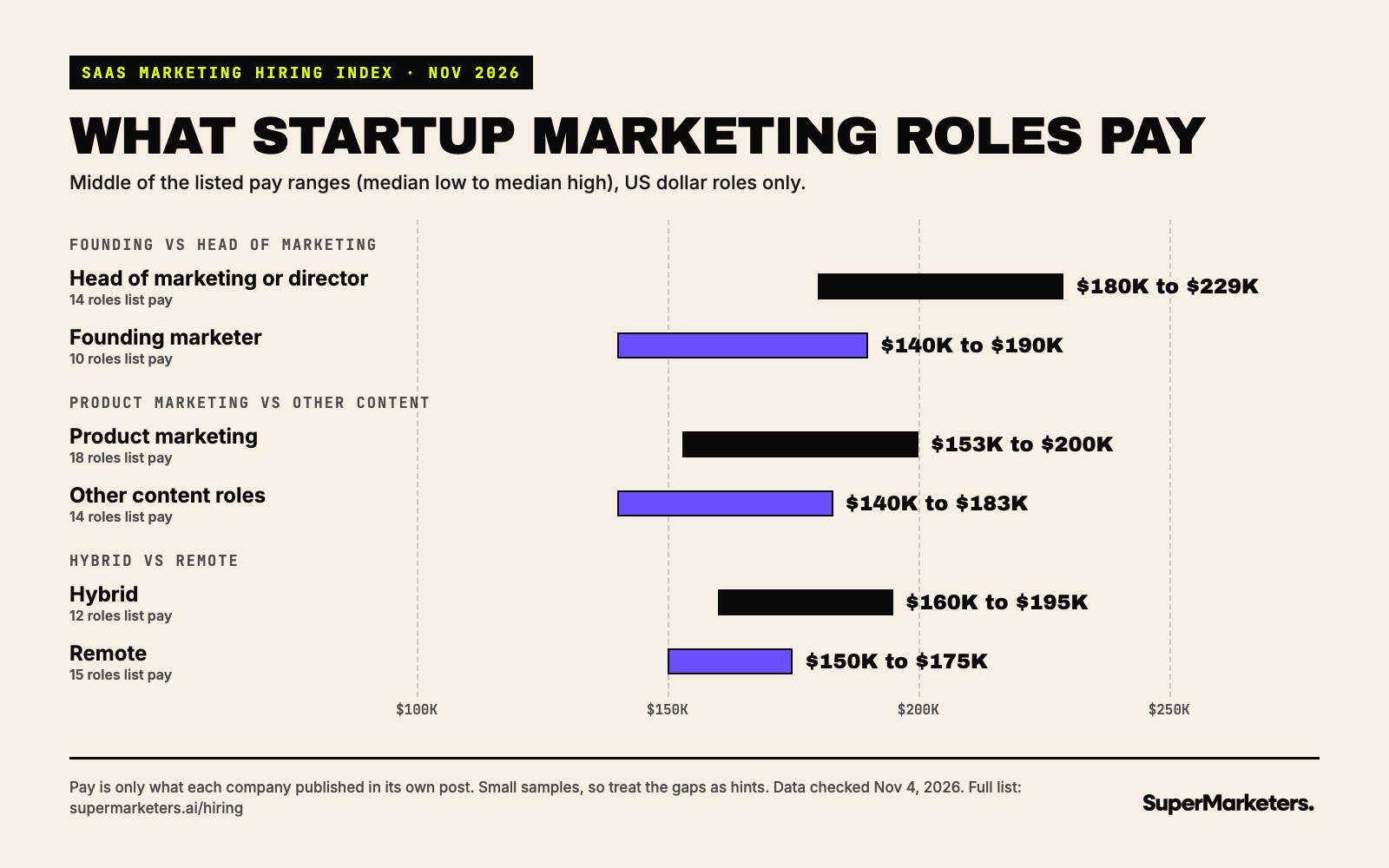
| Comparison | Middle of the range | Roles that list pay |
|---|---|---|
| Head of marketing or director | $180K to $229K | 14 |
| Founding marketer | $140K to $190K | 10 |
| Product marketing | $153K to $200K | 18 |
| Other content roles | $140K to $183K | 14 |
| Hybrid | $160K to $195K | 12 |
| Remote | $150K to $175K | 15 |
Founding marketers are paid less in cash and more in equity: 8 of the 10 founding roles that list pay add equity. You're paid in upside for doing the head-of job early.
Product marketing pays the most of the content work, at $153K to $200K against $140K to $183K for other content roles.
Remote costs about $20K at the top of the range: $150K to $175K for remote roles, against $160K to $195K for hybrid. These are small samples (15 and 12 roles), so treat it as a hint, not a rule.
What else stands out?
- "Growth" is the word of the year. It's in 41 of the 134 job titles, more than any other word.
- Equity is the norm. 57 of the 77 roles that list pay also offer equity.
- Half the companies hiring are AI companies. 52 of the 101 describe themselves with "AI" or "agents".
- Some ranges are very wide. The typical published range is $40K wide. A few run $150K to $300K. My guess is those companies haven't decided whether they're hiring a manager or a head of marketing.
- 57 of the 134 roles don't list pay at all.
Which startups are hiring remote marketers this week?
One role per company, newest first. Pay is listed where the company published it. Roles close, so check the Hiring Index for the current list.
How is the Hiring Index built?
Five steps. I built it with Claude Code over two days, and it runs on my Mac every Monday.
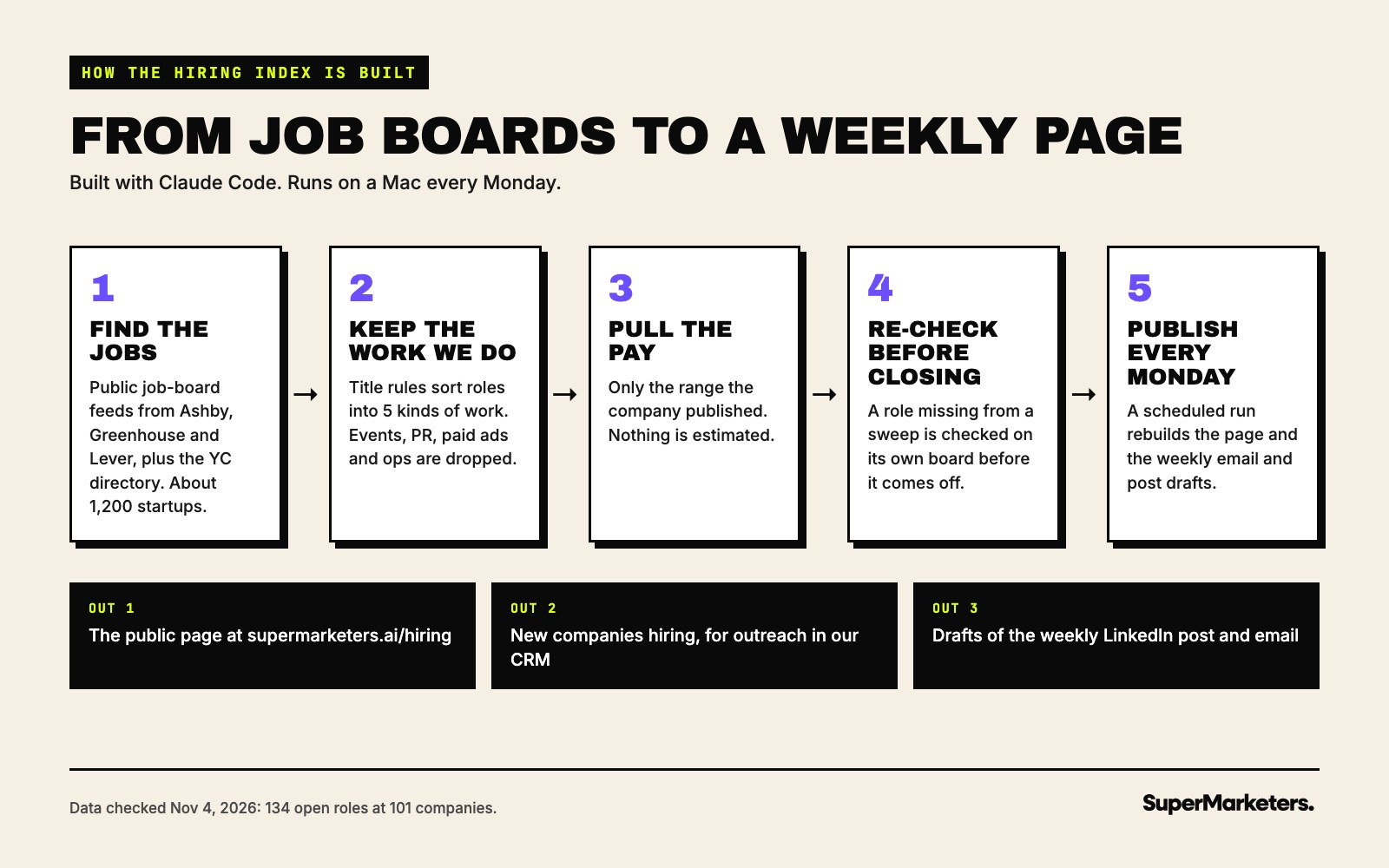
- Find the jobs. Most startups post through Ashby, Greenhouse or Lever, and each has a free public job-board feed. You can open one in a browser:
api.ashbyhq.com/posting-api/job-board/campfirereturns Campfire's open roles. The YC directory adds company facts. - Keep the work you care about. A short list of title rules sorts each role ("SEO", "content", "lifecycle", "founding") and drops the rest.
- Pull the pay. All three job-board feeds carry the published range when a company enters one. Use only what's published.
- Re-check before closing. When a role drops out of a weekly sweep, check the company's board again before taking it off the list.
- Publish on a schedule. Every Monday it re-sweeps, rebuilds the page and drafts the weekly email and LinkedIn post.
What broke along the way
- Names collide. A job board called "Fulcrum" turned out to belong to an Australian staffing agency, not the startup with that name. Check that the board matches the company.
- "Remote" isn't always remote. Ashby marks hybrid roles as remote too, so read the workplace type, not the flag.
- Short descriptions get cut off. YC's one-line descriptions sometimes end in "…". I pull the full sentence from the long description or the company's homepage instead.
- One company can set the median. One company posting five similar roles skewed a whole category, so each company counts once in a median.
- Sweeps don't cover the same companies every week. A role can look closed when it simply wasn't checked. That's why step 4 exists.
How can you use it?
If you're looking for a role: turn on "Pay listed" first, check "New this week" every Monday, or get the new roles by email each week.
If you're hiring: you can feature your role for free in the weekly email and LinkedIn post, and get a pay benchmark for your kind of role.
If you sell to startups: job posts are the most honest public data a company publishes. A company hiring an "SEO & AEO Manager" is telling you its plan for the next year. Swap the title rules and the same tracker becomes a list of companies that need what you sell.
Questions
Where does the job data come from?
From each company's own public job board on Ashby, Greenhouse or Lever, plus the Y Combinator company directory. LinkedIn and Wellfound aren't scraped, because their terms forbid it.
How often is the Hiring Index updated?
Every Monday. Roles that are no longer on a company's board come off the list after a re-check.
Is the pay data estimated?
No. It's only the range each company published in its own job post. Medians count each company once, and a kind of work needs at least 3 companies before the page shows a median.