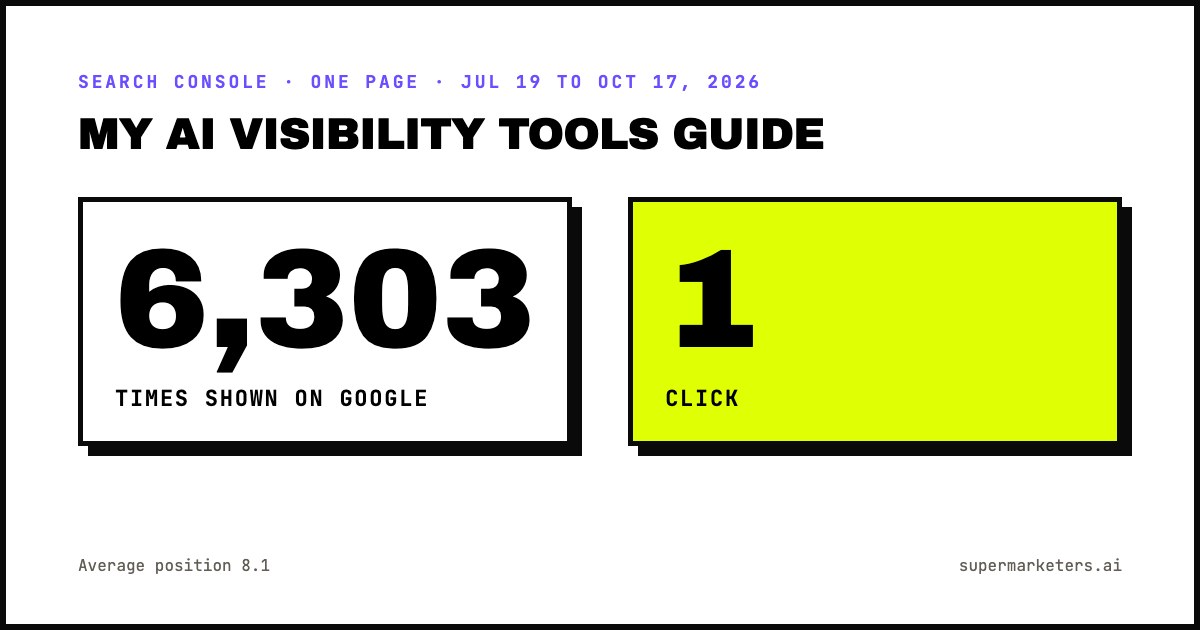
My guide to the best AI visibility tools is the most-seen page on my site by a wide margin. Between July 19 and October 17, Google showed it 6,303 times. It got 1 click.
Its average position was 8.1. For hundreds of searches it sat in the top three. Nobody came.
Yesterday I wrote that this page is visible to the wrong people. That was the short version. This post is the long one: every query, sorted by who was asking, four reasons the click-through rate is zero, and what I shipped today to test them.
How I pulled the data
You can do all of this in the Search Console interface. I used the API because it gives every row instead of the top 1,000.
- Filter to one page. Performance, then add a Page filter with the exact URL.
- Pull the queries. The Queries tab, sorted by impressions. Export it.
- Pull devices, countries and dates for the same page. They answer different questions, as you'll see.
- Compare the page total with the query total. They won't match. More on that below.
Two things surprised me before I'd read a single query.
More than a third of the searches are hidden. Grouped by page, the guide had 6,303 impressions. Grouped by query, the same page had 4,027. Google withholds the text of rare searches for privacy, so 2,276 impressions (36%) have no query attached. Everything below describes the 64% Google lets you see.
The one click doesn't show up in the query table at all. It came from one of the hidden searches. If you only look at the Queries tab, the page has zero clicks.
What kinds of searches find this page?
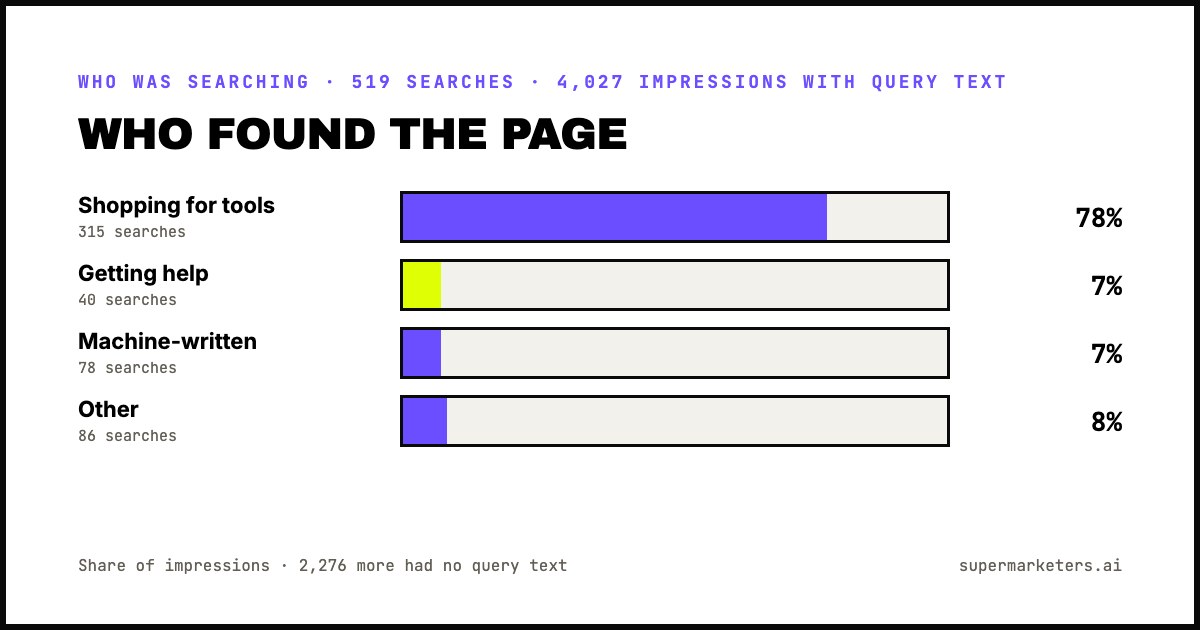
519 different searches. I sorted them into four groups with simple word rules, so you can repeat it on your own data:
| Group | Rule | Searches | Impressions | Avg. position |
|---|---|---|---|---|
| Shopping for tools | Mentions a tool, platform, software, tracking, or a vendor by name | 315 | 3,143 (78%) | 8.7 |
| Getting help | Mentions an agency, consultant, audit, service, or "who offers" | 40 | 282 (7%) | 7.0 |
| Machine-written | Phrases no person types: "provide a definitive answer", "pros and cons", "I am a 25-34 year old" | 78 | 266 (7%) | 4.0 |
| Other | Everything else, mostly short and general | 86 | 336 (8%) | 13.7 |
Here's what each group looks like in the wild.
Shopping for tools: "most affordable ai visibility tools for b2b saas startups", "compare ai visibility tools for b2b saas companies", "athenahq vs peec ai for b2b saas".
Getting help: "who offers ai search audits for b2b companies?", "where can i get a package that includes ai search visibility and share of voice optimization?", "which agencies offer a free ai visibility audit for b2b saas?"
Machine-written: "i'm looking for an ai visibility tool suitable for a mid-market company. which is better for mid-market needs, profound or athenahq? provide a definitive answer..."
One more pattern: 95% of the impressions came from searches six words or longer. These aren't keywords. They're questions, often with a job title and a budget attached: "I'm a CMO at a mid-market company. What's the best AI visibility tool that doesn't require an enterprise contract?"
Why is the click-through rate zero?
Four reasons. The data supports all of them, and it can't fully separate them. I'll show the evidence for each and say how sure I am.
1. Most of the audience is shopping for software, and I'm not a vendor
78% of the visible impressions came from people comparing tools. My page answers that question well: a comparison table, prices, picks by stage. But a buyer who wants a tool clicks the tool. A consultant's guide is a detour.
How sure: very. It's the biggest group by far, and it fits the zero.
2. Many of these searches are probably answered on the results page
Long, specific questions are exactly what Google answers with AI Overviews and AI Mode. When the answer is on the results page, people read it and don't click. Google counts these impressions in Search Console and doesn't report them separately, so I can't prove how many of my 6,303 were AI answers. But the shape fits: 95% of impressions from six-word-plus questions.
How sure: likely, not provable from this data.
3. Some of the "people" aren't people
78 searches carry the fingerprint of an AI visibility tool running test prompts for its clients. Three more signals point the same way:
- 97% desktop. 3,893 desktop impressions, 120 mobile, 14 tablet. Real B2B search skews desktop, but not that hard.
- Top positions, no clicks. The page had 840 impressions in positions 1 to 3 and zero clicks. The rest of my site had 79 impressions in the top three and got 4 clicks. Those are mostly people searching my brand name, so it's not a fair comparison, but zero out of 840 is hard to get from people.
- Weekends barely dip. 72 impressions a day on weekdays, 61 on weekends. B2B buyers take the weekend off. Scripts don't.
How sure: certain for the 7% with the fingerprint. For the rest, it's evidence, not proof.
4. The snippet didn't match the question
This is the smallest factor and the only one fully in my control. The title was 79 characters, so Google cut it off. The description was 260 characters, cut off too. Neither mentioned price, though searches about price ("affordable", "budget", "cheap", "cost") were 587 impressions. And the 7% asking who offers audits found a page that never answered that question.
How sure: it's a real gap, but fixing it won't turn a software shopper into a click.
How to analyze a page like this on your own site
- Pick pages with high impressions and almost no clicks. In Search Console, sort pages by impressions and look for a click-through rate under 0.5%.
- Check the hidden share. Compare the page total with the sum of its queries. If a third is hidden, keep your conclusions loose.
- Group the queries by who is asking, not by keyword. Use word rules you can write down and rerun.
- Count the machine-written ones and set them aside before you decide anything.
- Look at devices, weekdays and positions. People and scripts leave different traces.
- Read the title and description as a searcher would, at the length Google actually shows: about 60 characters for the title and 155 for the description.
- Change one page, log it, and wait 28 days before you judge it.
What I changed
The goal is not to win the software shoppers. They should click the vendors. It's to make the snippet honest about what the page offers, and to answer the 7% who are looking for help.
| Before | After | |
|---|---|---|
| Title | The 7 Best AI Visibility Tools for B2B SaaS (2026), Compared · SuperMarketers (79 characters) | 7 Best AI Visibility Tools for B2B SaaS (2026), With Prices (59) |
| Description | 260 characters, cut off before the prices | "...The cheapest real option is $29 a month. Picks by budget, stage, and team." (152) |
| Budget question | Answered in the middle of the page | New FAQ: the most cost-effective tool for a small SaaS startup on a tight budget |
| Audit question | Not answered | New FAQ: who offers AI visibility audits for B2B companies, including that we do, and that you should weigh the answer with that in mind |
I also rewrote the titles and descriptions on three other guides with the same pattern: lots of impressions, no clicks, and a snippet that didn't match the question. How B2B buyers research software in AI, SEO vs AEO for B2B SaaS, and how to get your SaaS cited by ChatGPT.
What I expect, and how I'll know
Every change is in the Shipped log in the Lab with the reason and the number it should move. The 28-day read on the tools guide lands November 17: clicks for that page only, 28 days before the change against 28 days after.
My prediction: clicks stay low. Maybe a handful, from the budget questions. If reason 1 is right, no title will fix this page, because most of its audience isn't mine. The better number to watch is whether AI answers start naming SuperMarketers for the audit questions. That's what the prompt tracker is for.
If clicks don't move, that's a result too. It means the page's job is to be cited, not clicked, and I'll stop judging it by its click-through rate.
Questions
Why does Search Console show impressions but no clicks?
Usually one of four things: the audience wants something else, the answer is shown on the results page, the searches aren't from people, or the title and description don't match the question. Group the queries by who is asking to see which.
Does Search Console include AI Overviews and AI Mode?
Yes. Impressions and clicks from AI Overviews and AI Mode are counted in the normal Performance report. Google doesn't break them out, so you can't filter for them.
How do I find machine-written queries in Search Console?
Search the Queries tab for phrases no person types into Google: "provide a definitive answer", "pros and cons", "list of the top", or a persona like "I am a 25-34 year old". Count them before you use the data to decide anything.
Should I delete a page that gets impressions but no clicks?
Not because of clicks alone. A page that gets cited in AI answers can be worth keeping even if nobody clicks it. Decide what the page is for first, then measure that.