How I evaluated these tools
I'm Gen Furukawa, founder of SuperMarketers. We work inside B2B SaaS marketing teams as their AI marketing partner, and a big part of that work is getting companies cited when buyers ask ChatGPT, Perplexity, Gemini, or Google's AI answers which software to buy. So I spend a lot of time looking at the data these tools produce, and a lot of time doing the work that comes after it.
I want to be specific about what I've used, because most "best tools" lists blur this. I've used two of these products hands-on: Profound and AirOps. I'm a Profound Certified Marketing Engineer and an AirOps Certified Content Engineer. This summer I was one of 50 builders selected from about 250 applicants for Profound's first Marketing Engineer hackathon, where I built a working product on top of Profound's citation data and made the final eight. AirOps is part of how we deliver client work, including a lot of the production behind our Oyster engagement. I have not been a paying customer of AthenaHQ, Scrunch, Goodie, Peec AI, or Otterly.AI. For those five, my analysis comes from their pricing pages, product documentation, public demos, and announcements, all checked on October 8, 2026, and from what I see when clients and peers bring their dashboards to me.
Every review below carries a label so you know which is which. Used it means I've worked in the product. Researched means I'm reporting what the vendor publishes and giving you my read on it. Nobody paid for placement, and none of these links are affiliate links. SuperMarketers isn't a tool, so I'm not competing with any of them, though I do sell the execution work that happens after a tool shows you the gap. Weigh my opinions with that in mind.
Quick picks by situation
The richest measurement layer, plus an API and MCP server if you want to build on it. Custom pricing.
A content engineering platform where visibility insights feed straight into creation and refresh work.
11+ engines, prompt volume estimates, and an action center. Free tier, then $295/month.
Page audits, live AI crawler monitoring, and an agent-ready content layer. From $250/month annually.
Full-stack AEO with content creation and revenue attribution. From $399/month.
The most transparent prompt-based pricing and a very readable dashboard. From $95/month.
15 prompts for $29/month, with GEO audits included. The easiest way to start measuring.
Feature comparison table
This is the table I wish existed when I started comparing these. It shows what each vendor offers as of October 8, 2026, based on their own pricing and product pages. A partial mark usually means the feature exists but is limited to a higher plan, is narrower than the name suggests, or the vendor doesn't document it in enough detail for me to call it a full yes. Scroll sideways on mobile.
| Feature | Profound | AirOps | AthenaHQ | Scrunch | Goodie | Peec AI | Otterly.AI |
|---|---|---|---|---|---|---|---|
| Overview | |||||||
| My experience | Used it | Used it | Researched | Researched | Researched | Researched | Researched |
| Core job | Enterprise visibility data + AI Marketer | Content engineering + visibility Insights | Visibility + Action Center | Visibility + agent experience layer | Full-stack AEO | AI search analytics | Low-cost monitoring + GEO audits |
| Entry price | Custom7-day free trial | Free to startNo $ published | Free tierStarter $295/mo | $300/mo$250/mo annual | $399/mo | $95/mo | $29/mo$25/mo annual |
| Best fit | Funded teams, enterprise | Content teams shipping at volume | Series A to mid-market | Mid-market to enterprise, site-heavy brands | Mid-market and consumer brands | Marketing teams and agencies | Founders, SMBs, agencies |
| AI engines | |||||||
| ChatGPT | Yes | Yes | Yes | Yes | Yes | Yes | Yes |
| Perplexity | Yes | Pro and up | Yes | Yes | Yes | Yes | Yes |
| Google AI Overviews | Yes | Pro and up | Yes | Yes | Not listed | Yes | Yes |
| Google AI Mode | Not listed | Pro and up | Not listed | Yes | Yes | Yes | Add-on |
| Gemini | Yes | Pro and up | Yes | Yes | Yes | Yes | Add-on |
| Claude | Yes | Pro and up | Yes | Yes | Yes | Enterprise | Add-on |
| Microsoft Copilot | Yes | Pro and up | Yes | Not listed | Yes | Yes | Yes |
| Grok / Meta AI / DeepSeek | DeepSeek | Grok | All three | Meta AI | All three | Enterprise | Not listed |
| Engines on top plan | 8+ named | 7+ | 11+ | 7 | Up to 13 | Up to 13 | 7 with add-ons |
| Measurement | |||||||
| Prompt / answer tracking | Yes | Yes | Yes | Yes | Yes | Yes | Yes |
| Share of voice vs competitors | Yes | Yes | Yes | YesBy persona and geo | Yes | Yes | Yes |
| Sentiment | Yes | Yes | Yes | Misrepresentation flags | Yes | Yes | Yes |
| Citation / source analysis | Yes | YesIncl. offsite sources | Yes | Yes | Yes | YesWith gap analysis | Yes |
| Prompt volume / demand data | Prompt Volumes | Market dataset | With $ value estimates | Not listed | Prompt Research | Relative 1–5 score | Prompt Research |
| AI crawler / bot analytics | Agent Analytics | Listed, limited detail | Listed, limited detail | Real-time bot feed | Agent Analytics | CDN log integrations | Standard and up |
| AI referral traffic / attribution | Not listed | GA4 + GSC | GA4 + GSC | Not listed | Revenue attribution | Google Analytics | Not listed |
| AI shopping / product tracking | Enterprise | Not listed | Shopify | Not listed | Agentic Commerce | SKU-level | Not listed |
| Action | |||||||
| Content creation | AI Marketer + Agents | Core product | Content agent | AI-readable page versions | Content Studio | Agent actions | No |
| Content refresh workflows | Via agents | Core product | Action Center | Diagnostics | Optimization Actions | Recommendations | Audit recommendations |
| Brand voice / governance | Context Manager | Brand Kits + Knowledge Bases | Enterprise KB | Not listed | Brand-trained writer | Not listed | No |
| On-site technical audits | Not listed | Not listed | On-page actions | Page Audits | Yes | Crawlability check | GEO Audit |
| Offsite / third-party work | Citation data | Offsite | Off-page actions | Not listed | Not detailed | Source gaps | No |
| Platform | |||||||
| API | Enterprise | Pro and up | Paid add-on | Enterprise | Enterprise | Higher tiers | Standard and up |
| MCP server | Yes | Pro and up | Not listed | Not listed | All plans | Yes | Standard and up |
| Seats | Unlimited | 1 on Solo, unlimited on Pro | Unlimited | 3 to 5 | 5 on Core, unlimited on Pro | Unlimited | Unlimited |
| Agency / multi-brand | Agency plan | Enterprise | Agency program | Agency packages | Agency plans | Agency pricing | Partner program |
| SOC 2 | Enterprise | Not listed | Yes | Type II | Enterprise | Not listed | Yes |
| Free trial | 7 days | 14 days | Free tier | 7 days | 7 days | Not listed | Yes |
✓ = offered · ◐ = partial, plan-limited, or thinly documented · — = not listed on the vendor's site as of October 8, 2026. "Not listed" doesn't always mean a feature is missing; it means I couldn't confirm it publicly, so ask in the demo. Vendors ship monthly in this category, so check anything that matters to your decision.
Pricing compared, and cost per prompt
Pricing in this category is hard to compare because every vendor meters something different: prompts, credits, "answers," tasks, or engines. The table below lists published monthly prices on monthly billing unless noted. Two vendors, Profound and AirOps, don't publish dollar figures at all.
| Tool | Entry plan | Mid plan | Upper plan | Enterprise | What's metered |
|---|---|---|---|---|---|
| Profound | Trial: free for 7 days50 prompts daily on ChatGPT, Gemini, AI Overviews | Agency GrowthPrice not published | n/a | CustomAll engines, API, SOC 2, Shopping | Prompts, AI Marketer credits |
| AirOps | Solo: free to start35k tasks, 1 user, ChatGPT Insights only | Pro: free to start100k tasks, unlimited seats, 7+ engines, API + MCP | n/a | CustomUnlimited Brand Kits, SSO, BYO model keys | Tasks (workflow runs) |
| AthenaHQ | Essential: free300 credits, 5 platforms | Starter: $295/mo3,600 credits, 11+ models | n/a | Custom | Credits |
| Scrunch | Starter: $300/mo$250 annual · 350 prompts · 3 seats | Growth: $500/mo$417 annual · 700 prompts · 5 seats | n/a | CustomData API | Custom + industry prompts |
| Goodie | Core: $399/mo120 prompts · 5 models · 5 seats | Pro: $999/mo250 prompts · 8 models · unlimited seats | n/a | CustomUp to 13 models, 500+ prompts | Prompts, action credits, pages |
| Peec AI | Starter: $95/mo50 prompts · 3 models | Pro: $245/mo150 prompts · 3 models | Advanced: $495/mo350 prompts · 3 models | CustomUp to 13 models | Prompts × models |
| Otterly.AI | Lite: $29/mo15 prompts | Standard: $189/mo100 prompts, API, MCP | Premium: $489/mo400 prompts | Custom1,000+ prompts | Prompts; extra engines are add-ons |
Prices from each vendor's pricing page on October 8, 2026, shown in USD. Peec AI prices vary by region. Annual billing is cheaper for most vendors.
The number I find most useful is cost per tracked prompt per month, because that is what you're mostly paying for. On entry plans, Otterly Lite works out to about $1.93 per prompt, Peec Starter to $1.90, Otterly Standard to $1.89, Scrunch Starter to about $0.86 for its custom prompts (before counting the 1,000 industry prompts it adds), and Goodie Core to about $3.33. At the higher tiers, Peec Advanced falls to about $1.41 and Otterly Premium to $1.22. These numbers aren't strictly comparable, since Goodie's price includes content and optimization credits, Peec charges per model beyond three, and Otterly charges extra for Gemini, AI Mode, and Claude. But they show something real. If all you need is measurement, you are paying a large premium at the top end for features that sit on top of measurement, and you should be sure you'll use them.
What these tools actually measure
Every tool here runs a list of prompts (the questions your buyers ask) through AI engines on a schedule and records what comes back. The metrics built on top of that are similar across vendors, even when the names differ:
- 01Visibility or mention rateThe share of tracked prompts where your brand appears in the answer at all. This is the headline number on most dashboards.
- 02Citation rateHow often the engine links to your domain as a source. Being mentioned and being cited are different things, and the second is what sends traffic. We go deeper on this in our guide to citation rate.
- 03Share of voice and positionHow often you appear relative to competitors, and where you land in the list when you do. AI answers rarely name more than a handful of vendors, so position matters more than it did in ten blue links.
- 04Sentiment and accuracyWhether the engine describes you favorably and correctly. For B2B SaaS, the accuracy part often matters more: wrong pricing, outdated features, or a category you left two years ago. I wrote about why accuracy deserves its own tracking in AI claims intelligence.
- 05Source analysisWhich domains and URLs the engine pulls from when it answers your category's questions. This is the most actionable data in the whole category, because it tells you where to publish and who to get mentioned by.
- 06AI crawler activityHow often GPTBot, ClaudeBot, PerplexityBot, and others hit your pages, and whether they hit errors. If the bots can't read your pages, nothing else matters.
If you want to see these numbers before paying anyone, run our 30-minute AI visibility audit by hand first. It will also make you a much sharper buyer in demos.
1. Profound
Used itThe deepest data layer in the category, now growing into an AI marketing platform.
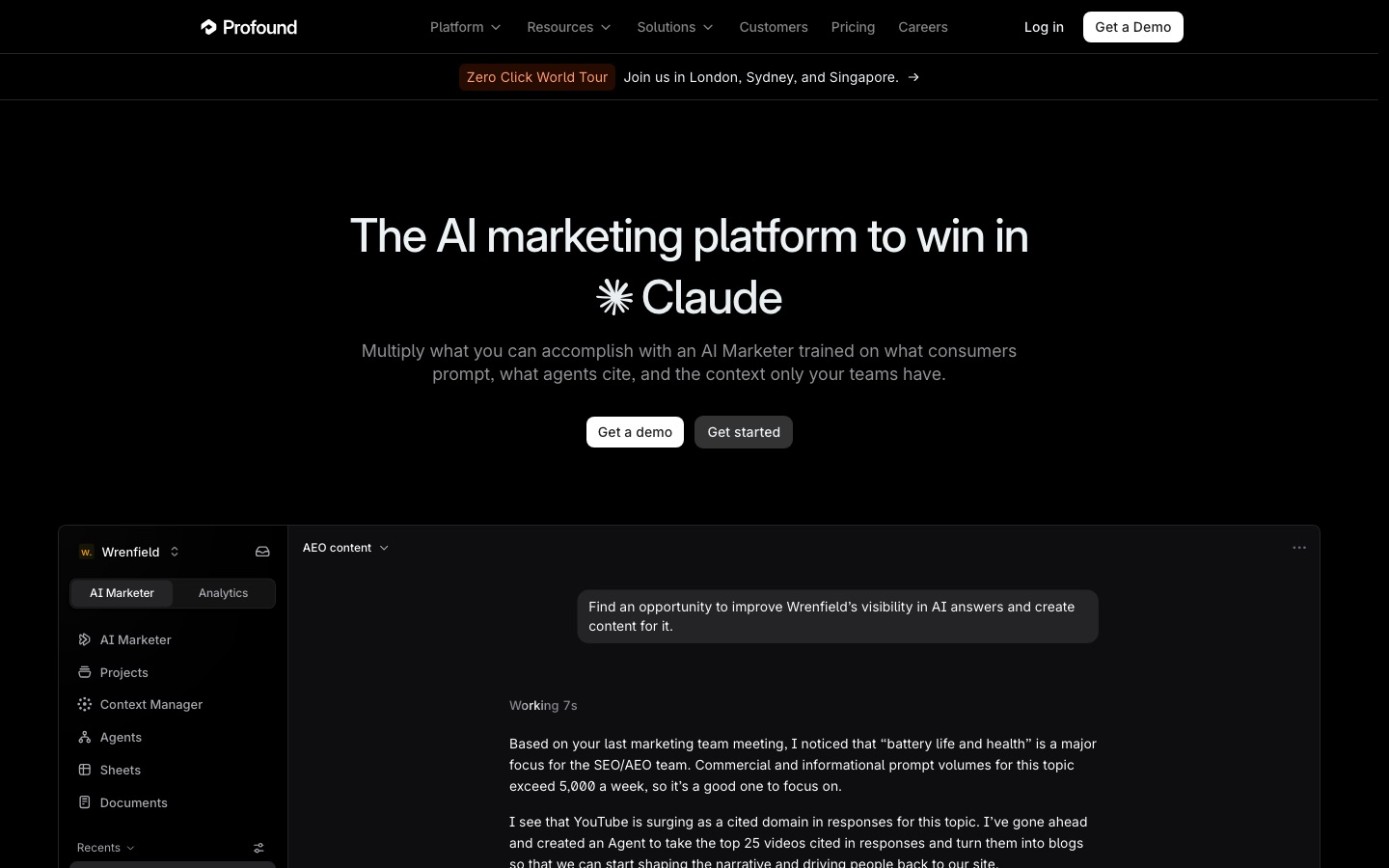
Profound is the tool I know best. I went through its Marketing Engineer certification, and at its hackathon in June I built a prototype called Flagship Video in eight hours. Flagship reads Profound's visibility data for a domain and a category, scores every prompt where the brand isn't cited by gap and volume, and then generates a video, captions, a companion article, and schema to close that gap. It pulled the visibility scores back in afterward so every asset was tied to the gap that justified it. I wrote up the whole day in Building was the easy part.
Building on it taught me what Profound is really good at, which is the data underneath the dashboard. The citation data goes down to the URL, so you don't just learn that "YouTube is a top source." You learn which specific videos the engines cite for which prompts, and the insight Flagship ran on came straight out of that: AI engines cite specific videos rather than channels, and most brands own none of the videos being cited. That kind of finding is the difference between a tool that grades you and a tool that tells you what to make. Profound also offers Prompt Volumes (an estimate of how often topics are actually asked), Agent Analytics (how AI crawlers hit your site), and an API plus a hosted MCP server, so you can pull the data into your own agents. For a team like mine that builds workflows in Claude Code, that last part matters a lot.
The company has been moving fast. It raised a $96M Series C at a $1B valuation in February 2026, then a $180M Series D at a $1.8B valuation in September, co-led by Sequoia and Kleiner Perkins, and launched an "AI Marketer," a Context Manager, and an Ads Studio for AI search ads alongside it. The homepage now leads with the AI Marketer rather than the dashboards. That's a reasonable bet, but it changes what you're buying: Profound is no longer just a measurement tool, and it's starting to overlap with the content platforms further down this list.
What stands out
- URL-level citation data that tells you what to create, not just how you score
- Prompt Volumes and Agent Analytics in the same platform
- API and MCP server for teams that build their own workflows
- Broad engine coverage, unlimited seats, SOC 2 and SCIM on Enterprise
Where it falls short
- No published prices; the self-serve tiers are gone, leaving a trial and Enterprise
- More than a seed-stage company tracking 30 prompts needs
- The AI Marketer push means paying for content features you may already have elsewhere
- AI Mode isn't named among supported engines on its public pages
- Pricing
- 7-day free trial, then custom Enterprise
- Engines
- ChatGPT, Perplexity, Gemini, AI Overviews, Claude, Copilot, DeepSeek, more
- Customers
- Ramp, MongoDB, Plaid, Zoom, Figma, ServiceNow
- 2026 news
- $96M Series C (Feb), $180M Series D at $1.8B (Sep)
2. AirOps
Used itNot a visibility tool first. A content engineering platform that closes the loop.
AirOps belongs on this list for a different reason than the others. I'm an AirOps Certified Content Engineer, and I've pointed a lot of marketers to its training when they ask me how to learn this work. What AirOps taught me is a way of thinking: content as a system with inputs, rules, and quality checks, rather than a stack of one-off drafts. Most tools on this list start with a dashboard and bolt on content later. AirOps started with production and added measurement.
The platform has a few pieces that fit together. Brand Kits and Knowledge Bases hold your voice, product facts, and source material so the output doesn't drift. Workflows and Grids let you run content creation and refreshes in bulk, in a spreadsheet-style view where you can review rows before anything publishes to your CMS. Insights, the visibility module, tracks share of voice, citations, and sentiment across answer engines, and its job is to tell the production side what to work on next, mostly as refresh recommendations for pages that are losing citations. In February AirOps added Offsite, which extends that to the third-party sources AI engines cite, and a native Claude integration.
That loop is the point. The hard part of AI visibility for most teams isn't finding the gap; it's refreshing forty pages and publishing twenty new ones without the quality falling apart. AirOps is built for exactly that. Its own research supports the focus: its 2026 State of AI Search report found that 83% of citations for commercial queries came from pages updated in the past 12 months, which I wrote about in Schema won't save you. Freshness is a signal you control, and AirOps is designed to help you control it at volume.
It's also the platform I lean on most in client work. A lot of the production behind our Oyster case study runs on AirOps. That engagement didn't start by publishing new pages. We measured which pages Oyster already had that should have been winning buyer questions, refreshed them structurally against a single source of truth, and pushed them through a repeatable pipeline to legal, brand, and editorial review. Measured against each page's own pre-refresh window, the refreshed pages earned 11x more AI citations and 110% more organic clicks. That is the kind of work AirOps is good at: many pages, tight quality control, and a team of reviewers who need near-final drafts rather than blank pages.
The tradeoff is that Insights is a module, not the whole product. If what you want is the deepest possible measurement across every engine and persona, a dedicated tracker will go further. Getting real value from AirOps also takes setup. A well-built Brand Kit and a few tested workflows are what make the output good, and that's an investment of time before you see results. The certification exists for a reason.
What stands out
- Visibility gaps flow directly into content creation and refresh
- Behind much of our Oyster work: 11x AI citations from refreshed pages
- Brand Kits and Knowledge Bases keep output on-voice and factual
- Grids make bulk refreshes reviewable before they publish
- Offsite covers the third-party sources engines cite
- API and MCP on Pro, plus a 14-day trial
Where it falls short
- Solo plan tracks ChatGPT only; you need Pro for 7+ engines
- No dollar prices on the pricing page
- Visibility tracking is shallower than a dedicated monitor
- Real setup time before workflows produce your best output
- Pricing
- Solo and Pro free to start, 14-day trial, custom Enterprise
- Engines
- 7+ on Pro: OpenAI, Google, Perplexity, Claude, Copilot, Grok
- Customers
- Ramp, Webflow, Chime, HubSpot, Carta, Brex, Wiz, Gong
- 2026 news
- Offsite and native Claude integration (Feb); $40M Series B (Nov 2025)
3. AthenaHQ
ResearchedThe broadest engine coverage at a mid-market price, with a free way in.
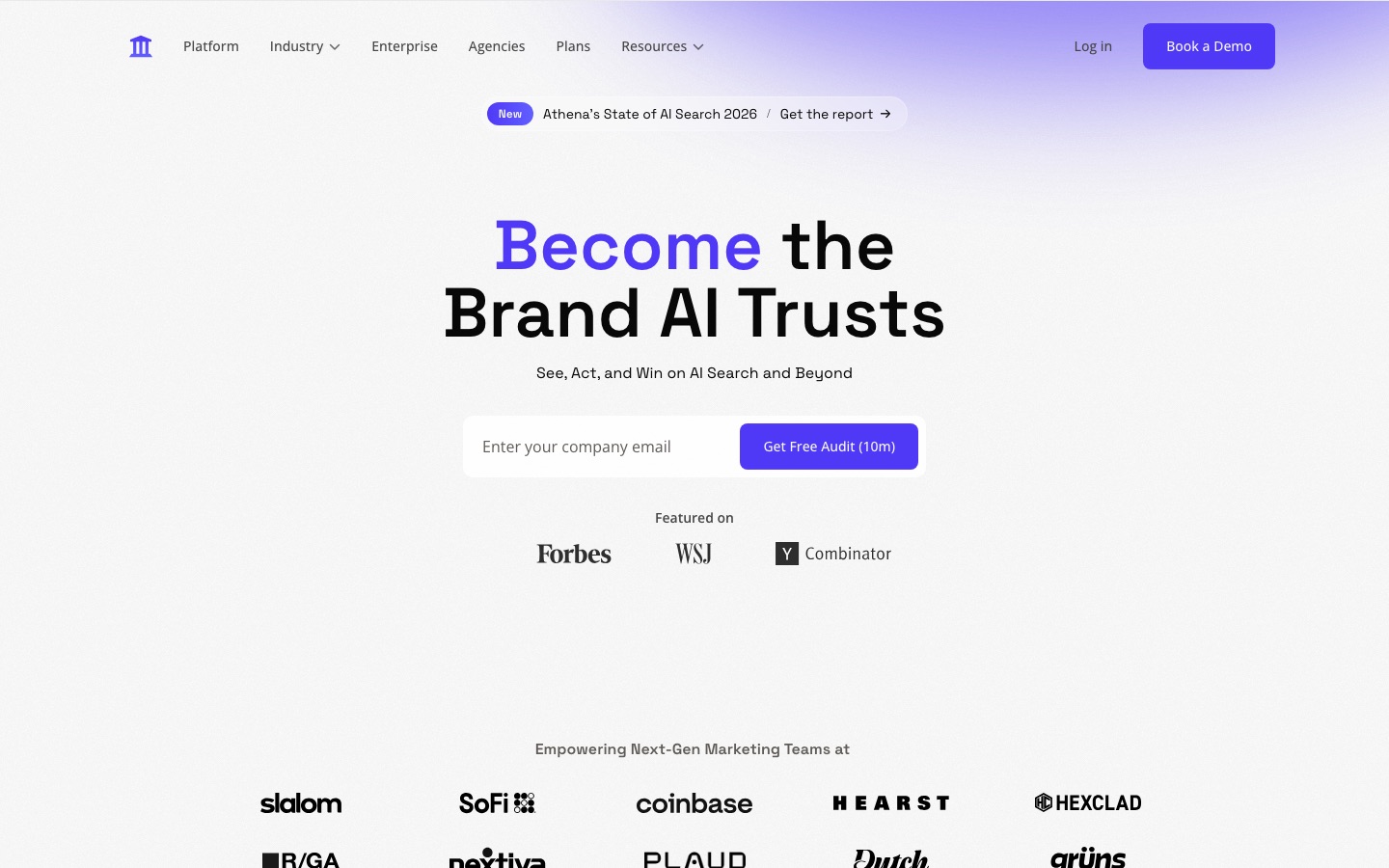
AthenaHQ, a Y Combinator company, has one of the more complete feature sets for its price. The Starter plan at $295/month covers 11+ models, including Grok, Meta AI, DeepSeek, and Mistral, which few competitors match at that tier. It estimates prompt volume and attaches a dollar value to prompts, which is a useful way to argue for budget internally. Its Action Center turns gaps into on-page and off-page recommendations, and a content agent drafts fixes. It also connects to GA4, Search Console, Shopify, and Webflow, so you can tie visibility to AI referral traffic.
From the outside, the thing I'd test hardest is the credit system. Everything runs on credits (300 on the free tier, 3,600 on Starter), and how far those credits go depends on how many prompts, engines, and actions you run. Model a realistic month before you commit. The free Essential tier makes that easy to do, and it's the only free plan among the paid-grade tools here.
What stands out
- 11+ engines on a $295 plan
- Prompt volume with dollar-value estimates
- Free tier for a real test
- GA4, GSC, Shopify, Webflow integrations; SOC 2
Where it falls short
- Credit-based pricing is harder to forecast
- API is a paid add-on below Enterprise
- Crawler analytics are listed but thinly documented
- Pricing
- Free tier; Starter $295/mo; Enterprise custom
- Engines
- ChatGPT, Perplexity, AI Overviews, Gemini, Copilot, Claude, Grok, DeepSeek, Meta AI, Mistral
- Customers
- Coinbase, SoFi, Hearst, PagerDuty, Nextiva
4. Scrunch
ResearchedBuilt around the idea that AI agents, not people, are now your site's main readers.
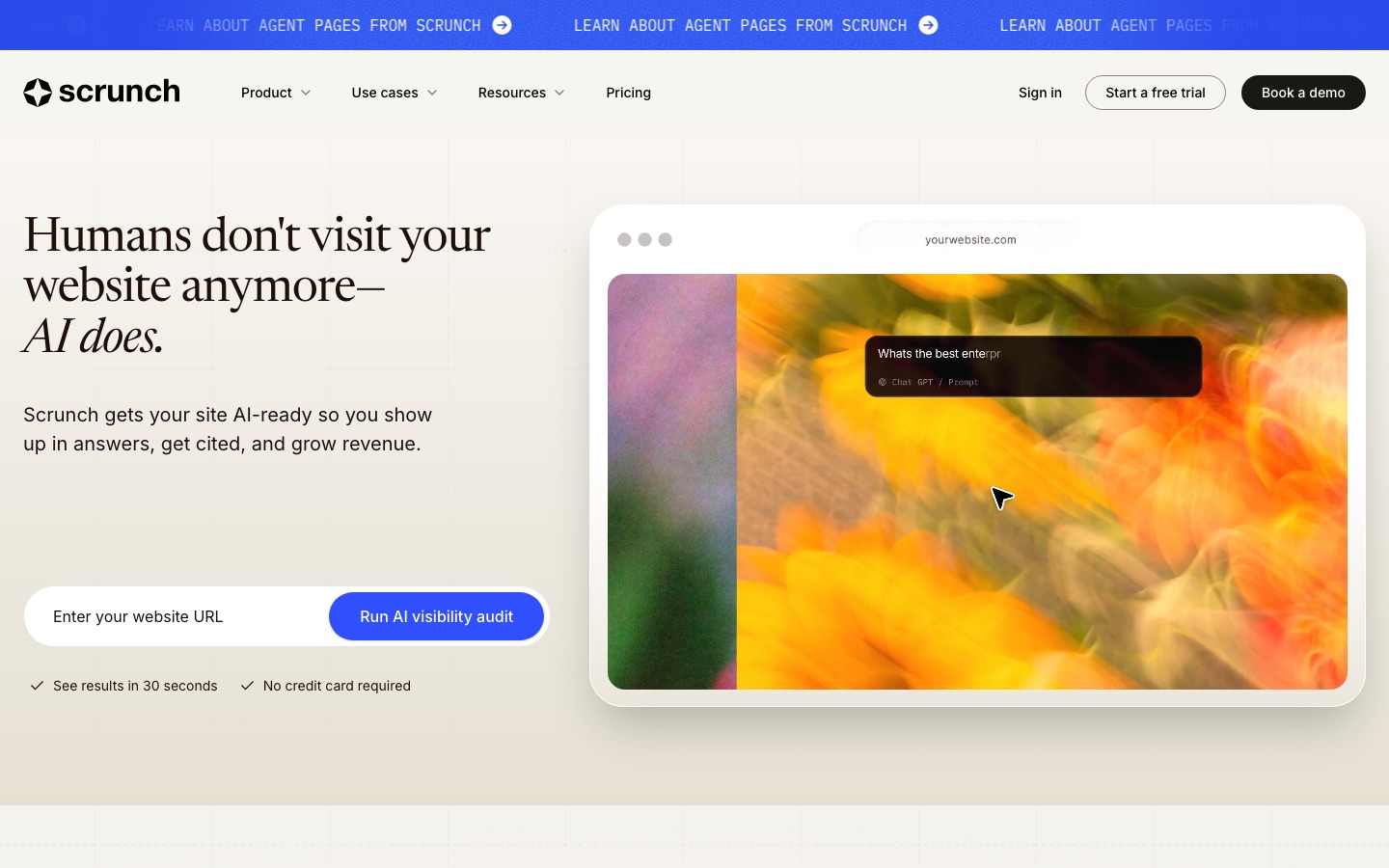
Scrunch's homepage makes its thesis plain: humans don't visit your website anymore, AI does. Where most tools focus on the answers, Scrunch puts a lot of weight on your site itself. Every plan includes Page Audits, a real-time feed of AI bot traffic with crawl errors, and persona-based prompt tracking, and its Agent Experience Platform serves compressed, machine-readable versions of your pages to AI crawlers without changing what humans see. Sitecore acquired Scrunch on June 3, 2026, so expect it to become more tightly bound to Sitecore's digital experience platform over time.
The pricing is the most generous on prompt count in this group. Starter gives you 350 custom prompts plus 1,000 industry prompts for $300/month, or $250 billed annually. The limit is seats: three on Starter, five on Growth. For B2B SaaS teams with a large docs site or a lot of product pages, the technical side is the main draw. If your site renders mostly in JavaScript, or your docs are hard for crawlers to parse, Scrunch is likely to show you problems the answer-tracking tools won't.
What stands out
- Page Audits and live AI bot traffic on every plan
- Most prompts per dollar on entry plans
- Persona and geography segmentation
- SOC 2 Type II
Where it falls short
- Copilot isn't listed among tracked engines
- Only 3 to 5 seats below Enterprise
- Roadmap now tied to Sitecore
- API only on Enterprise
- Pricing
- Starter $300/mo ($250 annual); Growth $500/mo ($417 annual); Enterprise custom
- Engines
- ChatGPT, Claude, Gemini, Perplexity, AI Mode, AI Overviews, Meta AI
- 2026 news
- Acquired by Sitecore, June 3, 2026
5. Goodie
ResearchedFull-stack AEO, from prompt research to revenue attribution.
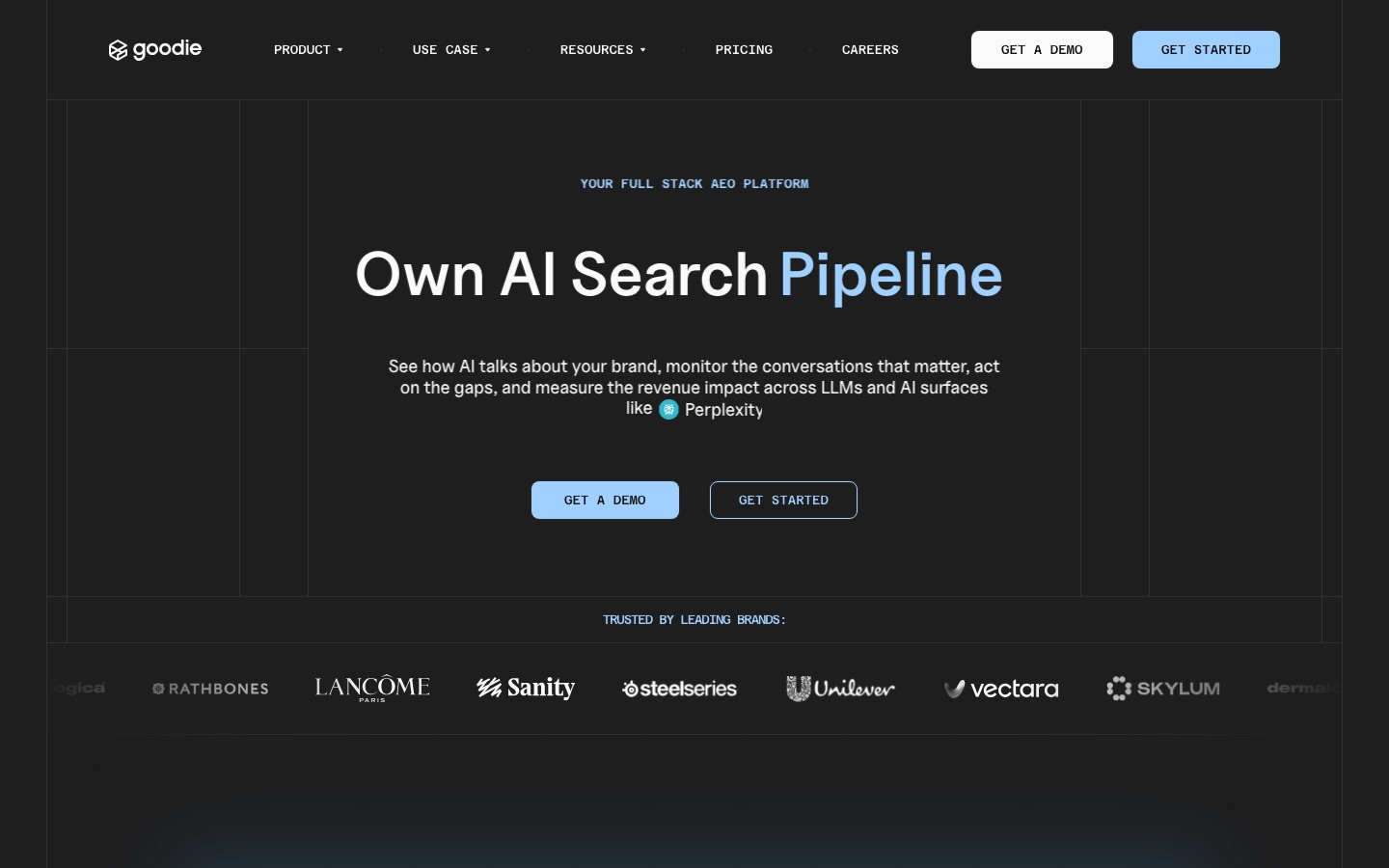
Goodie calls itself a full-stack AEO platform, and the feature list supports that. It covers monitoring across up to 13 engines (including AI Mode and Amazon's Alexa for Shopping), prompt research, AI agent analytics, a Content Studio, optimization actions, technical audits, and revenue attribution. MCP access is included on every plan, which is unusual. Its homepage headline, "Own AI Search Pipeline," tells you who it's aimed at: teams that need to connect AI visibility to revenue rather than report a visibility score.
It's also the most expensive published entry point here, at $399/month for 120 prompts and five models, and $999/month for 250 prompts on Pro. Part of that price is content and action credits, so you're paying for the "do" side as well as the "see" side. If you'd use both, that's fair. If you'd only use the dashboard, Peec or Otterly will measure the same prompts for much less. Goodie's logo wall leans toward consumer and enterprise brands (Unilever, Lancôme, SteelSeries), though it does list B2B names like Sanity and Vectara.
What stands out
- Monitoring, content, audits, and attribution in one place
- Up to 13 engines, including AI Mode and Alexa for Shopping
- MCP on every plan
- Agency plan from $275/month
Where it falls short
- Highest entry price per prompt
- 120 prompts on Core is tight for a multi-product SaaS
- API only on Enterprise
- Pricing
- Core $399/mo; Pro $999/mo; Enterprise custom; 7-day trial
- Engines
- ChatGPT, Claude, Perplexity, Gemini, Copilot, Grok, Meta AI, AI Mode, DeepSeek, more
- Customers
- Unilever, SteelSeries, Sanity, Vectara, Rathbones
6. Peec AI
ResearchedClean, segmentable AI search analytics with the most honest pricing page in the category.
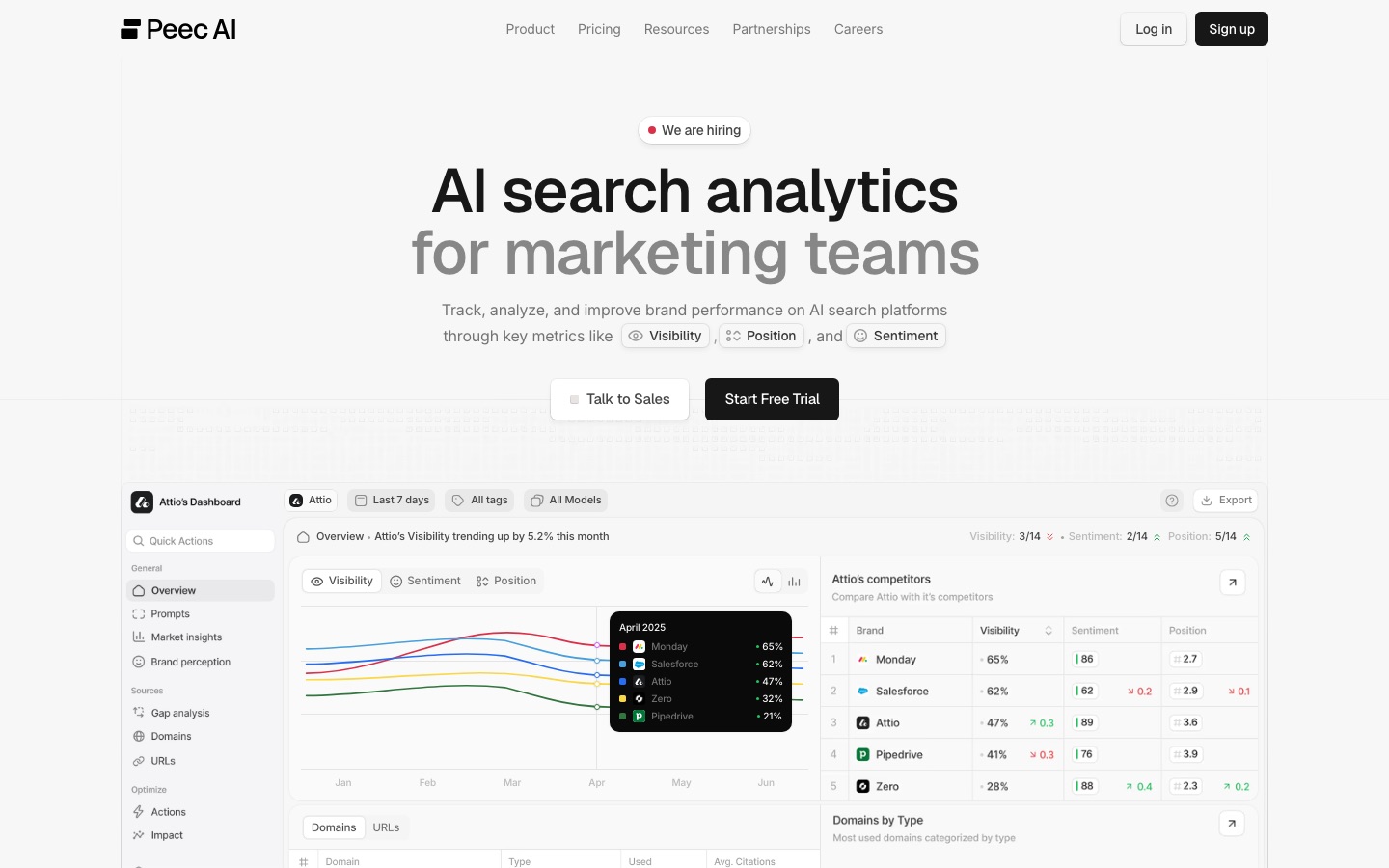
Peec does analytics and does them well. The dashboard on its homepage shows the core idea: visibility, sentiment, and position for you and your competitors, side by side, filterable by model, country, and tag. It separates brand mentions from source citations, has a gap analysis that shows which sources cite competitors but not you, and has added agent analytics with log integrations for Vercel, Cloudflare, CloudFront, Akamai, and WordPress. That last one is a smart choice, because pulling AI crawler data from your CDN is more accurate than estimating it.
The pricing is the clearest I found: $95, $245, and $495 a month for 50, 150, and 350 prompts, each with three models of your choice and unlimited users. Extra models are a published add-on. Peec raised a $21M Series A in November 2025 and says more than 3,000 brands and agencies use it. Customers include Attio, n8n, and ElevenLabs, which is a reasonable signal that it works for software companies. What Peec doesn't try to do is write your content. Its "actions" are recommendations, so the work stays with you.
What stands out
- Transparent prompt-based pricing, unlimited users
- Source gap analysis that points to where to get mentioned
- CDN-based agent analytics
- Strong B2B SaaS customer base; MCP available
Where it falls short
- Three models per plan; more cost extra
- Recommendations, not content production
- Claude and Perplexity depth depend on plan
- Pricing
- Starter $95/mo; Pro $245/mo; Advanced $495/mo; Enterprise custom
- Engines
- ChatGPT, AI Mode, AI Overviews, Copilot, Gemini, Perplexity, Naver; up to 13 on Enterprise
- Customers
- Attio, n8n, ElevenLabs, Chanel, DEPT
7. Otterly.AI
ResearchedThe cheapest honest way to start measuring.
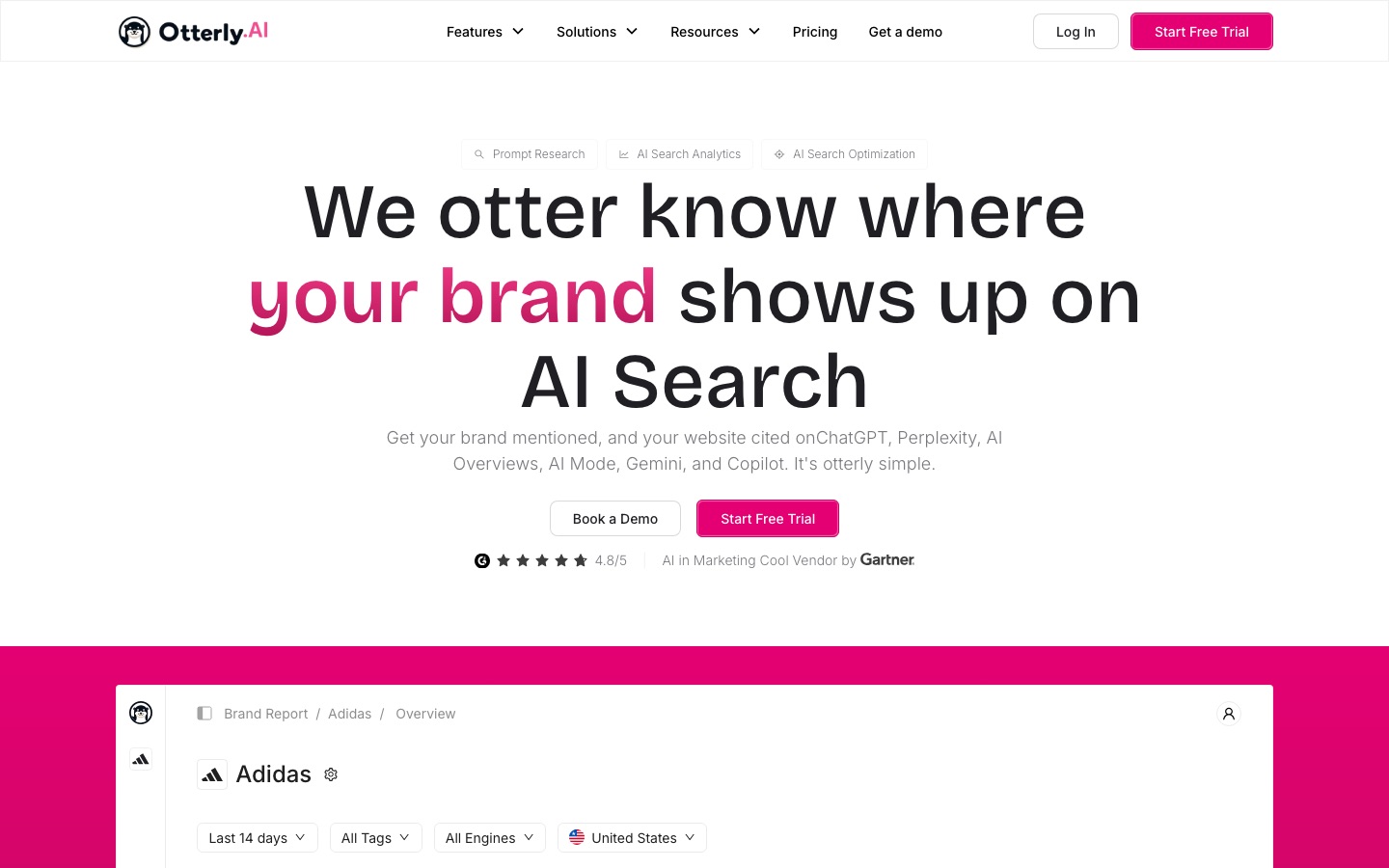
Otterly is the tool I'd point a founder to who has never measured AI visibility and doesn't want to sign anything. Lite costs $29/month for 15 prompts, which is enough to track your most important buyer questions across ChatGPT, Perplexity, AI Overviews, and Copilot. Standard, at $189/month for 100 prompts, adds an API, an MCP server, agent analytics, and tracking of ChatGPT ads, which is a lot for the price. Every plan includes unlimited users, tracking in 50+ countries, prompt research, and a GEO Audit that checks whether AI engines can crawl and understand your pages.
The catch is engine coverage. Gemini, AI Mode, and Claude are paid add-ons, and the Claude add-on in particular can cost more than the base plan at higher tiers. Otterly also doesn't produce content. It's a measuring instrument with useful audit recommendations, which is exactly what it's priced as. It's bootstrapped, based in Vienna, was named a Gartner Cool Vendor in AI in Marketing, and claims more than 40,000 users.
What stands out
- $29/month entry, unlimited users
- GEO Audit included on every plan
- API and MCP from $189/month
- SOC 2 compliant
Where it falls short
- Gemini, AI Mode, and Claude cost extra
- No content creation
- 15 prompts on Lite is a sample, not a strategy
- Pricing
- Lite $29/mo; Standard $189/mo; Premium $489/mo; Enterprise custom
- Engines
- ChatGPT, Perplexity, AI Overviews, Copilot; AI Mode, Gemini, Claude as add-ons
- Customers
- Roche, Opera, Visma, F-Secure, Publicis Sapient
Measurement tools vs production platforms
After going through all seven, I think the most useful way to sort them isn't by price or engine count. It's by where each one sits between measuring the problem and doing the work to fix it.
- 01Measure: Otterly.AI, Peec AIExcellent at telling you where you stand and where competitors beat you. They recommend, but the work is yours. Cheapest, and the right choice when you already have people (or a partner) to act on the data.
- 02Measure and direct: Scrunch, AthenaHQMeasurement plus structured guidance on what to fix, with some automation. Scrunch leans technical (audits, bots, agent-ready pages); AthenaHQ leans on content and off-page actions.
- 03Measure and make: Goodie, ProfoundPlatforms that track, then draft and act through agents. Profound starts from the strongest data layer; Goodie from a broad all-in-one feature set with attribution.
- 04Make, informed by measurement: AirOpsProduction first. Visibility data is the input to a content system built for volume and quality control.
A setup I see work well for B2B SaaS teams is one tool from the first two groups for honest measurement, plus a production system for the work. Profound or Peec for the data and AirOps for the content is a common pairing for exactly that reason. Paying for two "do everything" platforms usually means paying twice for features you use once.
Where the data misleads you
Every one of these tools is only as good as the prompts you give it and how you read the results. These are the mistakes I see most often when teams bring me their dashboards.
- Tracking the prompts you want to win instead of the ones buyers ask.Teams load the dashboard with branded and vanity queries, see a high visibility score, and relax. Build your prompt list from sales calls, support tickets, G2 reviews, and competitor comparisons. We wrote a full method for this in our guide to AEO keyword research and prompt tracking.
- Reading one run as the truth.AI answers vary between runs, sessions, and locations. A drop from 40% to 30% in a week on 20 prompts is mostly noise. Look at multi-week trends on a large enough prompt set, ideally 50 to 100 prompts or more.
- Ignoring how the answers are collected.Some tools query engines through APIs, others capture the interface real users see, and the two can differ a lot, especially for ChatGPT with search enabled. Ask every vendor which they do.
- Mistaking mentions for citations.Being named in an answer helps awareness. Being cited as a source sends traffic and builds trust with the engine. Track both, and separate them.
- Skipping the source data.The single most actionable view in most of these tools is the list of domains the engines cite for your category. It tells you which publications, review sites, communities, and videos to show up in. Teams that ignore it end up rewriting their own pages and wondering why nothing moves.
How to choose, by stage and budget
- Pre-seed to seed: start free, then go cheap.Run the manual audit first. When you want it automated, Otterly Lite ($29) or Peec Starter ($95) gives you a real baseline. Put your effort into rebuilding three pages, not into a premium dashboard you won't have time to act on.
- Series A: pick measurement plus direction.This is when AI visibility either compounds or stalls. AthenaHQ or Peec Pro gives you broad coverage and guidance. If content is your bottleneck, add AirOps rather than upgrading the dashboard.
- Series B and beyond: deep data, plus resourced execution.Profound, Scrunch, or Goodie will cover engines, personas, seats, and security reviews. At this stage the bottleneck is rarely seeing the gap. It's having a team and a system to close it every week.
- At every stage: budget for measuring and for doing as separate lines.Companies that fund only the first end up with a precise, well-formatted record of staying invisible.
Questions to ask in every demo
- Do you collect answers through the engines' APIs or from the user interface, and logged in or logged out?
- How often does each prompt run, and how many times per run?
- Which engines are included in the plan I'm buying, and which are add-ons?
- Can I segment by persona, country, and buyer stage?
- Do you separate brand mentions from source citations?
- Can I export raw answers and citations, or use an API or MCP server to pull them?
- How do you estimate prompt volume, and what's the source?
- What does the tool do after it finds a gap: recommend, draft, or publish?
- How do you connect visibility to AI referral traffic or pipeline?
When a tool isn't enough
Here is the pattern I keep seeing. A company buys a good tool, gets a clean dashboard, learns it appears in 1 of 10 buyer queries while a competitor appears in 7, and then nothing changes for two quarters. The data was never the missing piece. Acting on it was.
Even the tools that now draft content can't decide your positioning, get your entity description consistent across your site and the third-party sources engines trust, or earn you the analyst mention or Reddit thread that tips a citation your way. Those are the things that move the number, and all of them need to be done and kept up over time.
That isn't a knock on the tools. I use two of them and I'd recommend all seven to the right team. It's a correction to the assumption that buying one is the same as fixing the problem.
SuperMarketers is the AI marketing partner for B2B SaaS teams that want more pipeline from the team they have. Our AI Search work sits after the dashboard: we use whatever tool you already have (or set one up), rebuild and refresh pages for extraction, keep entity information consistent, earn third-party mentions, and track citation rate against the 9-dimension AI Visibility Score. Disclosure: this is our offer, so weigh it as one.
If you've concluded a tool alone won't move your number, that's the right conclusion. Measurement is step one. The next step is covered in our guide to getting cited by ChatGPT.