

AEO Glossary: 20 Key Terms Every B2B Marketer Needs to Know


By Gen Furukawa | SuperMarketers.ai
The AEO landscape moves fast. New terminology appears monthly, and half the industry can't agree on definitions.
This glossary cuts through the confusion. Twenty essential terms, defined clearly, with practical context for B2B SaaS marketers who need to understand answer engine optimization without wading through academic jargon.
Bookmark this page. You'll reference it more than you expect.
Answer Engine Optimization (AEO)
Definition: Answer Engine Optimization is the practice of optimizing digital content so that AI-powered search engines—including ChatGPT, Perplexity, Gemini, and Google AI Overviews—cite, reference, or recommend your brand when users ask relevant questions.
AEO differs from traditional SEO in a fundamental way. SEO optimizes for ranking positions on a results page. AEO optimizes for inclusion in AI-generated responses, where there are no "positions"—only citations or silence.
For B2B SaaS companies, AEO is critical because 94% of buyers now use LLMs during purchase research (Gartner, 2025). If your brand doesn't appear in AI-generated answers to queries like "best CRM for mid-market SaaS," you're invisible to a growing majority of buyers.
Example: A project management SaaS company optimizes its content structure, builds entity authority, and implements schema markup. Within 90 days, ChatGPT begins citing their product in responses to "best project management tools for remote teams."
Related terms: GEO, AI Overview, Citation Rate
AI Overview
Definition: AI Overview is Google's AI-generated summary that appears at the top of search results, synthesizing information from multiple sources into a direct answer with linked citations, replacing the need for users to click through to individual websites.
AI Overviews represent Google's response to ChatGPT and Perplexity. They pull content from indexed pages, synthesize an answer, and display it prominently above traditional search results.
For B2B marketers, AI Overviews are both a threat and an opportunity. They reduce click-through rates on traditional results (contributing to zero-click searches), but they also create a new visibility channel for brands that get cited as sources.
Example: A search for "how to reduce SaaS churn" shows an AI Overview with a synthesized answer citing three sources. Brands optimized for AEO appear as cited sources with links.
Related terms: Featured Snippet, Zero-Click Search, Answer Engine Optimization
Retrieval-Augmented Generation (RAG)
Definition: Retrieval-Augmented Generation is the AI architecture pattern where a large language model retrieves relevant content from external sources before generating a response, enabling it to cite current information beyond its training data cutoff.
RAG is the technical foundation that makes AEO possible. Without RAG, LLMs could only reference information from their training data. With RAG, they can search, retrieve, and cite current web content in real time.
Understanding RAG explains why content structure matters so much for AEO. RAG systems chunk content into passages, embed them as vectors, and retrieve the most relevant chunks for a given query. If your content isn't structured for chunking and extraction, it won't be retrieved.
Example: When a user asks Perplexity "What are the best AEO tools?", the RAG system retrieves relevant passages from indexed pages, and the model generates a response citing those sources.
Related terms: Content Chunking, AI Crawler, Answer Capsule
Citation Rate
Definition: Citation rate is the percentage of tracked AI-generated responses that include a reference, mention, or link to your brand or content, measured across specific target queries and AI engines over a defined time period.
Citation rate is the core KPI for AEO. It's the AI equivalent of search ranking position—except instead of ranking #1-10, you're either cited or you're not.
Most B2B SaaS companies start with a citation rate of 0-5% for their target queries. Well-optimized companies reach 20-40% for core category queries. Track this metric weekly using dedicated AEO tracking tools.
Example: You track 50 queries relevant to your SaaS product. AI engines cite your brand in responses to 12 of them. Your citation rate is 24%.
Related terms: Share of Voice, Brand Mention
Share of Voice
Definition: Share of voice in AEO measures your brand's citation frequency relative to competitors across the same set of target queries in AI-generated responses, expressed as a percentage of total citations within your category.
Share of voice gives you competitive context that citation rate alone doesn't. A 20% citation rate means little if your top competitor has 60%. Share of voice reveals your actual competitive position in AI visibility.
This metric is most valuable when tracked over time. Monthly share of voice trends show whether your AEO efforts are gaining ground against competitors or falling behind.
Example: In 50 tracked queries about "CRM software," your brand gets cited 15 times, Competitor A gets cited 25 times, and Competitor B gets cited 10 times. Your share of voice is 30%.
Related terms: Citation Rate, Brand Mention
Entity Authority
Definition: Entity authority is the cumulative strength of your brand's digital identity across all platforms and sources, determining how confidently AI engines associate your brand with specific topics, categories, and expertise areas.
Entity authority is to AEO what domain authority is to SEO—except it's built differently. Domain authority comes from backlinks. Entity authority comes from consistent, corroborated information across the web: business profiles, review sites, media mentions, social platforms, and structured data.
Building entity authority requires what I call the E-E-A-T framework for AI—demonstrating experience, expertise, authoritativeness, and trustworthiness through verifiable signals that AI engines can parse.
Example: A SaaS company has consistent brand descriptions across their website, Crunchbase, G2, LinkedIn, and 15 industry publication mentions. This consistency creates strong entity authority, increasing AI citation probability.
Related terms: E-E-A-T, Knowledge Panel, Brand Mention
Experience, Expertise, Authoritativeness, Trustworthiness (E-E-A-T)
Definition: E-E-A-T is the framework AI engines use to evaluate content credibility, measuring whether content demonstrates first-hand experience, subject expertise, source authoritativeness, and information trustworthiness before selecting it for citation.
Originally a Google quality rater concept, E-E-A-T has become central to AI visibility. LLMs don't have human quality raters, but they evaluate similar signals algorithmically: author credentials, source reputation, cross-platform corroboration, and content accuracy.
Research shows that 48% of AI citations come from earned media sources (Profound, 2025), demonstrating how authoritativeness signals from third-party coverage directly influence AI citation decisions.
Example: An article by a recognized industry expert with Person schema markup, published on a site with strong entity authority, citing original research—this content scores high on all four E-E-A-T dimensions.
Related terms: Entity Authority, Schema Markup, Topical Authority
Schema Markup
Definition: Schema markup is structured data code (typically JSON-LD) added to web pages that provides machine-readable context about the content's type, authorship, topic, and relationships, helping AI crawlers accurately parse and index content for retrieval.
Schema markup is the bridge between human-readable content and machine-readable data. For AEO, the most important schema types are Organization, Person, Article, FAQPage, and HowTo.
Implementing schema doesn't guarantee AI citations, but it removes barriers. Without schema, AI crawlers must infer context from unstructured content. With schema, you're providing explicit signals.
Example: Adding FAQPage schema to your blog post's FAQ section enables AI engines to directly extract question-answer pairs, increasing the probability that your answers appear in AI-generated responses.
Related terms: FAQPage Schema, E-E-A-T, AI Crawler
FAQPage Schema
Definition: FAQPage schema is a specific structured data type that marks up question-and-answer content on a page, enabling AI crawlers and search engines to directly extract Q&A pairs for use in AI-generated responses and rich search results.
FAQPage schema is the single highest-ROI schema implementation for AEO. It creates direct, extractable question-answer pairs that match how users query AI engines.
Every blog post with a FAQ section should have FAQPage schema. The implementation is straightforward JSON-LD that wraps each question-answer pair in the appropriate markup.
Example: A blog post about "AEO tools" includes five FAQ questions with FAQPage schema. When a user asks ChatGPT one of those questions, the model can directly extract and cite the answer.
Related terms: Schema Markup, Answer Capsule, Content Chunking
Zero-Click Search
Definition: Zero-click search occurs when a user's query is answered directly on the search results page—through AI Overviews, featured snippets, or knowledge panels—without the user clicking through to any website, reducing organic traffic to source pages.
Zero-click searches now account for over 60% of all Google searches (SparkToro, 2025). For B2B marketers, this means traditional traffic metrics increasingly undercount your content's actual reach and influence.
AEO embraces zero-click by optimizing for citation visibility rather than click-through. Your brand being cited in an AI Overview—even without a click—creates awareness and authority.
Example: A buyer searches "best analytics tools for SaaS" and reads the AI Overview, which cites three tools. They never click any result but now have three brands in their consideration set.
Related terms: AI Overview, Featured Snippet
Generative Engine Optimization (GEO)
Definition: Generative Engine Optimization is an academic term for optimizing content to appear in AI-generated search results, largely synonymous with AEO but more commonly used in research contexts to describe the technical optimization of content for generative AI systems.
GEO and AEO describe the same discipline. GEO tends to appear in academic research (Georgia Tech's 2024 paper popularized the term). AEO is more common in practitioner contexts.
The key research finding from the GEO framework: content with statistics boosts AI visibility by 22%, and content with quotations boosts visibility by 37% (Writesonic, 2025). These are directly actionable insights for content structure optimization.
Example: A researcher optimizing for "generative engine optimization" and a practitioner optimizing for "answer engine optimization" are doing the same work with different terminology.
Related terms: Answer Engine Optimization, RAG
Brand Mention
Definition: A brand mention in AEO context occurs when an AI engine names your brand, product, or company in a generated response, regardless of whether it includes a direct link or formal citation to your content.
Brand mentions are the broadest measure of AI visibility. They include formal citations (with links), informal references ("tools like Acme"), and categorical mentions ("several CRM platforms including...").
Not all brand mentions are equal. A citation with a link drives more value than a passing mention. Track both, but prioritize improving mentions that include attribution.
Example: ChatGPT responds: "For project management, consider tools like Asana, Monday.com, and Acme." Acme received a brand mention without a formal citation.
Related terms: Citation Rate, Share of Voice, Entity Authority
Knowledge Panel
Definition: A Knowledge Panel is the structured information box that appears in Google search results for recognized entities, displaying verified details about a brand, person, or organization sourced from Google's Knowledge Graph database.
Knowledge Panels signal strong entity recognition. If Google displays a Knowledge Panel for your brand, it has classified your company as a verified entity—a signal that carries weight in AI systems that use Google's data.
Building a Knowledge Panel requires consistent entity information across authoritative sources: Wikipedia, Wikidata, Crunchbase, and official business listings.
Example: Searching "Salesforce" shows a Knowledge Panel with company description, stock price, founding date, and key people. This entity recognition extends to AI engines.
Related terms: Entity Authority, Schema Markup
Topical Authority
Definition: Topical authority is the perceived depth and breadth of a website's expertise on a specific subject, built through comprehensive content coverage across related subtopics, which AI engines use as a signal when selecting citation sources.
Topical authority for AEO requires more depth than SEO. You can't rank for "CRM software" with one page. You need a content cluster covering comparisons, implementation guides, integration tutorials, pricing analyses, and category education.
This is why pillar page strategies matter for AEO. A single comprehensive guide supported by 15-20 cluster pages creates topical authority that AI engines recognize.
Example: A SaaS company publishes 25 pieces about revenue operations—from strategy guides to tool comparisons to implementation playbooks. AI engines recognize them as a topical authority and cite them for RevOps queries.
Related terms: Entity Authority, E-E-A-T, Content Chunking
Content Chunking
Definition: Content chunking is the process by which AI retrieval systems break web pages into smaller passages (typically 100-500 tokens) for vector embedding and retrieval, making paragraph structure and self-containment critical for AEO.
Content chunking explains why content structure is the most important technical factor in AEO. RAG systems don't retrieve whole pages. They retrieve chunks—passages, paragraphs, sections.
If your key information spans multiple paragraphs with dependent references, chunking will break the context. Self-contained paragraphs of 40-60 words survive chunking intact.
Example: A 2,000-word blog post gets chunked into 15-20 passages. The passage that best matches a user's query gets retrieved. If that passage contains a complete, self-contained answer, it gets cited.
Related terms: RAG, Answer Capsule, Content Chunking
Answer Capsule
Definition: An answer capsule is a self-contained block of content—typically 40-80 words—specifically crafted to provide a direct, complete answer to a specific question, designed for extraction by AI retrieval systems and inclusion in generated responses.
Answer capsules are the atomic unit of AEO content. Each one should be able to answer a question without any surrounding context.
The answer-first architecture I recommend puts an answer capsule at the beginning of every H2 section. This ensures that regardless of how the RAG system chunks your content, the direct answer is always intact and extractable.
Example: The first paragraph under each H2 in this glossary is an answer capsule—a 40-60 word definition that directly answers "What is [term]?" without needing any other context.
Related terms: Content Chunking, RAG, FAQPage Schema
AI Crawler
Definition: An AI crawler is an automated bot operated by AI companies (such as OpenAI's GPTBot or Google's Gemini crawler) that systematically visits and indexes web pages to build the knowledge base that powers AI-generated responses.
AI crawlers are distinct from traditional search engine crawlers. Google's search crawler indexes pages for search results. GPTBot indexes pages for ChatGPT's retrieval system. They have different behaviors, different access patterns, and different robots.txt directives.
Managing AI crawler access through robots.txt is an important AEO decision. Blocking AI crawlers means your content can't be cited. Allowing them means your content enters the AI retrieval pipeline.
Example: A SaaS company checks their server logs and finds GPTBot crawling their site 500 times per day. They optimize their robots.txt to allow access to blog content while restricting access to gated resources.
GPTBot
Definition: GPTBot is OpenAI's official web crawler (user-agent: GPTBot) that indexes web content for use in ChatGPT's retrieval-augmented generation system, controllable through robots.txt directives and directly responsible for whether your content can be cited by ChatGPT.
GPTBot is the most important AI crawler for most B2B SaaS companies because ChatGPT has the largest market share among AI engines.
Check whether your site allows GPTBot in your robots.txt. Many CMS platforms and CDN providers block AI crawlers by default. If GPTBot is blocked, ChatGPT literally cannot cite your content.
Example: Adding User-agent: GPTBot / Allow: /blog/ to your robots.txt ensures ChatGPT can index and cite your blog content while restricting access to other sections.
Related terms: AI Crawler, RAG
Perplexity
Definition: Perplexity is an AI-powered answer engine that generates comprehensive responses with inline citations to source websites, functioning as a direct competitor to Google for research queries and representing a growing channel for B2B brand visibility.
Perplexity is particularly important for B2B SaaS because its user base skews toward professionals doing research—exactly your ICP. Unlike ChatGPT, Perplexity always shows citations with links, making it a direct traffic driver.
Optimizing for Perplexity follows the same principles as general AEO: structured content, entity authority, and answer-first architecture. Track your Perplexity citations with dedicated AEO tools.
Example: A buyer asks Perplexity "What CRM integrates best with HubSpot?" and receives a detailed response with five cited sources. Each cited source gets a visible link and potential click-through.
Related terms: Answer Engine Optimization, Citation Rate, RAG
Featured Snippet
Definition: A featured snippet is a highlighted answer box in Google search results that extracts and displays content from a web page above organic results, serving as both a traditional SEO asset and a precursor to AI Overview content selection.
Featured snippets are the bridge between SEO and AEO. Pages that win featured snippets are often the same pages that get cited in AI Overviews, because both systems select content based on similar extraction criteria.
Optimizing for featured snippets—clear answers, structured formatting, concise paragraphs—trains the same muscles needed for AEO.
Example: A search for "what is answer engine optimization" displays a featured snippet extracted from a page with a clear, concise definition paragraph. That same page is likely cited in the AI Overview.
Related terms: AI Overview, Zero-Click Search, Answer Capsule
Frequently Asked Questions
What is the difference between AEO and SEO?
SEO optimizes content to rank on search engine results pages. AEO optimizes content to be cited in AI-generated responses from ChatGPT, Perplexity, Gemini, and Google AI Overviews. The key difference: SEO targets ranking positions while AEO targets citation inclusion. Only 8-12% of top Google results overlap with ChatGPT citations, meaning they require different strategies.
Do I need to learn all 20 AEO terms to get started?
No. Start with five core terms: Answer Engine Optimization, Citation Rate, Entity Authority, Content Chunking, and Schema Markup. These cover the fundamental concepts needed to begin an AEO strategy. The remaining terms become relevant as you advance and need to understand specific technical mechanisms and measurement approaches.
How is AEO terminology different from traditional SEO terminology?
AEO introduces concepts specific to AI retrieval: RAG, content chunking, answer capsules, and citation rate have no direct SEO equivalents. Other terms like E-E-A-T and topical authority carry over from SEO but have different implications for AI visibility. The biggest shift is from ranking-based metrics to citation-based metrics.
What AEO terms should I know for measuring success?
The essential measurement terms are Citation Rate (percentage of queries where you're cited), Share of Voice (your citations vs. competitors), and Brand Mention (any AI reference to your brand). Track these with dedicated AEO tools. Secondary metrics include content extractability scores and entity authority indices.
Will AEO terminology keep changing?
Yes. The AEO field is evolving rapidly and terminology will continue shifting. New AI engines, new optimization techniques, and new measurement approaches will introduce new terms. This glossary reflects 2026 consensus terminology. We'll update it quarterly at SuperMarketers to keep pace with industry changes.

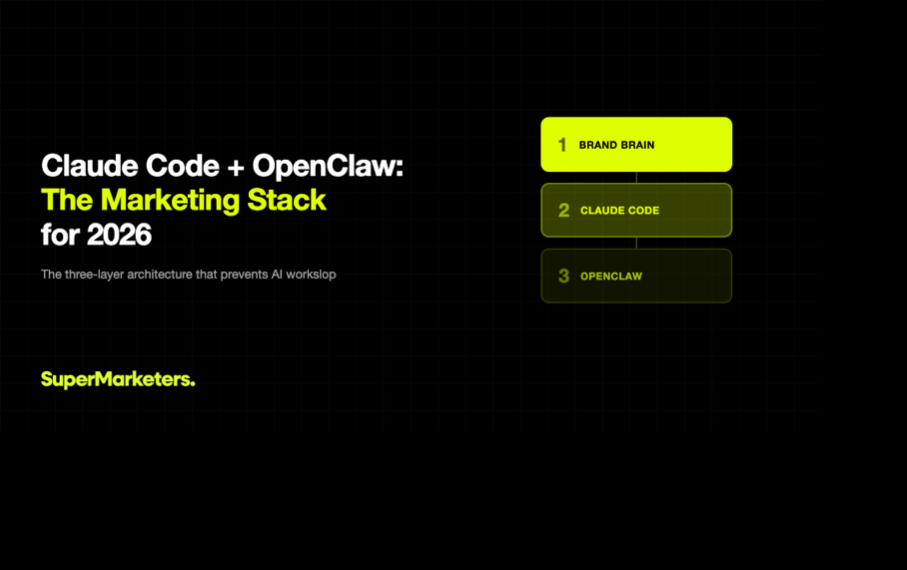
Most founders spend 5-10 hours per week on content and get inconsistent results. Here is the three-layer system that cuts that to 30 minutes.


A data-backed guide to Answer Engine Optimization for B2B SaaS. Based on audits of 24 companies. Includes a 90-day implementation timeline.
Ready to Build Visibility
That Drives Pipeline?
Book a strategy call. We'll audit where you're invisible, show you where competitors are winning, and map out exactly what a visibility system would look like for your business—even if we're not the right fit.
.svg)