

How to Audit Your AEO Visibility in 60 Minutes (Free Framework)


An AEO audit evaluates your brand's visibility across AI answer engines by scoring six dimensions: Content Structure, Schema and Technical, Entity Authority, Content Format, Topic Architecture, and AI Visibility. This framework — developed at SuperMarketers from auditing dozens of B2B SaaS sites — gives you a clear picture of where you stand and what to fix first.
I'm Gen Furukawa, founder of SuperMarketers. Here's the exact audit process we use with clients, adapted so you can run it yourself in 60 minutes.
For full context on what AEO is and why it matters, start with our complete AEO guide.
What Are the Six Dimensions of an AEO Audit?
The six dimensions of an AEO audit cover every factor that determines whether AI systems cite your brand: how your content is structured, your technical markup, your brand's entity authority, your content formats, your topic architecture, and your current AI visibility. Each dimension is scored 1-5 and weighted equally.
Here's the scoring rubric:
| Score | Level | Description |
|---|---|---|
| 1 | Not Started | No optimization for this dimension |
| 2 | Basic | Minimal, inconsistent implementation |
| 3 | Developing | Partial implementation across key pages |
| 4 | Strong | Systematic implementation with minor gaps |
| 5 | Excellent | Comprehensive, consistent, monitored |
Total score: 30 possible. Under 15 = urgent action needed. 15-22 = solid foundation with clear gaps. 23-30 = optimized, shift to monitoring and iteration.
Dimension 1: How Is Your Content Structure? (10 minutes)
Content structure measures whether your pages lead with direct answers, use question-shaped headers, maintain short paragraphs, and are built in independently extractable sections. This is the highest-impact dimension because it directly determines whether AI systems can extract and cite your content.
What to check:
Pull up your top 10 pages by traffic. For each, evaluate:
- Does the first paragraph directly answer the page's core question in 40-60 words? (Not a preamble. Not "In this article, we'll explore...")
- Are H2 headers framed as questions or clear descriptive phrases?
- Are paragraphs 3-4 sentences maximum?
- Could you pull any 200-500 word section and have it make sense on its own?
Tool: Just your browser. Open each page and skim the structure.
Scoring:
- 1: Pages have no clear structure, answers buried deep
- 3: Some pages lead with answers, inconsistent headers
- 5: Every key page has direct answers, question headers, extractable sections
Dimension 2: How Is Your Schema and Technical Markup? (10 minutes)
Schema and technical markup measures the structured data implementation across your site — Organization, Article, FAQPage, Person, and other schema types that drive AI citations. Sites with 3+ schema types see 13% higher citation rates.
What to check:
- Run your homepage and 5 key pages through Google's Rich Results Test
- Check for Organization schema (site-wide)
- Check for Article schema on blog posts (author, dates, publisher)
- Check for FAQPage schema on pages with FAQ sections
- Verify
dateModifiedis current on recently updated content
Tools: Google Rich Results Test, Schema.org Validator
Scoring:
- 1: No structured data on any page
- 3: Article schema present, no FAQPage or Organization
- 5: 3+ schema types consistently implemented, all validated, dates current
Dimension 3: How Strong Is Your Entity Authority? (10 minutes)
Entity authority measures how strongly AI systems associate your brand with your core topics. It's built through cross-platform consistency, earned mentions, original research, and thought leadership signals that AI models use to evaluate trustworthiness.
What to check:
- Search your brand in ChatGPT and Perplexity. Does the AI know what your company does? Is the description accurate?
- Check Crunchbase, G2, LinkedIn company page, and Wikipedia (if applicable). Is your brand description consistent across platforms?
- Search your CEO/founder name. Does the AI associate them with your company and expertise area?
- Check for original research or data you've published. Does it appear in AI responses?
Tools: ChatGPT, Perplexity, Crunchbase, G2
Scoring:
- 1: AI systems don't recognize your brand at all
- 3: AI knows your brand exists but description is generic or partially wrong
- 5: AI accurately describes your brand, associates it with your core topics, cites your content
Dimension 4: How Are Your Content Formats? (10 minutes)
Content format measures whether your pages include the specific content types that AI systems extract most effectively: definition paragraphs, numbered lists, comparison tables, FAQ sections, and statistics with source attribution.
What to check:
Review your top 10 pages for the presence of:
- Definition paragraphs ("X is..." format, 40-60 words)
- Numbered or bulleted lists (steps, criteria, features)
- Comparison tables (your product vs competitors, method A vs method B)
- FAQ sections with 5-10 questions (pages with FAQs are 3.2x more likely to be cited)
- Statistics with sources (specific numbers, not vague claims)
Tool: Your browser. Skim each page and check format diversity.
Scoring:
- 1: Mostly long-form prose with no structured formats
- 3: Some lists and occasional statistics, no FAQ sections
- 5: Every key page includes 3+ extractable formats including FAQ sections with schema
Dimension 5: How Is Your Topic Architecture? (10 minutes)
Topic architecture measures whether your content is organized in clusters that demonstrate comprehensive topical expertise — pillar pages linked to supporting content, consistent internal linking, and complete coverage of your core subject areas.
What to check:
- Map your content to topics. Do you have clear pillar pages for your core topics?
- Check internal linking. Do supporting pages link back to pillar pages? Do pillar pages link out to supporting content?
- Assess topic completeness. For your primary topic, have you covered the key subtopics (comparisons, how-tos, specific tactics, audits/frameworks)?
- Review anchor text. Are internal links using descriptive text that matches natural queries?
Tools: Semrush Site Audit (content clusters report), or manually map your content in a spreadsheet
Scoring:
- 1: Content scattered across unrelated topics, no clustering
- 3: Some topic groupings, inconsistent internal linking
- 5: Clear pillar-cluster architecture, comprehensive topic coverage, systematic internal linking
Dimension 6: What Is Your Current AI Visibility? (10 minutes)
AI visibility measures your actual presence in AI-generated answers right now. This is the outcome dimension — it tells you whether the other five dimensions are translating into real citations and brand mentions across AI platforms.
What to check:
- Prepare 10-15 questions your buyers ask. Mix branded ("What is [your product]?") and unbranded ("What's the best [category] tool for [use case]?") queries.
- Ask each question in ChatGPT, Perplexity, Claude, and Google AI Overviews.
- Record: Does your brand appear? How is it positioned? What sources are cited instead?
- Note patterns. Which topics cite you? Which don't? Which competitors appear instead?
Tools: Profound (automated AI citation tracking), Otterly (AI search monitoring), HubSpot's free website grader (baseline technical check), manual testing in ChatGPT/Perplexity/Claude
Scoring:
- 1: Brand doesn't appear in any AI responses
- 3: Brand appears in some branded queries, rarely in unbranded
- 5: Brand consistently cited in both branded and unbranded queries across multiple AI platforms
How Do You Interpret Your Audit Score?
Interpret your total score across all six dimensions to determine your AEO maturity level and prioritize next steps. The dimension scores matter more than the total — they show exactly where to focus your optimization efforts for maximum impact.
Under 15 (Urgent): Your brand is largely invisible to AI systems. Start with Content Structure and Schema — these two dimensions give the fastest uplift. Implement FAQ sections with schema markup on your top 20 pages within 30 days.
15-22 (Developing): You have a foundation but significant gaps. Identify your two lowest-scoring dimensions and focus there. Most companies in this range are missing either Schema/Technical implementation or Topic Architecture.
23-30 (Strong): You're ahead of most competitors. Shift to monitoring and iteration. Set up automated AI visibility tracking, test new queries monthly, and optimize based on citation data.
For a deeper understanding of how these dimensions map to specific tactics, see our guides on SEO vs AEO differences and schema markup implementation.
What Should You Do After the Audit?
After completing your audit, create a prioritized 30-60-90 day action plan targeting your lowest-scoring dimensions first. Focus on high-leverage, low-effort wins in the first 30 days (FAQ sections, basic schema markup), then systematic improvements in days 31-60, and monitoring infrastructure in days 61-90.
30-Day Priorities:
- Add FAQ sections (5-10 questions, 40-60 word answers) to your top 20 pages
- Implement FAQPage, Article, and Organization schema
- Restructure your top 5 pages to lead with direct answers
60-Day Priorities:
- Build or complete topic clusters around your core subjects
- Implement Person schema and strengthen author pages
- Update cross-platform brand descriptions for entity consistency
90-Day Priorities:
- Set up automated AI visibility monitoring (Profound or Otterly)
- Establish monthly AI citation testing cadence
- Build editorial process that includes AEO requirements for all new content
Frequently Asked Questions
How often should I run an AEO audit?
Run a full AEO audit quarterly. Between full audits, do monthly spot checks — test 10-15 buyer questions across AI platforms and track whether your citations are increasing, stable, or declining. AI models update frequently, so ongoing monitoring catches shifts that quarterly audits miss.
Can I automate the AEO audit process?
Partially. Tools like Profound and Otterly automate Dimension 6 (AI Visibility) by tracking citations across platforms. Schema validation tools automate Dimension 2. But Dimensions 1, 3, 4, and 5 still require human judgment — evaluating content quality, entity accuracy, and topic completeness.
What's the most common audit finding for B2B SaaS companies?
Missing FAQ sections and schema markup. Most B2B SaaS sites score well on content quality (Dimension 1 partial) and entity authority (Dimension 3), but fall short on the structural and technical optimizations that make content extractable by AI systems. These are also the fastest fixes.
How does this audit framework compare to a traditional SEO audit?
An AEO audit evaluates many of the same fundamentals — content quality, technical health, site architecture — but adds AI-specific dimensions: content extractability, schema types that drive citations, entity recognition across AI platforms, and actual AI visibility testing. Think of it as an SEO audit plus an AI citation layer.
What tools do I need to run this audit?
For a free audit: Google Rich Results Test (schema validation), ChatGPT/Perplexity/Claude (AI visibility testing), and your browser (content review). For enhanced auditing: Profound (AI citation tracking), Semrush (site audit and topic clusters), Otterly (AI search monitoring), and HubSpot's free website grader (baseline technical check).
Want Us to Run This Audit for You?
This framework gives you a solid self-assessment. But there's a difference between identifying gaps and knowing how to close them efficiently.
At SuperMarketers, we run comprehensive AEO audits and build the implementation roadmap to fix what we find. For B2B SaaS companies serious about AI visibility, we handle strategy through execution.
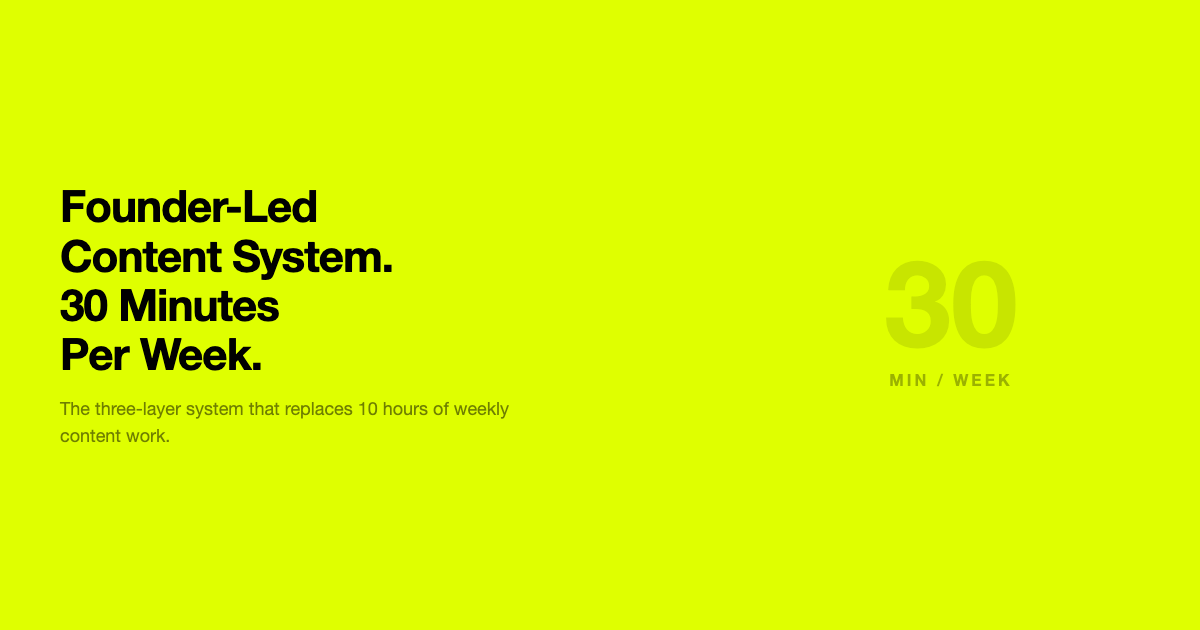
Most founders spend 5-10 hours per week on content and get inconsistent results. Here is the three-layer system that cuts that to 30 minutes.


A data-backed guide to Answer Engine Optimization for B2B SaaS. Based on audits of 24 companies. Includes a 90-day implementation timeline.
Ready to Build Visibility
That Drives Pipeline?
Book a strategy call. We'll audit where you're invisible, show you where competitors are winning, and map out exactly what a visibility system would look like for your business—even if we're not the right fit.
.svg)