

SEO vs AEO: What's Different, What's the Same, and Why You Need Both


SEO and AEO share about 80% of the same foundation — quality content, technical excellence, topical authority — but diverge in a critical 20% that determines whether your brand gets cited by AI answer engines. SEO gets you ranked. AEO gets you recommended. You need both, and understanding where they overlap and split is the key to allocating resources correctly.
I'm Gen Furukawa, founder of SuperMarketers. We build AI visibility systems for B2B SaaS companies, and the SEO vs AEO question is the one I get asked most. Here's the honest answer.
What Do SEO and AEO Have in Common?
SEO and AEO both reward high-quality, well-structured content published by authoritative sources on topics they have genuine expertise in. The fundamentals — E-E-A-T (Experience, Expertise, Authoritativeness, Trustworthiness), technical health, and content depth — power both disciplines equally.
Google's John Mueller put it well: "Focus on making a great website. The fundamentals of SEO haven't changed." He's right. And those same fundamentals are exactly what AI systems use to evaluate content quality.
Here's what carries over directly:
- Content quality — Unique insights, original data, clear writing
- Technical health — Fast load times, clean crawlability, mobile optimization
- Topical authority — Deep, comprehensive coverage of your subject area
- E-E-A-T signals — Author credentials, brand reputation, trustworthy sourcing
- Internal linking — Logical site architecture that demonstrates topic relationships
- Fresh content — Regular updates with current information
If you're already doing SEO well, you have 80% of your AEO foundation built. The remaining 20% is where the strategic divergence happens — and where most companies are falling behind.
Where Do SEO and AEO Actually Differ?
The core differences between SEO and AEO lie in content structure, success metrics, technical optimization, and competitive dynamics. SEO optimizes for ranking on a results page. AEO optimizes for being extracted and cited within an AI-generated answer. That distinction changes how you write, structure, and measure everything.
| Dimension | SEO | AEO |
|---|---|---|
| Primary goal | Rank on page 1 of SERPs | Get cited in AI-generated answers |
| Content structure | Keyword-optimized, comprehensive | Direct answers, extractable sections |
| Headers | Keyword-rich H2s/H3s | Question-shaped, conversational H2s |
| Success metric | Rankings, organic traffic, CTR | AI citations, brand mentions, referral traffic |
| Technical priority | Core Web Vitals, crawlability | Schema markup, entity clarity, structured data |
| Authority signals | Backlinks, domain rating | Entity recognition, cross-platform consistency |
| Competition | 10 organic spots per SERP | 1-3 cited sources per AI answer |
| Measurement tools | Google Search Console, Ahrefs, SEMrush | Profound, Otterly, manual AI testing |
| Time to results | 3-6 months typical | 4-8 weeks for initial citations |
| Content format | Long-form pillar pages | FAQ sections, definition blocks, comparison tables |
Why Is Content Structure the Biggest Difference?
Content structure is the biggest differentiator because AI systems extract information in chunks, not pages. A well-ranking SEO page can bury its answer in paragraph seven after a long introduction. An AEO-optimized page leads with a direct 40-60 word answer because that's what LLMs are designed to extract and cite.
In SEO, you're writing for humans who scan a page. In AEO, you're writing for AI systems that chunk your content into processable segments. Every section needs to stand on its own.
This means:
- Lead with the answer. Not context. Not story. The answer.
- Use question-shaped headers. "How does X work?" not "Understanding X."
- Keep sections independently extractable. 200-500 words that make sense in isolation.
- Include FAQ sections. Pages with FAQ sections are 3.2x more likely to be cited by AI systems.
The good news: content structured for AEO also performs well in SEO. Google's featured snippets use similar extraction logic. Optimizing for AI citations often improves your traditional SERP performance too.
How Do Authority Signals Differ Between SEO and AEO?
In SEO, authority is primarily measured through backlinks and domain rating. In AEO, authority is measured through entity recognition — how strongly AI systems associate your brand with specific topics across multiple platforms and data sources.
Backlinks still matter for AEO indirectly (they help with SEO, which feeds discoverability). But AEO adds a new authority layer:
Entity consistency. Is your brand described the same way on your website, Crunchbase, G2, LinkedIn, and industry publications? AI models cross-reference these sources.
Earned mentions. When authoritative sources mention your brand — even without linking — AI models register that association. Mentions are the new backlinks for AEO.
Schema markup. Structured data explicitly tells AI systems what your brand is, who runs it, and what it does. Sites with 3+ schema types see 13% higher AI citation rates.
Original data. Proprietary research, unique frameworks, and first-party data give AI systems a reason to cite you specifically rather than a generic source.
Should You Prioritize SEO or AEO?
Neither — you should integrate both into a unified content strategy. The 80% overlap means most optimizations benefit both channels simultaneously. The question isn't which to prioritize, but how to capture the 20% AEO-specific uplift without sacrificing SEO performance.
Here's my recommended approach for B2B SaaS companies:
If your SEO foundation is weak: Fix the fundamentals first. Site speed, crawlability, content quality, topical authority. These feed both SEO and AEO.
If your SEO is solid but you have zero AI visibility: Layer AEO optimizations onto your existing content. Restructure top pages with direct answers, add schema markup, implement FAQ sections, build topic clusters. Start with the AEO audit framework to identify gaps.
If you're building from scratch: Build for AEO from day one. Structure every page for extractability. Implement schema markup site-wide. Design your content architecture as topic clusters. You'll get SEO benefits automatically while being AEO-ready.
The companies that will dominate the next five years are the ones treating SEO and AEO as one integrated discipline — not competing priorities. For a comprehensive overview of how all the pieces fit together, read our complete AEO guide.
Frequently Asked Questions
Will AEO make SEO obsolete?
No. SEO remains critical for discoverability — AI systems with web access rely on search-indexed content to retrieve sources. AEO builds on SEO's foundation. Think of it as an additional optimization layer, not a replacement. The strongest strategy integrates both disciplines into unified content operations.
What's the fastest AEO win for a company already doing SEO?
Add FAQ sections with structured markup to your top 20 pages. Pages with FAQ sections are 3.2x more likely to be cited by AI systems. This single change leverages your existing content quality and adds the extractability layer AI systems need.
Do backlinks still matter for AEO?
Backlinks matter indirectly — they improve SEO performance, which improves discoverability for AI retrieval systems. But AEO adds new authority signals: entity recognition, cross-platform brand consistency, earned mentions, and structured data. A balanced link building and entity authority strategy serves both.
How do you measure AEO performance separately from SEO?
Track AI-specific metrics: citation frequency in ChatGPT/Perplexity/Claude responses (using tools like Profound and Otterly), referral traffic from AI platforms in your analytics, and conversion rates from AI-referred visitors. Compare these against your traditional SEO metrics to see the incremental impact.
Can you over-optimize for AEO and hurt SEO?
It's unlikely if you follow best practices. AEO optimizations — clear structure, direct answers, schema markup, FAQ sections — generally improve SEO performance too. The only risk is stripping content so aggressively for extractability that you lose the depth Google rewards. Keep comprehensive content; just structure it better.
Build a Unified SEO + AEO Strategy
At SuperMarketers, we build integrated visibility systems that capture both search rankings and AI citations. For B2B SaaS companies, this dual-channel approach is the highest-leverage marketing investment you can make right now.
Most founders spend 5-10 hours per week on content and get inconsistent results. Here is the three-layer system that cuts that to 30 minutes.


A data-backed guide to Answer Engine Optimization for B2B SaaS. Based on audits of 24 companies. Includes a 90-day implementation timeline.
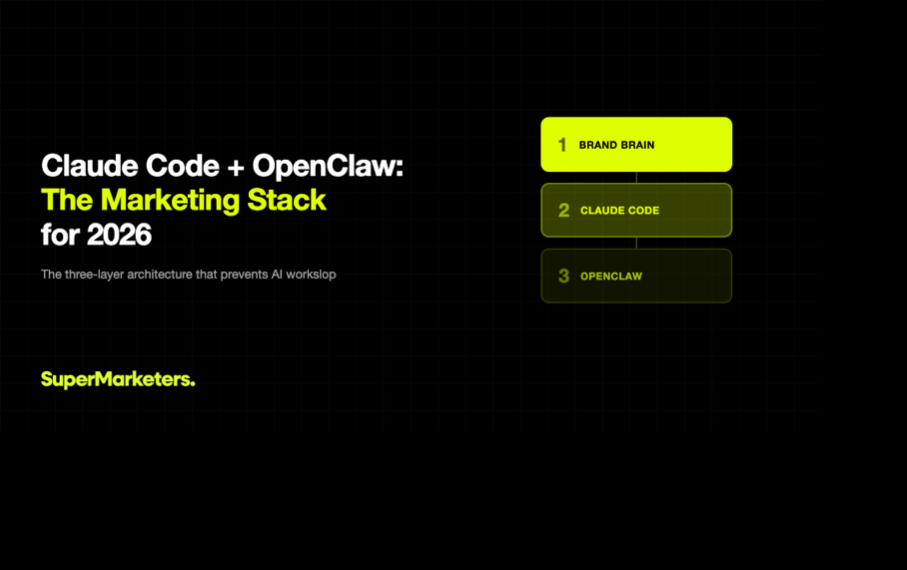
Ready to Build Visibility
That Drives Pipeline?
Book a strategy call. We'll audit where you're invisible, show you where competitors are winning, and map out exactly what a visibility system would look like for your business—even if we're not the right fit.
.svg)